- Home
- Shoulder Anatomy
- Hand Bones
Bones Of The Hand:
Anatomy, Structure & Function
Written By: Chloe Wilson BSc (Hons) Physiotherapy
Reviewed By: SPE Medical Review Board
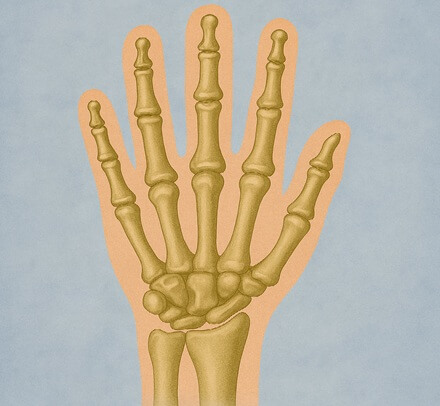
The bones of the hand are one of the most beautifully designed and complex structures in the human body.
They allow us to grip, write, type, lift, play musical instruments, and perform incredibly fine, precise movements.
But because the bones in the hand work so hard, they’re also vulnerable to injury, wear-and-tear, and pain.
In this guide, I’ll walk you through the complete hand bone anatomy, including a clear breakdown of each bone group, what they do, and how the entire bone structure of the hand works together. We’ll also look at the most common causes of hand bone pain.
How Many Bones Are in the Hand?
There are 27 bones in the hand, divided into three major groups:
- 8 Carpal Bones: wrist bones
- 5 Metacarpal Bones: bones in the palm
- 14 Phalanges: finger bones
Together, these create one of the most flexible, adaptable skeletal structures in the body.
A. Carpal Bones: Wrist
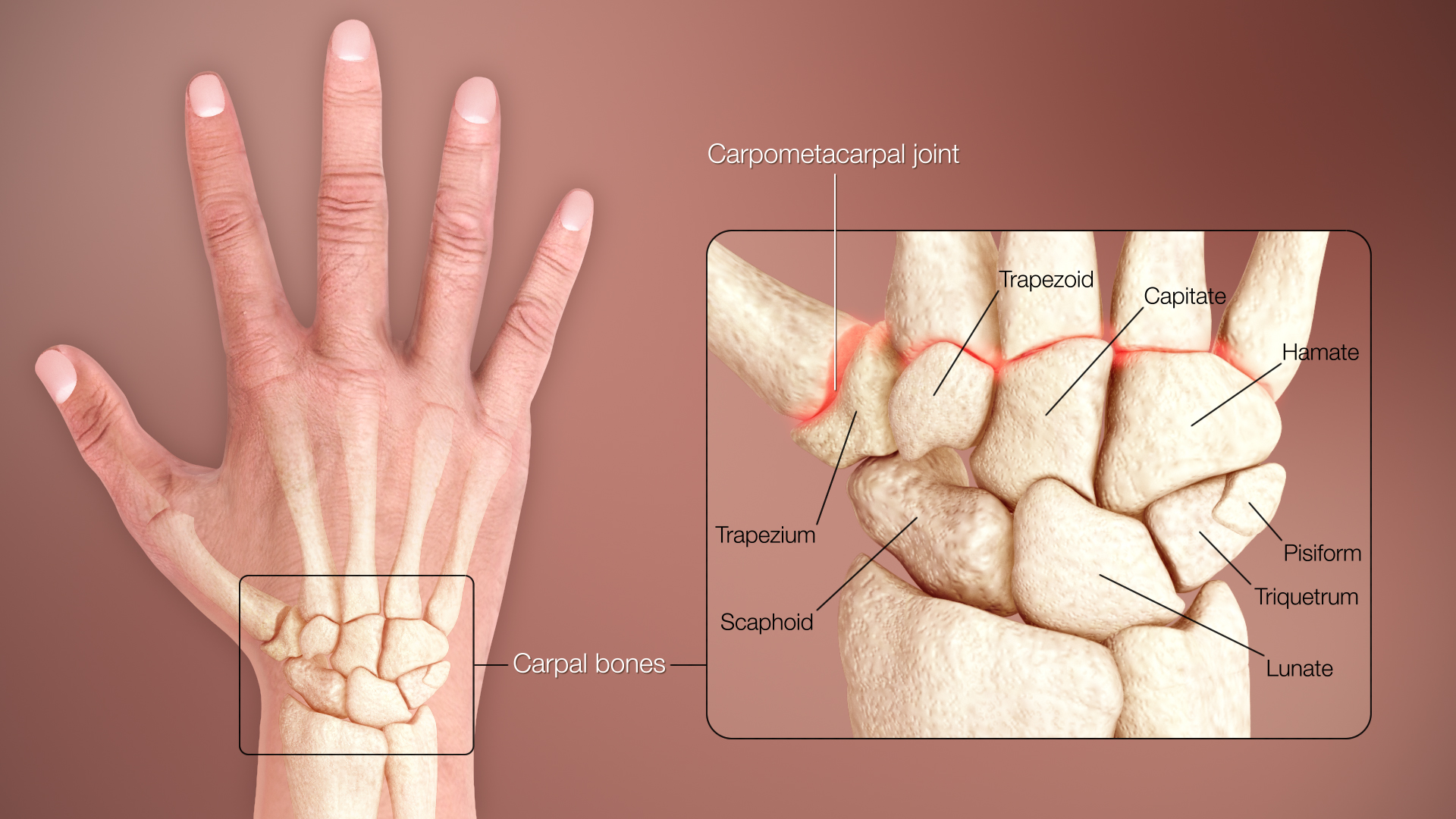
The carpal bones are a cluster of 8 small bones in the hand that form the wrist.
They act as the foundation of the hand and are arranged in two rows:
- Proximal Row: Scaphoid, Lunate, Triquetrum & Pisiform
- Distal Row: Trapezium, Trapezoid, Capitate & Hamate
Proximal Row Carpal Bones
The proximal row of the carpal bones is the row closest to the forearm, forming the wrist joint. There are four bones that make up the proximal row of carpal bones in the hand, from thumb side to little finger side:
1. Scaphoid
- Boat-shaped bone located on the thumb (radial) side
- Key stabiliser of the wrist
- Transfers force from the thumb into the forearm
- Poor blood supply, resulting in slow healing
- Most commonly fractured carpal bone (60-70%) with scaphoid fractures causing pain and tenderness in the anatomical snuffbox
2. Lunate
- Crescent-shaped bone in the centre of the wrist
- Major role in wrist bending and straightening
- Delicate vascular supply → risk of avascular necrosis (Kienböck’s disease)
- Most frequently dislocated carpal bone
3. Triquetrum
- Pyramid-shaped bone on the ulnar side
- Supports ulnar deviation (bending wrist toward the little finger)
- Second-most commonly fractured carpal bone (25%)
4. Pisiform
- Small pea-shaped bone that sits on top of the triquetrum
- Easy to feel on palm side of wrist
- Acts as a sesamoid bone to improve pull of the FCU tendon
- Provides attachment for ligaments in the inner wrist
- Can become irritated in cyclists or with repetitive wrist pressure
Distal Row Carpal Bones
The distal row of carpal bones is the second row, further in from the wrist. They form one side of the carpometacarpal joints and from thumb to little finger side are:
1. Trapezium
- Irregular saddle-shaped bone beneath the thumb
- Forms the thumb’s CMC joint - essential for pinch and opposition
- Common site of thumb arthritis, especially in women over 45
2. Trapezoid
- Smallest bone in the distal row
- Wedge-shaped and tightly anchored → very stable
- Helps stabilise the index finger during fine motor tasks
- Rarely fractured due to its protected position
3. Capitate
- Largest carpal bone in the hand
- Central “keystone” that coordinates movement across the carpal rows
- Important for overall wrist stability
- Articulates with the 3rd metacarpal - crucial for grip strength
4. Hamate
- Hook-shaped bone on the ulnar side
- The “hamulus” (hook) protects nerves and tendons passing through Guyon’s canal
- Supports ring and little finger metacarpals
- Commonly injured in sports such as golf, baseball or tennis due to handle impact forces.
Function of the Carpal Bones
The main functions of the carpal bones of the hand are to:
- Allow wrist motion in all directions
- Absorb shock from gripping and load-bearing
- Form the carpal tunnel, which protects the median nerve
- Provide a stable yet flexible base for the hand
These small wrist bones are essential for fine motor control and overall hand stability.
B. Metacarpal Bones: Palms
_01_palmar_view_with_label.png "Metacarpal Bones Of The Hand: Showing the Base, body/shaft and head of the bones")
There are five metacarpal bones, running through the palm from the wrist to the fingers.
They form the long bones of the palm and connect the wrist to the fingers
Each metacarpal has a:
- Head: forms the knuckles (MCP joint)
- Body/Shaft: long central section
- Base: connects to the carpal bones
1st Metacarpal (Thumb)
- Shorter, thicker and highly mobile
- Essential for thumb opposition and pinch strength
- Associated fractures - Bennett’s and Rolando fractures
2nd Metacarpal (Index Finger)
- Longest metacarpal
- Provides a stable anchor point for precision grip
3rd Metacarpal (Middle Finger)
- Acts as the central pillar of the hand.
- Provides stability for power grip.
4th Metacarpal (Ring Finger)
- More mobile than 2nd/3rd.
- Works with the 5th metacarpal to enhance grip
- Often fractured in rotation injuries.
5th Metacarpal (Little Finger)
- Very mobile, helping contour the hand around objects
- Most frequently fractured metacarpal - “boxer’s fracture.”
Function of the Metacarpals
The main functions of the metacarpal bones in your hand are to:
- Form the framework of the palm
- Play a key role in gripping and weight-bearing
- Connect wrist motion to finger movement
- Allow the hand to cup, flatten, grip and adapt to objects
- Create the knuckles (MCP joints)
Metacarpal fractures are among the most common causes of hand bone pain, especially at the 5th metacarpal.
C. Phalanges: Finger Bones
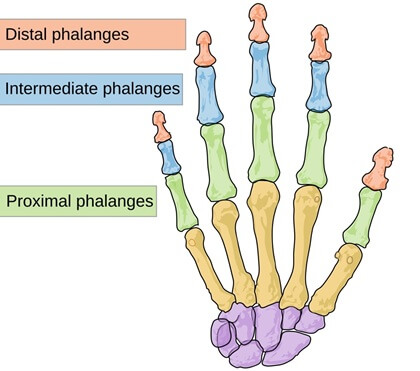
The fingers contain 14 phalanx bones:
- 3 phalanges per finger (proximal, middle, distal)
- 2 phalanges in the thumb (proximal and distal only)
The phalanges form the structural support for the fingers and allow the vast range of motion used in gripping, tapping, and fine manipulation.
1. Proximal Phalanx
- Longest finger bone segment.
- Forms the knuckle where it connects to the metacarpals.
- Important for strong grip force
2. Middle Phalanx
- Absent in the thumb
- Enables bending at the PIP joint
- Common site of dislocations or “jammed finger” injuries.
3. Distal Phalanx
- Supports the fingertip and nail bed.
- Essential for sensory feedback and fine touch
- Frequently injured in crush accidents e.g. finger in a door
Function of the Phalanges
The phalanges bones in the fingers:
- Allow fine precision movements
- Help us pinch, grasp, point, and manipulate tools
- Provide dexterity for typing, writing, and intricate tasks
- Anchor tendons for finger flexion and extension
Injury to the phalanges, especially the distal phalanx, can lead to significant hand bone pain, such as mallet finger or crush injuries.
Joint Structure of the Hand
The bones of the hand form a complex system of joints:
1. Wrist Joint (Radiocarpal Joint)
- Formed between radius/ulna and proximal carpal row
- Allows bending, straightening, deviation, and rotation
2. Carpal Joints
- Multiple connections between the eight carpal bones of the hand
- Allow small gliding movements that create overall flexibility.
3. Carpometacarpal (CMC) Joints
- Connect distal carpal row to metacarpals
- Provide stability and flexibility
- Thumb CMC is the most mobile → crucial for opposition, gripping and pinching
4. Metacarpophalangeal (MCP) Joints
- The MCP joints form the knuckles connecting the metacarpals and proximal phalanges
- Enable flexion, extension, and side-to-side movement
5. Interphalangeal (IP) Joints
- Between the phalanges
- Critical for bending and straightening the fingers
Functions of the Bones of the Hand
The hand bones work together to provide:
- Strength: for pushing, lifting, gripping, and weight-bearing.
- Precision: allow delicate fine movements like sewing, playing piano and writing.
- Flexibility: multi-joint structure lets the hand adjust to any shape or object.
- Stability: Strong ligament attachments keep the hand steady during movements.
- Protection: The hand bones shield and protect nerves, blood vessels, tendons, and ligaments.
The wrist provides broad movement while the palm and fingers offer control and force. Without this perfect combination, everyday activities would be much harder.
Common Causes of Hand Bone Pain
Hand bone pain can come from a variety of causes, including:
1. Hand Injuries
- Fractures (metacarpal, phalangeal, scaphoid)
- Sprains or ligament tears
- Crush injuries
2. Repetitive Strain
- Overuse from typing, gripping, and lifting
- Tendonitis around the fingers or wrist
- Overload from sport or manual work
3. Arthritis
- Osteoarthritis
- Rheumatoid arthritis
- Basal thumb arthritis (CMC OA)
4. Nerve Compression
- Carpal tunnel syndrome
- Ulnar nerve irritation
5. Medical Conditions
- Gout
- Infection (rare but serious)
If you're experiencing persistent hand bone pain, getting a proper diagnosis is key.
Summary: Bones of the Hand Explained
The bones of the hand form a complex and highly functional system of 27 bones working together to give you strength, precision, stability, and flexibility.
From the tiny carpal bones of the wrist to the phalanges of each finger, every hand bone plays a vital role in how we grip, lift, move, and manipulate objects every day.
Understanding the hand bone anatomy helps you better recognise injuries, reduce pain, and protect your hand function long-term.
You may also be interested in the following articles:
- Wrist Pain Diagnosis Chart
- Inner Wrist Pain
- Outer Wrist Pain
- Central Wrist Pain
- Ganglion Cyst Hand
- Trigger Finger
Related Articles
Shoulder Problems
January 29, 2026
Shoulder Diagnosis
September 23rd, 2026

Rehab Exercises
May 21, 2024
Medical & Scientific References
- The Hand. Wikipedia
- Anatomy Of The Hand. John Hopkins Medicine
- Anatomy Of The Hand And Wrist. Cleveland Clinic
Page Last Updated: December 10th, 2025
Next Review Due: December 10th, 2027

Visitor Comments
"Such an informative and valuable site. Clearly written and matches the guidance from my orthopedic surgeon. Even offers many rehab exercises. Thank you very much!" Izabela
"I am a massage therapist and found your website perfect. Very useful. Clear, easy understand. Big help. Thank you!" Viktoria
"This is a great site. Very informative" Marilyn
"I benefited a lot from your distinguished work, thank you." Sayed
"Hi
and thanks so much, great site! You
are doing a lot of good in the world with this helpful site, thanks again." Karen
The material on this website is intended for educational information purposes only. It should not delay or substitute medical advice, diagnosis or treatment. See our T&C's
Shoulder-Pain-Explained.com is a trading name of Wilson Health Ltd. All rights reserved. Terms & Conditions apply
© shoulder-pain-explained.com 2015-26 Last updated 30th September 2026
Contact Us About Us Blog Privacy Policy Advertising Policy Sitemap
