- Home
- Wrist Pain Diagnosis
- Mallet Finger
Mallet Finger:
Causes, Symptoms, Diagnosis &
Treatment Options
Mallet Finger
Written By: Chloe Wilson BSc (Hons) Physiotherapy
Reviewed By: SPE Medical Review Board
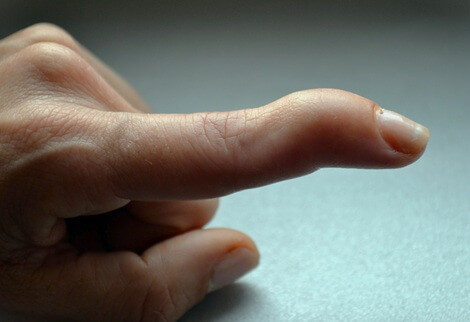
Mallet finger, aka baseball finger, is a common finger injury that affects the ability to straighten the tip of the finger, causing it to droop.
It is common in sport or everyday activities when something hard hits the tip of the finger causing it to overbend.
While mallet finger is usually not dangerous, early diagnosis and correct treatment are essential to ensure proper healing and to prevent long-term deformity or stiffness.
In this article, we’ll look at what mallet finger is, what causes it, how it’s diagnosed, the best treatment options (including splints and surgery), recovery timelines, and how it differs from other finger conditions such as trigger finger.
What Is Mallet Finger?
Mallet finger is an injury to the extensor tendon at the tip of the finger, which straightens the distal interphalangeal (DIP) joint.
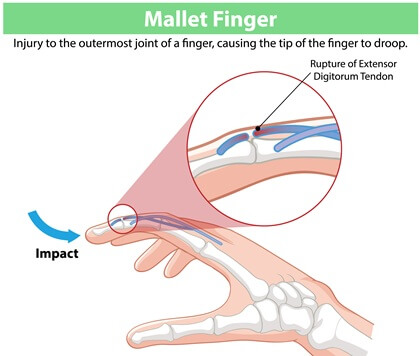
With a mallet finger injury:
- The DIP is forced to bend too far
- The extensor tendon tears or pulls away from the bone
- Sometimes a small bone fragment is pulled off (avulsed) aka bony mallet finger
- The fingertip cannot straighten actively
- The fingertip droops, resembling a mallet
Mallet finger most commonly affects the middle finger, ring finger or occasionally the thumb (mallet thumb).
Because it often occurs when a ball strikes the fingertip, it’s also called baseball finger.
Jersey finger is similar injury, where the fingertip is forced back into extension, preventing active bending at the fingertip.
What Causes Mallet Finger?
Mallet finger occurs when force suddenly bends the fingertip, overstretching or rupturing the extensor tendon.
Common Causes of Mallet Finger
The most common causes of mallet baseball finger are:
1. Sports Injuries
- Baseball, basketball, netball, volleyball
- Football goalkeeping
2.
Direct Trauma
- Ball or hard object striking fingertip
- Finger caught in clothing or bedsheets
- Penetrating injury cutting the tendon
3. Everyday Accidents
- Jamming the finger
- Sudden force while lifting or grabbing objects
- Catching the finger in a door
Risk Factors
- Playing ball sports
- Poor hand positioning during catching
- Older age (bone avulsion more common)
- Osteoporosis (higher risk of fracture)
You don’t have to be an athlete - mallet finger can happen in everyday life from minor accidents
What Does Mallet Finger Feel Like?
Mallet baseball finger usually feels like a sudden loss of control at the fingertip rather than a sharp or severe pain.
Common mallet finger symptoms include:
- Fingertip droops and cannot actively straighten
- A dull ache or soreness at the DIP joint
- Tenderness when touched or knocked
- Weakness or “giving way” when trying to straighten the finger
- Swelling and stiffness around the fingertip
- Bruising after a direct impact
In some cases, especially immediately after injury, there may be a sharp pain at the moment of impact, and a visible deformity – this usually indicates a bony mallet finger
Key clue: If the fingertip rests in a bent position and you cannot straighten it actively, it’s likely mallet finger
Why this matters: Many people delay treatment because the pain is minimal. Without early splinting, the finger can heal bent, causing permanent deformity or swan neck deformity.
Diagnosing Baseball Finger

Doctors often diagnose mallet baseball finger by appearance and function:
- Fingertip droops, around 45o flexion
- Cannot actively straighten the DIP joint
- Passive extension using the other hand is usually possible
- Pain, swelling, and bruising around the DIP joint
Mallet Finger Test
A simple mallet finger test involves holding the affected finger and asking the patient to:
- Try to actively straighten the fingertip
- Compare movement with the uninjured hand
Inability to actively extend the DIP joint strongly suggests baseball finger.
Imaging
- X-rays check for bone avulsion, joint alignment, or subluxation
- Rarely, MRI or ultrasound is used for tendon evaluation
When to See a Doctor
You should seek medical attention if:
- fingertip droops after an injury
- cannot straighten the finger
- significant pain, swelling, or bruising
- Visible deformity
- open wound or suspected fracture
- Nail detachment or blood under nail
Early treatment greatly improves outcomes with baseball finger.
How To Fix Mallet Finger
The good news is that most mallet finger injuries heal without surgery if treated promptly.
1. Mallet Finger Splinting
The mainstay of baseball finger treatment is continuous splinting:
- The fingertip must be held in full extension
- The splint must be worn 24 hours a day
- Typical duration 6–8 weeks full-time, followed by 2–4 weeks night splinting
Even brief bending of the finger during this period can disrupt healing and reset the clock.
2. Skin Care & Compliance
- Keep skin clean and dry
- Regular splint checks (without allowing flexion)
- Education is critical — poor compliance is the most common cause of treatment failure
- Avoid moisturisers on your hand
3. Surgery For Mallet Finger
Surgery is rarely needed, but indicated for
- Large bone avulsion fragment (>30–40% of joint surface)
- Joint subluxation (misalignment)
- Open injuries
- Failed splinting
- Chronic mallet finger affecting function
Surgical Options
- Percutaneous Pinning (K-wires): acts like an internal splint for alignment
- Tendon Repair (rare): or graft where the torn tendon is replaced
- DIP Joint Fusion: permanent straightening for chronic deformity
Post-surgery, splinting and rehabilitation are still required.
Best Splints for Mallet Finger
Choosing the right splint ensures healing success
- Stack Splint: lightweight, commonly used
- Oval-8 Splint: adjustable, comfortable with swelling changes
- Custom Thermoplastic Splint: best fit, made by hand therapist
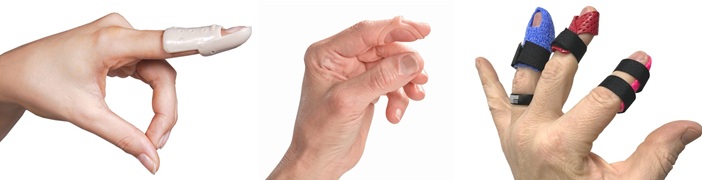
Key tip: The splint must keep the fingertip fully straight and be worn consistently
How Do You Clean a Mallet Finger Splint?
Good hygiene is essential during mallet finger treatment. Because the splint must be worn continuously for several weeks, skin irritation, maceration, and infection are common problems if care isn’t taken.
Step-by-Step: Cleaning a Mallet Finger Splint Safely
Good mallet finger splint hygiene improves comfort, reduces complications, and significantly increases the chances of successful recovery.
- Support
the fingertip in full extension at all times: Rest the finger on a flat surface or support it with your other hand so it
does not bend at the tip, even briefly.
- Remove
the splint only if advised: Some splints can be cleaned while still on. Only remove it if your
clinician has shown you how.
- Wash
the finger gently: Use mild soap and lukewarm water. Avoid soaking the finger unless
specifically advised.
- Clean
the splint separately: Wash plastic splints with warm soapy water, rinse well, and dry
completely.
- Dry
everything thoroughly: Carefully pat the skin dry, especially around the joint creases, before
reapplying the splint. Moist skin increases the risk of skin breakdown and
infection.
- Check the skin regularly: Look for redness, blistering, cracking, or signs of infection. If skin
problems develop, seek advice from a healthcare professional or hand
therapist promptly.
- Reapply the splint carefully: Make sure the fingertip remains fully straight throughout. Even a brief bend can disrupt healing.
Important Warning: If the fingertip bends at any point during cleaning, the healing tendon can re-tear, and the splinting period may need to restart from day one.
Mallet Finger Recovery
Recovery rates will vary from person to person but a general timeline is:
- 0–8 weeks: Continuous splinting 24/7
- 8–12 weeks: Gradual weaning and night splinting
- 3–4 months: Strength and function return with exercises
- 6 months: Final outcome apparent
What to Expect Long-Term
- Mild droop may persist (often cosmetic)
- Most people regain good function
- Grip strength usually unaffected
- Early treatment leads to excellent outcomes.
Trigger Finger vs Mallet Finger
People often ask what the difference between mallet finger and trigger finger is. These two conditions are often confused but are very different.
| Feature | Mallet Finger | Trigger Finger |
|---|---|---|
| Cause | Extensor tendon rupture or bony avulsion at the fingertip | Inflammation and thickening of the flexor tendon |
| Finger Position | Fingertip droops and cannot straighten actively | Finger catches, locks, or clicks during movement |
| Movement Issue | Inability to extend the tip of the finger | Difficulty bending or straightening the finger smoothly |
| Treatment | Continuous splinting, rarely surgery | Exercises, steroid injections, or surgery if severe |
Summary: Mallet finger affects the extensor tendon at the fingertip, while trigger finger involves tendon inflammation in the palm. Understanding the difference is important for correct treatment.
FAQs on Mallet Finger
Let's have a look at some of the most frequently asked questions about mallet finger.
Q1. How do I know if I have mallet finger or just a jammed
finger?
Q1. How do I know if I have mallet finger or just a jammed finger?
Mallet finger causes an inability to actively straighten the tip of the finger, whereas a jammed finger is painful but still moves normally. If the fingertip droops and won’t lift on its own, mallet finger is likely.
Q2. What does mallet finger feel like at first?
Q2. What does mallet finger feel like at first?
Mallet finger often feels mildly painful or swollen at first, with weakness rather than severe pain. Many people notice the fingertip drooping before they feel significant discomfort.
Q3. Do I really have to wear the splint all the time?
Q3. Do I really have to wear the splint all the time?
Yes. The splint must be worn continuously to keep the fingertip straight while the tendon heals. Even brief bending can cause re-tearing and restart the healing process from day one. Typically 6–8 weeks full-time, followed by night splinting.
Q4. Can you drive or
type with a mallet finger splint?
Q4. Can you drive or type with a mallet finger splint?
Yes, for most people light typing and driving is possible, but it depends on which finger is affected and the splint type. Avoid heavy gripping, rapid movements, or extended typing until your physiotherapist or doctor confirms it’s safe.
Q5. Will my finger ever
be completely straight again?
Q5. Will my finger ever be completely straight again?
Many people regain a straight finger, but a small residual droop is common. This usually doesn’t affect function or strength and is considered a good outcome.
Q6. Can mallet finger cause arthritis later on?
Q6. Can mallet finger cause arthritis later on?
If mallet baseball finger is treated early and correctly, it usually does not cause arthritis. However, untreated or severely misaligned injuries can increase the risk of joint wear and long-term stiffness, which may eventually lead to arthritis in the fingertip joint.
Q7. How long does mallet
finger stiffness last?
Q7. How long does mallet finger stiffness last?
Stiffness can last several weeks or months after splint removal. Gentle movement and time usually restore flexibility, even if stiffness feels slow to improve.
Q8. Can mallet finger
come back after treatment?
Q8. Can mallet finger come back after treatment?
Once the tendon has fully healed with proper splinting or surgery, mallet finger rarely recurs. The main risk is if the splint is removed too early or the finger is bent during healing, which can restart the injury.
Q9. What happens if mallet finger is left untreated?
Q9. What happens if mallet finger is left untreated?
Untreated mallet finger can lead to permanent fingertip drooping, joint stiffness, and deformity. Without splinting, it usually heals poorly and may leave permanent swan neck deformity.
Early treatment significantly improves long-term outcomes.
Q10. What is the difference between mallet finger vs jersey finger?
Q10. What is the difference between mallet finger vs jersey finger?
Mallet finger affects the extensor tendon on the back of the finger—causing the fingertip to droop and is usually treated with a splint.
Jersey finger affects the flexor tendon on the palm side—making it hard to bend the fingertip and often requires surgery.
Mallet Finger Summary
Mallet finger (baseball finger) occurs when the fingertip extensor tendon ruptures or pulls off a small bone fragment, causing the fingertip to droop.
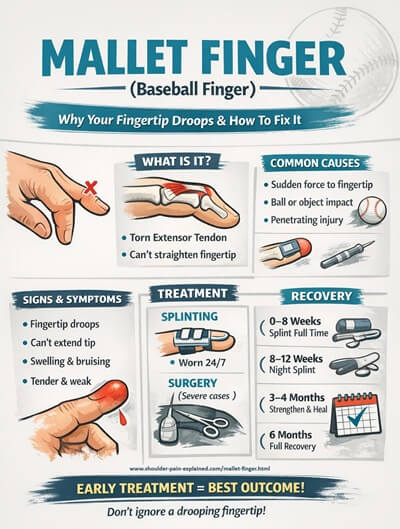
Early diagnosis and splinting are essential.
Most injuries heal without surgery if splinting is strict.
Proper skin care, hygiene, and compliance improve recovery.
Untreated injuries can lead to permanent deformity or stiffness.
If you notice a drooping fingertip after injury, don’t ignore it - early treatment leads to the best possible outcome.
If your finger won't bend after an injury, it is more likely to be jersey finger.
You may also be interested in the following articles:
Related Articles
Shoulder Diagnosis
September 23rd, 2026
Wrist Diagnosis
May 12th, 2026
Elbow Diagnosis
February 26, 2026
Medical & Scientific References
- Mallet Injuries – Standards for Treatment. The British Society for Surgery Of The Hand
- Mallet Finger. NHS UK
- The Diagnosis and Management of Mallet Finger Injuries. American Association For Hand Surgery
- Mallet Finger. American Association of Orthopaedic Surgeons
Page Last Updated: April 20th, 2026
Next Review Due: April 20th, 2028

Visitor Comments
"Such an informative and valuable site. Clearly written and matches the guidance from my orthopedic surgeon. Even offers many rehab exercises. Thank you very much!" Izabela
"I am a massage therapist and found your website perfect. Very useful. Clear, easy understand. Big help. Thank you!" Viktoria
"This is a great site. Very informative" Marilyn
"I benefited a lot from your distinguished work, thank you." Sayed
"Hi
and thanks so much, great site! You
are doing a lot of good in the world with this helpful site, thanks again." Karen
The material on this website is intended for educational information purposes only. It should not delay or substitute medical advice, diagnosis or treatment. See our T&C's
Shoulder-Pain-Explained.com is a trading name of Wilson Health Ltd. All rights reserved. Terms & Conditions apply
© shoulder-pain-explained.com 2015-26 Last updated 30th September 2026
Contact Us About Us Blog Privacy Policy Advertising Policy Sitemap
