- Home
- Wrist Pain Diagnosis
- Wrist Fractures
- Colles Fracture
Colles Fracture (Wrist)
Written By: Chloe Wilson BSc (Hons) Physiotherapy
Reviewed By: SPE Medical Review Board
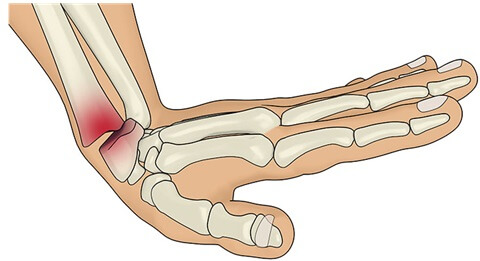
A Colles fracture is one of the most common types of wrist fractures.
It typically occurs when a person falls onto an outstretched hand resulting in immediate pain and swelling in the wrist.
This injury affects the distal radius, the larger of the two forearm bones, and can significantly impact wrist function if not treated properly.
In this article, we’ll explore what a Colles wrist fracture is, its causes, symptoms, diagnosis, treatment options, prevention strategies, and prognosis.
What Is a Colles Fracture?
A Colles fracture is a break in the distal radius, occurring about an inch from the wrist joint.
There are lots of different types of distal radius fracture, but the typical characteristics of a Colles fracture are:
- Complete Fracture: the bone breaks into 2 or more pieces, rather than a partial fracture
- Transverse Fracture: the break occurs perpendicular (90 degree angle) to the direction of the bone
- Dorsal Displacement: the broken fragment(s) shifts towards the back of the hand
- Dorsal Angulation: the bone fragment is tilted upwards
- Radial Shortening: the broken fragments displace in a way which shortens the overall length of the radius
- Extra-Articular Fracture: the break does not extent up into the wrist joint
- Comminuted: often the radius breaks into multiple pieces

These features of a Colles fracture create the classic “dinner fork deformity”, where the wrist appears bent in an abnormal position.
Colles fractures were first described by Irish surgeon Abraham Colles in 1814.
They are one of the most frequently encountered fractures in emergency rooms worldwide, accounting for 17.5% of all adult fractures. They are often accompanied by other injuries, most commonly an ulnar styloid fracture.
What Causes Colles Fractures?
A Colles fracture is usually caused by:
- A Fall: onto an outstretched hand (FOOSH) is the most common cause of a Colles fracture
- Sports Injury: High-impact activities, such as skiing, snowboarding, or cycling, can result in a wrist fracture
- Motor Vehicle Accident: Direct trauma from car crashes or other high-energy impacts can lead to a Colles fracture
Why do falls cause colles fractures? Typically, when you trip, your natural instinct is to try and break your fall with an outstretched arm and pronated hand (palm facing the floor). Your wrist is already bent backwards, and when you land, force from the fall is transmitted through the hand to the distal radius, causing it to break.
Risk Factors
Certain factors increase the likelihood of experiencing a Colles fracture, including:
- Osteoporosis: A disease that weakens bones, making them more susceptible to fractures. Anyone who suffers a colles fracture should be assessed for osteoporosis
- Age: Older adults, especially postmenopausal women, are at higher risk.
- Gender: Women are more prone to wrist fractures due to bone density loss.
- Participation in High-Risk Activities: Sports like rollerblading, skateboarding, horseback riding or contact sports increase the risk.
Colles Fracture Symptoms
The symptoms of a Colles fracture can vary but typically include:
- Immediate, intense pain around the wrist and lower forearm
- Swelling and bruising around the wrist
- Deformity of the wrist, often appearing bent backward into the classic “dinner fork deformity” shape
- Difficulty moving the wrist or fingers with range of motion significantly reduced
- Tenderness at the site of injury
Diagnosing Wrist Fractures
Diagnosing a Colles fracture involves several steps:
- History: Your doctor will ask you lots of questions about your injury. They will want to know when and how the injury occurred, what symptoms you have and when they started, and how the injury is affecting your daily activities
- Physical Examination: They will then assess the wrist for visible deformity, swelling, and range of motion. They will also evaluate your elbow, shoulder and hand to ensure there are no other injuries
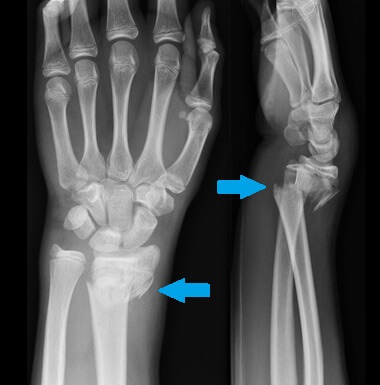
- X-Rays: If your doctor suspects a Colles fracture, they will send you for x-rays to confirm the fracture and determine its severity, as well as to check for any associated injuries. They will take at least 2 x-rays to view the wrist from different angles to get a clear picture of the extent of the injury
- CT Scan or MRI: These may be used in complex cases to evaluate soft tissue damage or associated fractures
Differential Diagnosis
A Colles fracture can sometimes be mistaken for other wrist injuries. Conditions that need to be ruled out include:
- Smith’s Fracture: A fracture of the distal radius with volar displacement - the opposite of a Colles fracture, often referred to as a Reverse Colles Fracture
- Barton’s Fracture: An intra-articular distal radius fracture that includes dislocation of the wrist joint.
- Hutchinson Fracture: A distal radius fracture involving the radial styloid process on the outer wrist
- Scaphoid Fracture: A break in one of the small wrist bones, often confused with a distal radius fracture due to similar pain presentation.
- Forearm Fractures: A break in one or both of the forearm bones, radius and ulna, further away from the wrist joint.

Colles fractures are often associated with other injuries, particularly with high-energy trauma, such as ulnar styloid fractures, nerve damage, tendon tears and scapholunate dissociation. If you're not quite sure what is going on, visit the wrist pain diagnosis chart or wrist fracture sections.
When to See a Doctor
You should seek urgent medical attention immediately if you experience:
- Severe pain and swelling in the wrist after a fall or trauma.
- Visible deformity or an inability to move the wrist.
- Numbness or tingling in the forearm, wrist or hand, which could indicate nerve damage.
#CommissionsEarned from Amazon on qualifying purchases
Colles Fracture Treatment
Treatment for a Colles fracture depends on its severity and displacement as well as your age and activity levels. The goal is to regain full mobility and strength in the wrist and be able to return to your normal activities.
When the fracture first occurs, apply an ice pack to the area and keep the hand elevated e.g. in a sling until you can see a doctor. Remember, if you think you may have broken your wrist, you should seek urgent medical attention.
1. Non-Surgical Treatment
Simple Colles fractures with minimal displacement can sometimes been treated non-operatively. Your doctor will start by manually realigning the bones and setting them into the right position, a procedure known as Closed Reduction.
This is usually done using some form of sedation, typically under local anaesthetic. The wrist is pulled under traction and force is applied to put the fragment back into place.
Once the fracture is well-aligned, a cast or splint is applied to the lower arm, extending from just below the elbow to the middle of your hand, to hold the wrist and forearm in a stable, immobilised position.
The wrist is typically positioned in slight flexion and ulnar deviation (slightly towards the pinky finger side of your wrist. The wrist position is checked on x-ray to ensure good alignment in the cast.
You will need to wear the cast or splint for 4-6 weeks. Once the fracture has healed, which is confirmed by x-ray, you will switch to a smaller, removable splint to support the wrist. You can continue to use this for a few weeks until you have regained full strength and flexibility in your wrist with rehab.
2. Surgical Treatment
Unstable or more complex Colles fractures will require surgery. This is usually done under general anaesthetic.
The surgeon will start by realigning the bones into the correct position and then hold them in place using one or more of the following:
- Plates
- Screws
- Metal pins
- Wires
This procedure is known as an Open Reduction and Internal Fixation (ORIF)
A cast is then applied to maintain the position which you will wear for around 6 weeks.
In complex cases with severe instability, an external frame may be applied to stabilise the wrist. This procedure is known as External Fixation.
Colles Fracture Recovery Time
Whether your Colles fracture has been treated with or without surgery, the recovery process will be fairly similar.
Recovery: First 6 Weeks
- Keep The Cast Dry: you can get special waterproof cast protectors to wear so that you can still wash
- Medication: over-the-counter painkillers e.g. paracetamol and anti-inflammatories e.g. ibuprofen can help to reduce pain and swelling in the wrist
- Elevation: keep your hand raised above heart level as much as possible. You can use a sling during the day, and at night, use pillows to support and raise your hand. Elevation helps to reduce swelling and can speed-up healing
- Avoid Heavy Lifting: with the affected arm and don’t lean on your arm or hand
- Exercises: It is really important to keep the rest of your arm moving to stop it from getting stiff. You should do exercises at least five times a day
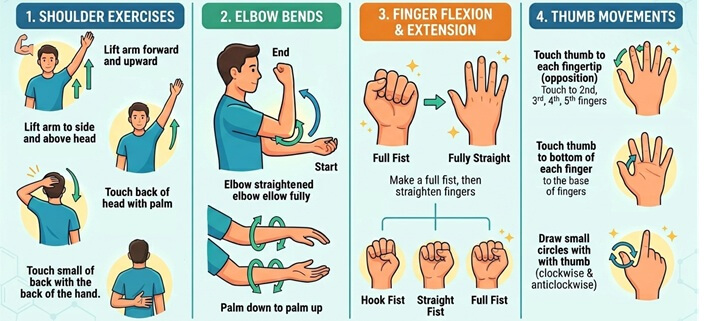
- Fingers/Thumb Exs: bend and straighten the fingers as much as possible at each joint, and touch your thumb to the tip of each finger.
- Elbow Exs: bent and straighten the elbow as far as possible
- Shoulder Exs: reach your hand above your head as far as possible, then reach behind your head and then behind your lower back
Recovery: 6-12 Weeks
Once the cast has been removed, you can start the following:
- Ice: regularly applying an ice pack to the wrist can help reduce pain and inflammation
- Removable Splint: you will be given a removable splint to wear to support the wrist as necessary. It can be helpful to wear this when you are out and about so people take extra care around you
- Physical Therapy: is essential for restoring wrist strength and flexibility. Your physical therapist will regularly review your rehab program to ensure you are exercising appropriately. You will start with simple wrist mobility exercises and will progress to more challenging strengthening exercises as able.
- Light Activities: you can often start light activities around 1-2 months after your cast is removed, but continue to avoid any heavy lifting at this stage
Recovery: 3-6 Months
It usually takes around 3 months for the fracture site to fully heal, with or without surgery. At this stage recovery focuses on:
- Physical Therapy: continue with your rehab programme of stretching and strengthening exercises until you have regained full strength, mobility and function in your wrist and hand.
- Gradually Increasing Activity Levels: You can start returning to your usual activities. Low wrist impact activities such as swimming and running can be started after 3 months, but your doctor may recommend waiting longer for more vigorous activities e.g. football, skiing or soccer
Everyone recovers at different rates following a Colles fracture, depending on factors such as severity and complexity of the fracture, age and other medical conditions.
It can take up to a year to regain full function in the wrist. It is really important to stick to your rehab program otherwise you may end up with long-term stiffness and weakness in your arm.
Find out more about how to make the best recovery including what exercises to do when, what foods can help and how to speed up recovery in the broken wrist recovery tips section.
Preventing Wrist Fractures
While it’s impossible to prevent all fractures, these steps can help reduce your risk of a Colles fracture:
- Improve Bone Health: Ensure adequate calcium and vitamin D intake to strengthen bones
- Use Protective Gear: Wear wrist guards during high-risk activities such as skating or snowboarding
- Prevent Falls: Use handrails, wear proper footwear, and remove trip hazards at home
- Strength Training: Exercises that improve balance and muscle strength can reduce fall risk
Colles Fracture Summary
A Colles fracture is a common wrist injury often caused by falls or trauma. It results in pain, swelling, and a characteristic wrist deformity. Diagnosis is confirmed through physical examination and imaging, and treatment ranges from immobilization to surgery.
Check out our top Broken Wrist Recovery Tips to help you make the best recovery from your colles fracture.
While recovery is generally good, early intervention and rehabilitation, e.g. wrist strengthening exercises and wrist stretches, are key to regaining full wrist function. Taking steps to improve bone health and prevent falls can significantly reduce the risk of experiencing this type of fracture.
There are lots of other types of distal radius fracture including Smith’s fracture and Barton fracture as well as other wrist fractures such as a scaphoid fracture.
You may also be interested in the following articles:
- Boxer's Fracture
- Radial Wrist Pain
- Central Wrist Pain
- Wrist Tendonitis
- De Quervain Tenosynovitis
- Ulnar Styloid Fractures
- Wrist Pain Diagnosis Chart
- Bones Of The Hand
Related Articles

Rehab Exercises
October 7, 2026
Shoulder Diagnosis
September 23rd, 2026
Elbow Diagnosis
February 26, 2026
Medical & Scientific References
- Colles Fracture. National Library Of Medicine
- Colles Fracture. Radiopaedia
- Determining the Borderline Anatomical Parameters for Better Functional Outcome of Colles Fracture: A Prospective Study. Brazilian Orthopedic Magazine
Page Last Updated: November 4th, 2026
Next Review Due: November 4th, 2028

Visitor Comments
"Such an informative and valuable site. Clearly written and matches the guidance from my orthopedic surgeon. Even offers many rehab exercises. Thank you very much!" Izabela
"I am a massage therapist and found your website perfect. Very useful. Clear, easy understand. Big help. Thank you!" Viktoria
"This is a great site. Very informative" Marilyn
"I benefited a lot from your distinguished work, thank you." Sayed
"Hi
and thanks so much, great site! You
are doing a lot of good in the world with this helpful site, thanks again." Karen
The material on this website is intended for educational information purposes only. It should not delay or substitute medical advice, diagnosis or treatment. See our T&C's
Shoulder-Pain-Explained.com is a trading name of Wilson Health Ltd. All rights reserved. Terms & Conditions apply
© shoulder-pain-explained.com 2015-26 Last updated 12th November 2026
Contact Us About Us Blog Privacy Policy Advertising Policy Sitemap
