- Home
- Wrist Pain Diagnosis
- Jersey Finger
Jersey Finger:
Causes, Symptoms, Treatment & Recovery
Jersey Finger
Written By: Chloe Wilson BSc (Hons) Physiotherapy
Reviewed By: SPE Medical Review Board
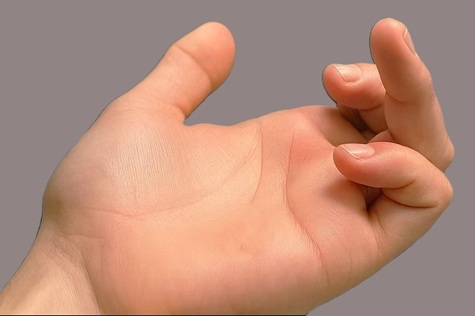
Jersey finger is a serious finger tendon injury that affects your ability to bend the fingertip and grip objects.
It most commonly occurs during sports like rugby or American football, when a player grabs another person’s jersey and the finger is forcefully pulled straight.
Unlike many finger injuries, a jersey finger injury almost always requires prompt medical treatment, and in most cases surgery. Delayed treatment can lead to long-term weakness, reduced grip strength, and permanent deformity.
In this article, we'll look at what jersey finger is, what causes it, the key symptoms to watch for, the best treatment options, splinting and recovery, and how it differs from mallet finger.
What Is Jersey Finger?
Jersey finger is an injury to the flexor digitorum profundus (FDP) tendon, the tendon that allows you to bend the fingertip (the distal interphalangeal or DIP joint).
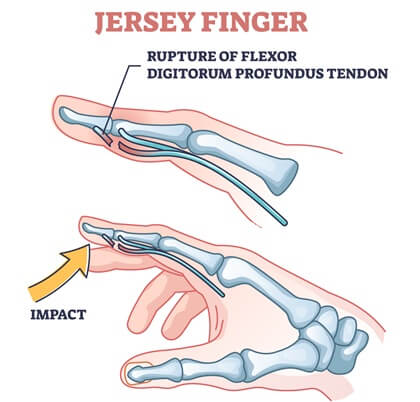
In a jersey finger injury:
- The fingertip is forcefully straightened
- The FDP tendon ruptures or pulls away from the bone
- Sometimes a small fragment of bone is pulled off with the tendon (avulsion)
- The finger cannot actively bend at the tip
This results in a classic jersey finger deformity, where the fingertip rests straight or slightly extended and cannot curl down.
Jersey finger most commonly affects the ring finger (75% of cases) but can also affect the little or middle finger. It is also known as rugby finger or sweater finger.
Causes of Jersey Finger
Jersey finger occurs when a flexed finger is suddenly forced into extension, placing extreme stress on the flexor tendon.
Common causes include:
- Grabbing an opponent’s jersey in rugby or football
- Tackling or contact sports where fingers catch on clothing
- Wrestling, martial arts or rock climbing
- Sudden force while gripping an object
- Falls where the finger is forcefully straightened
The flexor tendon injury usually happens in a single moment, often accompanied by a sharp pain or a “pop.”
Symptoms of Rugby Finger
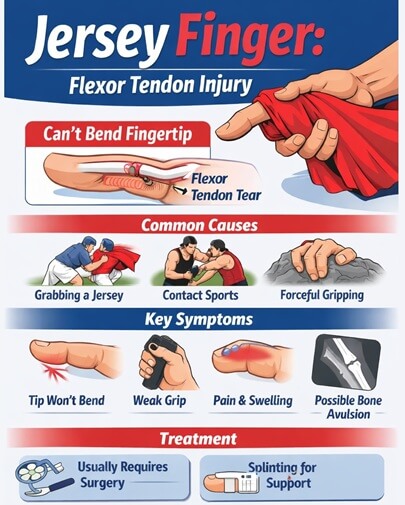
Common jersey finger symptoms include:
- Inability to bend the tip of the finger
- Weak or absent grip with the affected finger
- Pain and tenderness along the palm side of the finger
- Swelling and bruising
The classic jersey finger deformity is where the fingertip rests straight or slightly extended while other fingers bend normally
Key Red Flag: If you cannot actively bend the fingertip, sweater finger should be suspected until proven otherwise. This is not a simple “jammed finger”.
How Is Jersey Finger Diagnosed?
If you suspect a rugby finger, it’s important to get it checked as soon as possible. Early assessment can make a big difference in outcomes.
- Physical Examination: A doctor or hand therapist checks the finger’s ability to bend at the tip. They also assess swelling, bruising, and tenderness along the palm side.
- Imaging Tests: X-rays can show if a small piece of bone has been pulled off (avulsion). Ultrasound or MRI may confirm tendon rupture and show how far the tendon has retracted.
When To See A Doctor
Seek urgent care, ideally within a few days if:
- You cannot bend the fingertip after an injury.
- There is pain, swelling, or bruising along the palm side of the finger.
- You notice a visible deformity or the fingertip rests straight while other fingers bend normally.
Remember: A “jammed finger” that can’t bend is not something to ignore. Early diagnosis and treatment of a flexor tendon injury is essential to avoid long-term weakness or permanent deformity.
Types of Jersey Finger
Jersey finger is classified into five types based on how far the flexor tendon retracts and whether a bone fragment is involved.
| Type | Injury Description | Tendon Position | Why It Matters |
|---|---|---|---|
| I | Complete rupture FDP tendon | Retracts into the palm | Surgery within 7–10 days due to loss of blood supply |
| II | FDP rupture with no bone injury | Retracts to the PIP joint | Surgery required, but timing less critical |
| III | Bony avulsion, tendon attached to fragment | Bone fragment prevents further tendon retraction | Easier to repair surgically, good functional outcomes |
| IV | Bony avulsion plus separate tendon detachment | Tendon & bone fragment retract independently | Requires multi-stage surgical repair |
| V | Jersey finger with distal phalanx fracture | Varies depending on fracture pattern | Most complex; requires specialist hand surgery |
Type I injuries are most urgent, while Types III–V vary in surgical complexity due to bone involvement.
Treatment for Jersey Finger
Jersey finger treatment depends on the severity of the flexor tendon injury, but most cases require surgery, especially in active individuals.
Treatment Factors:
- How far the tendon has retracted
- Whether a bone fragment is involved
- How quickly the injury is diagnosed
Non-Surgical Treatment
Very mild or partial flexor tendon injuries may occasionally be managed conservatively in a splint, but this is uncommon and usually reserved for low-demand patients.
Surgical Treatment (Most Common)
Surgery is the gold standard treatment for jersey rugby finger and involves:
- Reattaching the flexor tendon to the bone
- Fixing any avulsion fracture if present
- Restoring finger flexion strength
Jersey finger surgery may be done under local or general anaesthetic depending on the procedure as a day case. You may need to wear a splint for 6-8 weeks post-op.
Timing matters: Surgery is ideally performed within 7–10 days. Delayed treatment can make repair more difficult and worsen recovery outcomes.
Jersey Finger Splint
A jersey finger splint is often used both before and after surgery. The purpose of the splint for jersey finger is to:
- Keep the finger in slight flexion
- Protect the repaired tendon
- Prevent accidental straightening
- Reduce stress on the healing tendon
Jersey finger splints are usually:
- Custom-made by a hand therapist
- Worn full-time initially
- Adjusted gradually during recovery
Splinting alone is not usually sufficient as definitive treatment for a complete sweater finger injury.
Recovery From Sweater Finger
Jersey finger recovery takes time and patience, even with surgery. Recovery will vary from person to person but as a general rule:
Typical Recovery Timeline
- 0–6 weeks: Protective splinting, limited movement
- 6–12 weeks: Gradual increase in finger motion
- 3–4 months: Strengthening and functional use
- 6 months: Near-full recovery for most people
- 9–12 months: Final strength and endurance
What to Expect Long-Term
- Most people regain useful finger flexion
- Grip strength usually improves significantly
- Some stiffness or weakness may persist
- Early treatment leads to the best outcomes
Hand therapy is a critical part of recovery from flexor tendon injuries and should not be skipped.
Prevention Tips
- Avoid grabbing clothing tightly in contact sports
- Strengthen finger flexor tendons with resistance exercises
- Use proper tackling techniques in rugby and football
- Consider finger taping or protective gloves
Jersey Finger vs Mallet Finger
Jersey finger and mallet finger are often confused, but they are opposite injuries.
The fingers are controlled by flexor tendons on the palm side and extensor tendons on the back of the finger. These tendons work together to allow smooth bending and straightening.
- Flexor Digitorum Superficialis (FDS): Bends the middle joint of the finger (PIP joint)
- Flexor Digitorum Profundus (FDP): Bends the fingertip. It runs deeper than the FDS & attaches to the distal phalanx (fingertip bone)
- Extensor Digitorum: extends the whole finger. Attaches to the distal phalanx allowing active straightening of the fingertip
Jersey finger and mallet finger are both caused by sudden overstretching of one of the finger tendons, but in different directions, so affect different tendons. Key differences of jersey finger vs mallet finger:
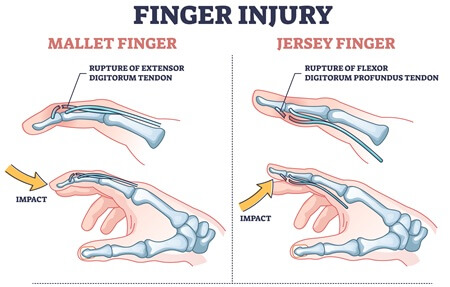
- Jersey Finger: Cannot bend the fingertip (flexor tendon injury)
- Mallet Finger: Cannot straighten the fingertip (extensor tendon injury)
Understanding the difference is essential, as treatment approaches are very different.
| Feature | Jersey Finger | Mallet Finger |
|---|---|---|
| Tendon affected | Flexor digitorum profundus tendon (palm side) | Extensor digitorum tendon (back of the finger) |
| Finger motion | Cannot bend the tip of the finger | Cannot straighten the tip of the finger |
| Common cause | Grabbing a jersey with forced finger extension | Direct blow to the fingertip |
| Treatment | Surgery is usually required | Splinting is often sufficient |
FAQs About Jersey Finger
Let's have a look at some of the most frequently asked questions about jersey rugby finger.
Q1. Can you still move your finger with a jersey finger?
Q1. Can you still move your finger with a jersey finger?
Yes - and this is one reason the injury is often missed.
With a jersey finger, you can usually still bend the finger at the middle
joint, but you cannot bend the fingertip. This happens because one
flexor tendon remains intact while the deeper tendon is torn.
Q2. Why does the fingertip sometimes look straight instead of
bent?
Q2. Why does the fingertip sometimes look straight instead of bent?
The fingertip often rests straight or slightly extended with sweater finger because the extensor tendons on the back of the finger are still working. Since the flexor tendon that bends the tip is damaged, the extensor tendon pulls the fingertip into a straight position.
Q3. Is jersey finger always painful?
Q3. Is jersey finger always painful?
Not always. While many people experience pain, swelling, or bruising, some notice mainly loss of movement rather than severe pain. This can lead people to assume it’s a minor injury, delaying treatment.
Q4. What happens if jersey finger is left untreated?
Q4. What happens if jersey finger is left untreated?
Without treatment, the torn tendon retracts and scars, making later repair much more difficult. This can lead to:
- Permanent inability to bend the fingertip
- Reduced grip strength
- Finger
stiffness or deformity
Early treatment offers the best chance of restoring function.
Q5. Can you bend the fingertip passively with a jersey
finger?
Q5. Can you bend the fingertip passively with a jersey finger?
Often yes. Someone else may be able to bend your fingertip for you, but you cannot actively bend it yourself. This difference between passive and active movement is an important diagnostic clue.
Q6. Is jersey finger considered a medical emergency?
Q6. Is jersey finger considered a medical emergency?
It’s not life-threatening, but it is time-sensitive. Certain types of jersey finger (especially Type I injuries) need surgery within days to prevent permanent tendon damage.
Q7. Why is the ring finger most commonly affected?
Q7. Why is the ring finger most commonly affected?
The ring finger is more vulnerable to jersey finger because:
- It is often the longest finger during gripping
- The FDP insertion into the ring finger is anatomically weaker than the other fingers
- Its tendon anatomy allows greater retraction when injured
- It is more likely to catch on clothing during tackles
Q8. Will the finger ever be completely normal again?
Q8. Will the finger ever be completely normal again?
Many people regain useful movement and strength, especially with early surgery and proper hand therapy. However, some mild stiffness, reduced endurance, or loss of full strength may persist long term.
Q9. Can exercises alone fix a jersey finger?
Q9. Can exercises alone fix a jersey finger?
No. Exercises are important after surgery, but they cannot reattach a torn tendon. Attempting to “work through” the injury can worsen outcomes and delay proper treatment.
Q10. How is jersey finger different from a jammed finger?
Q10. How is jersey finger different from a jammed finger?
A jammed finger is usually a joint or ligament injury and
still allows active bending and straightening.
With jersey finger, there is a loss of active fingertip bending, which
is a key warning sign that the tendon is injured.
Jersey Finger Summary

Jersey finger, aka rugby finger or sweater finger, is a serious finger flexor tendon injury.
It prevents active bending at the fingertip and commonly occurs during contact sports.
Key points to remember:
- Early diagnosis is critical for the best outcome
- Most jersey finger injuries require surgery
- Splinting supports healing but is rarely enough on its own
- Recovery takes several months and requires structured hand therapy
- Delaying treatment can lead to permanent weakness or deformity
If your fingertip won’t bend after a sports injury, seek specialist care immediately to give yourself the best chance of a full recovery from jersey finger.
You may also be interested in the following articles:
Related Articles
Shoulder Diagnosis
September 23rd, 2026
Wrist Diagnosis
May 12th, 2026
Elbow Diagnosis
February 26, 2026
Medical & Scientific References
- Jersey Finger. American Society For Surgery Of The Hand
- Flexor Tendon Injuries. Gloucestershire Hospitals NHS Foundation Trust
- Jersey Finger. National Library Of Medicine, NIH
- Jersey Finger. Radiopaedia
Page Last Updated: January 26th, 2026
Next Review Due: January 26th, 2028

Visitor Comments
"Such an informative and valuable site. Clearly written and matches the guidance from my orthopedic surgeon. Even offers many rehab exercises. Thank you very much!" Izabela
"I am a massage therapist and found your website perfect. Very useful. Clear, easy understand. Big help. Thank you!" Viktoria
"This is a great site. Very informative" Marilyn
"I benefited a lot from your distinguished work, thank you." Sayed
"Hi
and thanks so much, great site! You
are doing a lot of good in the world with this helpful site, thanks again." Karen
The material on this website is intended for educational information purposes only. It should not delay or substitute medical advice, diagnosis or treatment. See our T&C's
Shoulder-Pain-Explained.com is a trading name of Wilson Health Ltd. All rights reserved. Terms & Conditions apply
© shoulder-pain-explained.com 2015-26 Last updated 30th September 2026
Contact Us About Us Blog Privacy Policy Advertising Policy Sitemap
