- Home
- Diagnosis Guide
- Hand Pain Diagram
Hand Pain Diagram
Written By: Chloe Wilson BSc (Hons) Physiotherapy
Reviewed By: SPE Medical Review Board
A hand pain diagram is a great tool for narrowing down what might be causing pain in your hand.
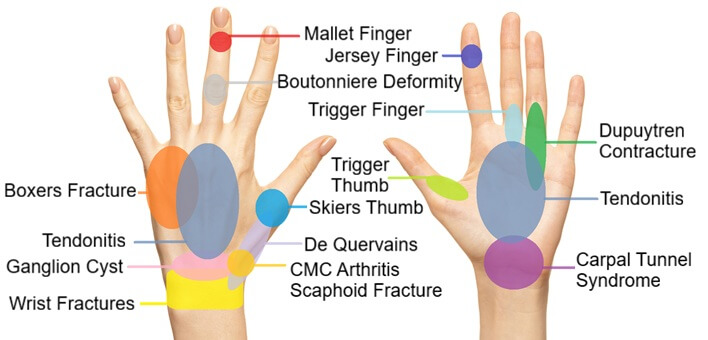
The exact location of your pain - whether it’s in the fingers, thumb, palm, back of the hand, or wrist - often points to very different underlying conditions.
The hand pain charts below will help you identify the most common causes of hand pain by location. Once you’ve identified the cause of your hand pain you can find out about the causes, symptoms, diagnosis and treatment for each condition.
Hand Pain Identifier Charts
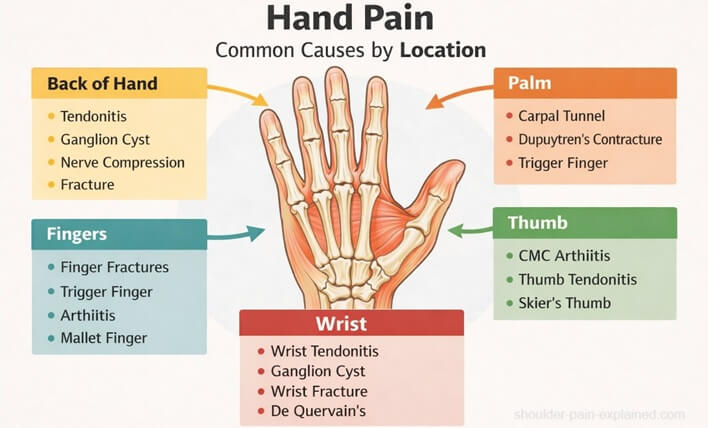
Hand pain tends to fall into five different regions. Each region contains different structures and is exposed to different stresses in our daily activities.
- Back Of Hand Pain: commonly associated with tendon inflammation or nerve irritation
- Pain In Palm: often due to compression or tightening of soft tissues
- Pain In Fingers: often joint, tendon or injury-related
- Pain In Thumb: grip related issues such as tendonitis or arthritis
- Wrist Pain: usually ligament, tendon, nerve or bone injuries
If the pain is further down your arm, check out the pain in the forearm or elbow pain diagrams.
How To Use A Hand Pain Diagram
- Identify the areas where you feel pain in your wrist or hand
- Find the matching area on the diagram below
- Use the list to see the most common causes of pain that location
- Follow the links to learn more about diagnosis and treatment
You can also view our hand pain charts to quickly match your pain location with common causes.
1. Back Of Hand Pain Chart
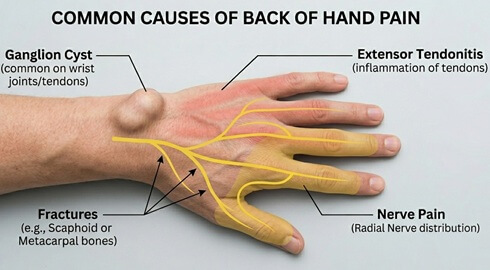
Our first hand pain diagram shows common causes of pain in the back of the hand.
Pain here is usually caused by irritation of the tendons or nerves that supply the hand, inflammation or an injury.
- Ganglion Cyst: Fluid-filled lumps that can press on nearby structures
- Extensor Tendonitis: inflammation of the tendons that straighten your fingers
- Fracture: break in one of the hand bones often from a fall or punching injury
- Nerve Pain: compression or irritation of the radial or ulnar nerve causing tingling or numbness
- Carpal Boss: Bony overgrowth that results in a hard lump on back of hand
There are other less common causes of dorsal hand pain such as infections or vascular conditions, some of which may cause hand lumps.
Find out all about the causes, symptoms and treatment in the pain on back of hand section.
2. Palm Hand Pain Diagram
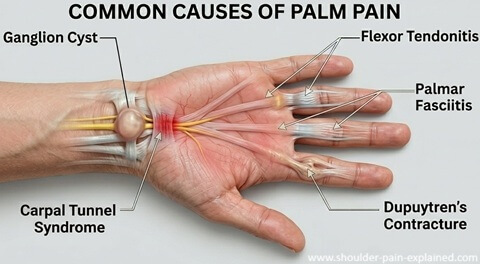
Our next hand pain diagram focuses on the common causes of pain in the palm of the hand.
Pain here is typically caused by irritation, thickening or tightening of the soft tissues, often linked with overuse or age.
- Carpal Tunnel Syndrome: compression of the median nerve causes tingling, numbness and palm pain
- Dupytren’s Contracture: thickening of tissue in the palm causing progressive finger curling
- Tendonitis: irritation or inflammation of one of the tendons that bends the fingers aka trigger finger
- Ganglion Cyst: Fluid-filled lumps that can press on nearby structures
- Palmar Fasciitis: rare condition caused by rapid inflammation of the palmar fascia, often linked with underlying cancer
There are a number of other less common causes of palm pain such as erythromelalgia. Find out more in the pain in palm of hand section.
3. Finger Pain Diagram
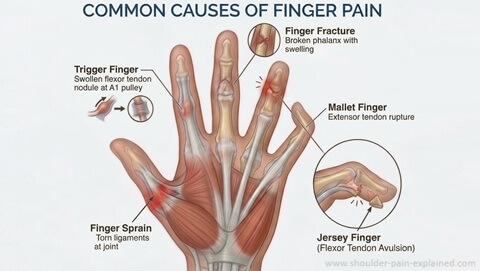
Our next diagram of hand pain focuses on hand and finger pain.
Pain in the fingers is extremely common and is often caused by bony injuries or tendon damage which can lead to reduced range of finger motion.
- Finger Fractures: breaks in the finger bones, usually from direct impact or crush injuries
- Trigger Finger: catching or locking due to tendon irritation
- Mallet Finger: damage to the tendon that straightens the fingertip, causing it to droop
- Jersey Finger: flexor tendon injury preventing fingertip bending
- Swan Neck Deformity: tendon imbalance causing the middle finger joint to hyperextend
- Finger Sprains: stretching or tearing of ligaments from sudden force or twisting
There are other less common causes of hand finger pain such as Boutonniere Deformity and scleroderma. Find out more about the causes, symptoms and treatment options in the finger pain section.
4. Pain In Thumb Chart
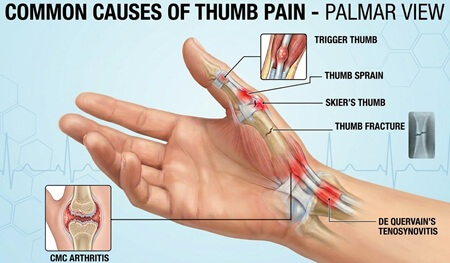
This hand pain identifier focuses on pain in the thumb region rather than the fingers.
Thumb pain can significantly affect grip and hand function and is typically caused by damage to the tendons, ligaments and bones of the thumb.
- De Quervain’s Tenosynovitis: irritation of thumb tendons causing pain in the thumb and wrist
- Skier’s Thumb: Tear in the ulnar collateral ligament causing thumb pain, weakness and instability
- Thumb (CMC) Arthritis: degeneration of the joint at the base of the thumb
- Thumb Sprain: overstretching or tearing of one of the thumb ligaments
- Trigger Thumb: tendon irritation causing the thumb to catch or lock when bending
- Thumb Fracture: break in one of the thumb bones usually from direct impact or a fall
Other less common causes of thumb pain include radial nerve compression and gout. Find out more in the pain in the thumb section.
5. Wrist Pain Diagram
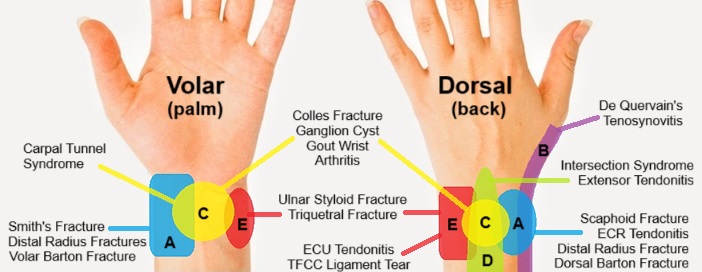
Our final hand pain diagram focuses on problems at the wrist joint.
Wrist pain often overlaps with hand pain but has its own distinct causes.
- Wrist Fracture: break in one of the wrist bones, often due to a fall onto an outstretched hand
- Wrist Tendonitis: inflammation of one or more of the wrist tendons from overuse or injury
- Carpal Tunnel Syndrome: compression of the median nerve across the front of the wrist
- Ganglion Cyst: firm/hard fluid-filled lumps that form around the wrist joint or tendons
Other possible causes of wrist pain include gout, intersection syndrome and arthritis. Find out more about the causes, symptoms and treatment by visiting our Wrist Pain Chart section.
6. Lump On Hand Diagram
There are a number of possible causes of hand lumps, the most common being:
- Ganglion Cyst: fluid-filled firm cyst that develops near joints or tendons
- Carpal Boss: hard bony lump at base of fingers
- Trigger Finger Nodule: thickening of the flexor tendon causing lump in palm
- Dupuytren's Nodule: firm lump in palm fascia of ring and little finger
- Arthritis: bony enlargement at joints from bone spurs
Other possible causes include epidermoid cysts, gout, soft tissue tumors and lipoma. Find out loads more in the Lump On Hand Guide article.
Other Causes Of Wrist And Hand Pain
As well as location-specific conditions, there are a number of systemic or general causes that can cause problems not shown on our hand pain identifier:
Other possible causes of hand pain include:
- Raynaud’s Disease: reduced blood flow to the fingers causes colour changes (white/blue/red), numbness and pain, often triggered by cold
- Osteoporosis: weakened bones increase the risk of fractures in the wrist and hand, even with minor injuries
- Gout: a type of inflammatory arthritis caused by uric acid crystals leading to sudden, severe joint pain, swelling and redness
- Arthritis: includes osteoarthritis and rheumatoid arthritis, causing joint pain, stiffness, swelling and reduced movement
- Scleroderma: a rare condition that causes skin thickening and tightening in the hands, often affecting movement and circulation
- Cuts and Lacerations: direct injury to the skin or deeper tissues can cause pain, swelling and risk of infection
When To See The Doctor
Most cases from our hand pain diagram settle with rest and simple treatment, but some symptoms need prompt medical assessment to avoid long-term problems.
Seek urgent medical attention if you have:
- Severe hand pain after a fall, direct blow, or twisting injury
- A visible deformity or suspected fracture/dislocation
- Inability to move your fingers, thumb, or wrist
- Loss of sensation, persistent numbness, or weakness
- A deep cut, open wound, or heavy bleeding
- Signs of infection (increasing redness, warmth, swelling, or fever)
Book a routine appointment if you notice:
- Hand pain that lasts longer than 1–2 weeks despite rest
- Recurrent or worsening symptoms with activity
- Ongoing stiffness or reduced range of motion
- Clicking, locking, or catching in the fingers or thumb
- Tingling or pins and needles, especially at night
- Hand swelling that does not settle
It is important to get an accurate hand pain diagnosis as soon as possible to help prevent chronic pain and stiffness and to reduce the risk of long-term joint damage or deformity.
Starting treatment early will help to reduce recovery time. Treatment will depend on what the underlying cause is so once you have identified your problem using our hand pain diagram, read the relevant article to find the best course of treatment.
FAQs on Hand Pain Diagram
Here you will find answers to the most frequently asked questions about a hand pain identifier.
1. What Does A Hand
Pain Diagram Show?
1. What Does A Hand Pain Diagram Show?
A hand pain diagram shows different areas of the hand (fingers, thumb, palm, back of hand, and wrist) and links each location to the most likely causes of pain. It helps you quickly narrow down possible conditions based on where your symptoms predominantly are.
2. When Should I Worry
About Hand Pain?
2. When Should I Worry About Hand Pain?
You should be concerned about hand pain if you have:
- Severe pain after an injury
- Persistent numbness or weakness
- Visible deformity or swelling
- Symptoms lasting more than 1–2 weeks
These may indicate a more serious condition that needs medical assessment.
3. Can Hand Pain Go
Away On Its Own?
3. Can Hand Pain Go Away On Its Own?
Yes, mild hand pain caused by strain or overuse often improves with rest, ice, and activity modification. However, persistent or worsening pain may need treatment such as physiotherapy or medical care.
4. Why Does My Hand
Hurt In The Morning?
4. Why Does My Hand Hurt In The Morning?
Morning hand pain is commonly caused by:
- Arthritis, which leads to joint stiffness
- Carpal tunnel syndrome, where nerve pressure increases overnight
Symptoms usually ease as the hand warms up and starts moving.
5. What Causes Pain
In Different Parts Of The Hand?
5. What Causes Pain In Different Parts Of The Hand?
Different areas of hand pain are linked to different conditions:
- Fingers: arthritis, trigger finger, tendon injuries
- Thumb: De Quervain’s, arthritis, trigger thumb
- Palm: carpal tunnel syndrome, Dupuytren’s
- Back Of Hand: tendonitis, nerve irritation
- Wrist: sprains, fractures, tendonitis
6. How Do I Know If
My Hand Pain Is A Fracture Or Sprain?
6. How Do I Know If My Hand Pain Is A Fracture Or Sprain?
- Fracture: severe pain, swelling, bruising, deformity, difficulty moving
- Sprain: pain, swelling, but usually no deformity and some movement remains
If in doubt, always get an X-ray to confirm.
7. What Helps Hand
Pain Recover Faster?
7. What Helps Hand Pain Recover Faster?
To speed up recovery:
- Rest and avoid aggravating activities
- Use ice to reduce pain and swelling
- Support the hand with a brace if needed
- Start gentle exercises as pain allows
More severe conditions may require physiotherapy or medical treatment.
Can A Hand Pain
Diagram Replace A Diagnosis?
Can A Hand Pain Diagram Replace A Diagnosis?
No, a hand pain chart is a guide, not a diagnosis. It helps you identify possible causes, but a healthcare professional is needed for an accurate diagnosis and treatment plan.
Hand Pain Diagram
Summary
A hand pain chart is one of the most effective ways to identify the likely cause of your symptoms based on their exact location. By breaking the hand into key areas, back of the hand, palm, fingers, thumb, and wrist, you can quickly narrow down whether your pain is coming from tendons, joints, nerves, ligaments, or bones.
- Back Of Hand Pain: is commonly linked to tendon or nerve irritation
- Palm Pain: often points to nerve compression or soft tissue problems
- Finger Pain: is usually caused by arthritis, tendon injuries, sprains, or fractures
- Thumb Pain: frequently affects grip and is often due to tendonitis or arthritis
- Wrist Pain: may involve sprains, fractures, tendonitis, or nerve issues
A hand pain diagram provides a clear starting point, helping you understand your symptoms and guide your next steps. However, it should be used alongside proper assessment, especially if symptoms are severe, persistent, or worsening.
Use this guide to identify where your pain is coming from, then explore the related condition pages for a full diagnosis, treatment options, and recovery advice.
You may also be interested in the following articles:
- Lump In Hand Guide
- Pain In The Forearm
- Elbow Pain Diagram
- Shoulder Pain Diagram
- Wrist Lumps & Bumps
- Lump On Back Of Hand
Related Articles



Page Last Updated: June 3rd, 2026
Next Review Due: June 3rd, 2028

Visitor Comments
"Such an informative and valuable site. Clearly written and matches the guidance from my orthopedic surgeon. Even offers many rehab exercises. Thank you very much!" Izabela
"I am a massage therapist and found your website perfect. Very useful. Clear, easy understand. Big help. Thank you!" Viktoria
"This is a great site. Very informative" Marilyn
"I benefited a lot from your distinguished work, thank you." Sayed
"Hi
and thanks so much, great site! You
are doing a lot of good in the world with this helpful site, thanks again." Karen
The material on this website is intended for educational information purposes only. It should not delay or substitute medical advice, diagnosis or treatment. See our T&C's
Shoulder-Pain-Explained.com is a trading name of Wilson Health Ltd. All rights reserved. Terms & Conditions apply
© shoulder-pain-explained.com 2015-26 Last updated 30th September 2026
Contact Us About Us Blog Privacy Policy Advertising Policy Sitemap
