- Home
- Hand Pain Diagram
- Thumb Pain
Pain In The Thumb
Written By: Chloe Wilson BSc (Hons) Physiotherapy
Reviewed By: SPE Medical Review Board
Pain in the thumb is extremely common and can make everyday activities surprisingly difficult. Simple tasks like gripping a cup, opening jars, texting, typing or turning a key can suddenly become painful and frustrating.
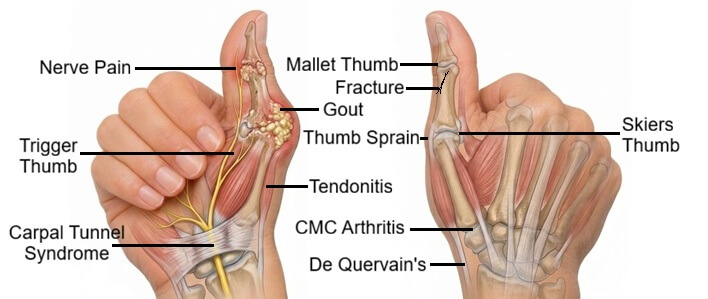
The thumb is responsible for around 40% of hand function, so even mild thumb pain can have a major impact on daily life. The good news is that most cases improve well with the right treatment and activity modification.
In this guide, we will look at the most common thumb pain causes, how symptoms vary depending on the location of the pain, when to seek medical help and the best ways to treat pain in the thumb.
Risk Factors For Thumb Pain
Certain factors can increase your risk of developing thumb pain, particularly conditions linked to overuse, inflammation, repetitive movements and joint wear. Often, several factors combine together.
Common risk factors for developing pain in the thumb include:
- Occupation: e.g. typing & computer work, manual work, hairdressing
- Sports And Hobbies: e.g. texting, gaming, golf, tennis, playing musical instruments, skiing
- Previous Thumb Or Wrist Injuries: e.g. fractures, ligament injuries
- Medical Conditions: e.g. arthritis, diabetes, hypermobility, gout
- Recent Life Events: e.g. pregnancy, caring for a newborn, new job/hobby, starting new exercise regime
- Recovery Inhibitors: Smoking, poor sleep, stress, poor nutrition, excess alcohol, obesity
People who frequently use their hands for work, sport or daily activities are generally more likely to develop thumb joint pain.
Common Thumb Pain Causes
There are many possible causes of thumb pain. The location of the pain, the type of symptoms and how the problem started can all help identify the underlying condition.
1. De Quervain’s Tenosynovitis
One of the most common causes of thumb and wrist pain is De Quervain Tenosynovitis which occurs when the tendons on the thumb side of the wrist become irritated and inflamed.
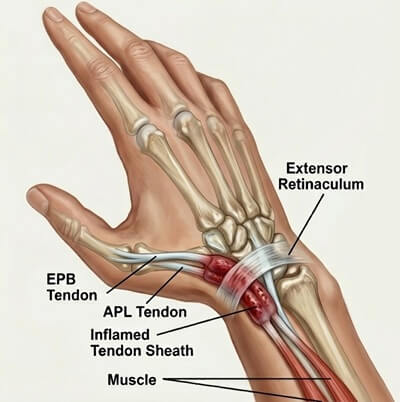
Common symptoms of De Quervain’s include:
- Pain at the base of the thumb that spreads to wrist
- Localised swelling and tenderness
- Sharp thumb pain when gripping, twisting or lifting
- Clicking or catching sensations when moving the thumb
Symptoms often worsen with lifting, texting or repetitive thumb movements and typically develop gradually rather than suddenly.
You can find out all about the common causes and best treatment options in the De Quervain Tenosynovitis section.
2. Trigger Thumb
Trigger thumb is another common cause of thumb pain and develops gradually when inflammation affects the flexor tendon that bends the thumb.
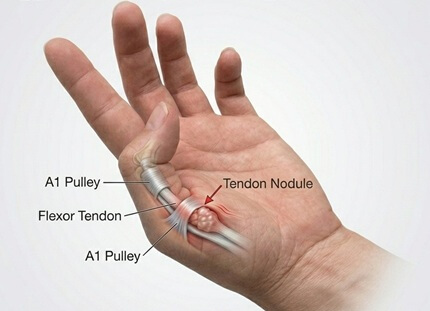
Common symptoms of trigger thumb include:
- Pain on palm side of thumb
- Thumb locking, catching or clicking when bending thumb
- Stiffness, especially in the morning, with difficulty straightening the thumb
- Tender lump in the palm
In severe cases, the thumb may get stuck in a bent position.
Find out more about the causes and best treatment options in the Trigger Finger section.
3. Thumb Arthritis
Arthritis is one of the leading causes of thumb joint pain, especially in adults over 50. The most common type is osteoarthritis affecting the carpometacarpal (CMC) joint at the base of the thumb.
Common symptoms of thumb arthritis include:
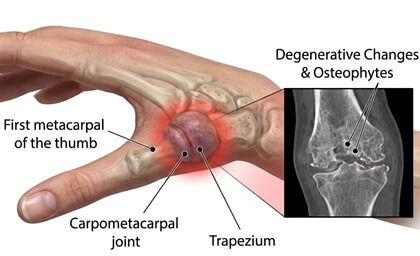
- Deep aching pain at base of thumb
- Stiffness and thumb joint pain, especially in the morning
- Weak pinch strength
- Grinding or clicking sensations
- Difficulty opening jars
- Enlarged or bony-looking thumb joint
Rheumatoid arthritis can also affect the thumb joints and often causes swelling in multiple joints.
4. Thumb Sprain
A thumb sprain is another common cause of thumb pain that occurs when the ligaments supporting the thumb are overstretched or torn, typically from high impact sports or a fall.
Common symptoms of thumb sprains include:
- Immediate thumb pain after twisting or jamming the thumb
- Localised swelling and bruising
- Reduced thumb movement
- Tenderness around the joint
Symptoms vary depending on the severity of the ligament damage.
5. Skier’s Thumb
Skier’s thumb is a ligament injury affecting the ulnar collateral ligament (UCL) on the inside of the thumb.
It commonly occurs when the thumb is forcefully bent backwards during a fall, not just when skiing!
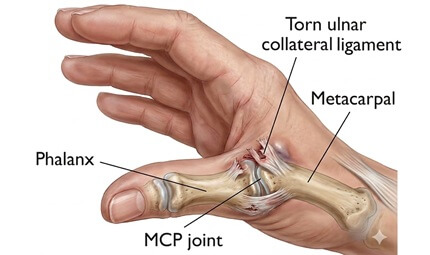
Common symptoms of skiers thumb include:
- Sudden inner thumb pain after injury or fall
- Swelling and bruising spreading into palm
- Difficulty gripping objects tightly
- Thumb instability and pain when pinching
You can find out all about the common causes, symptoms and best treatment for thumb pain in the Skier’s Thumb section.
6. Repetitive Strain Injury
Repeated thumb movements can irritate and inflame the muscles and tendons around the thumb and wrist resulting in pain on thumb.
Common symptoms of repetitive strain injuries of the thumb include:
- Dull, aching thumb pain that builds throughout the day
- Fatigue and reduced endurance with prolonged activity e.g. gripping
- Stiffness and cramping
- Tenderness and mild swelling along the affected tendon
- Symptoms improve with rest
One of the most common types of repetitive strain is thumb tendonitis such as “Texting Thumb”, aka smartphone thumb or gaming thumb, caused by excessive phone or games console
7. Carpal Tunnel Syndrome
Pain in the thumb, palm and fingers is often caused by carpal tunnel syndrome, where compression of the median nerve at the wrist can cause pain and altered sensation.
Common symptoms of carpal tunnel syndrome include:
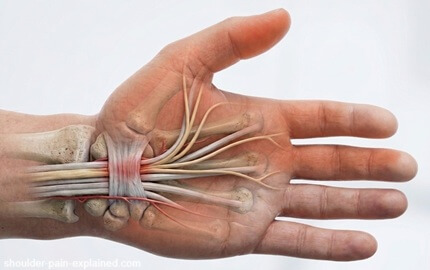
- Burning, tingling and numbness in the thumb, index and middle fingers
- Night pain which may wake you up
- Weak grip and frequently dropping objects
- Hand shaking may temporarily relieve symptoms
Carpal tunnel symptoms are often worse first thing in the morning. You can find out all about this common cause of thumb and finger pain in the Carpal Tunnel Syndrome section.
8. Thumb Fracture
Another common cause of sudden pain in the thumb is a broken thumb which can occur after falls, sports injuries or direct impact.
Common symptoms of thumb fractures are:
- Severe pain immediately after injury
- Rapid swelling and bruising
- Visible deformity or abnormal thumb position
- Difficulty moving the thumb
- Moderate to severe pain with minimal thumb movement
Thumb fractures usually require X-rays for diagnosis and often require immobilisation in a thumb splint or surgery.
9. Nerve Compression
Pain in thumb joint accompanied by abnormal sensations is often caused by irritation or compression of nerves in the neck, arm, elbow or wrist which can refer pain into the thumb.
Common symptoms of nerve pain in the thumb include:
- Burning or electric shock-type pain in the thumb
- Thumb numbness or pins and needles
- Symptoms radiating from neck, shoulder, elbow, forearm or wrist
- Weak thumb coordination
- Increased symptoms with certain neck or arm positions
Common causes include cervical radiculopathy and peripheral nerve entrapment and symptoms may come and go depending on posture.
You can find out more about the common causes, symptoms, diagnosis and treatment in the Arm Nerve Pain section.
11. Ganglion Cyst
The most common cause of lumps in the thumb are ganglion cysts, fluid-filled sacs that commonly develop near the wrist or thumb joints.
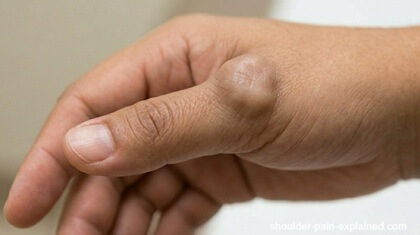
Common symptoms of ganglion cysts include:
- Visible lump that may fluctuate in size
- Tenderness with pressure
- Aching pain during thumb/wrist movement
- Reduced movement and flexibility
Some ganglion cysts are completely painless but they may cause pain in the thumb if they start to press on nearby structures.
Find out all about the common causes and best treatment options for these thumb lumps in the Ganglion Cyst section.
12. Mallet Thumb
Mallet thumb is a rare injury affecting the tendon that straightens the tip of the thumb.
Common symptoms of mallet thumb include:
- Sudden pain in tip of thumb after injury
- Drooping thumb tip and inability to fully straighten the thumb
- Top of thumb pain and swelling
- Weakness during fine motor tasks
- Difficulty performing pinching movements
Find out more about the causes, symptoms and how to treat thumb pain in the Mallet Finger section.
13. Gout
Sudden, intense thumb joint pain and swelling without an injury is often caused by Gout, a type of inflammatory arthritis caused by uric acid crystals building up in the joint.
Common symptoms of gout thumb include:
- Sudden severe thumb joint pain
- Redness, heat and swelling in the thumb
- Extreme tenderness
- Intense throbbing pain in thumb
- Symptoms develop rapidly, often at night
Even light contact may feel unbearable during a gout flare-up.
14. Infection
Infections around the thumb or nail can cause severe hand and thumb pain and swelling and can become serious if left untreated.
Common symptoms of a thumb infection include:
- Redness and heat spreading around the thumb
- Throbbing pain in thumb
- Pus or discharge
- Fever or feeling unwell
- Swollen lymph nodes
Symptoms of a thumb infection often worsen rapidly and require urgent medical treatment.
When To See A Doctor
Whilst many cases of pain in the thumb will settle down within a few days, you should see a doctor if you have:
- Severe thumb pain
- Significant swelling or visible deformity
- Inability to move the thumb
- Numbness, weakness or signs of infection
- Persistent symptoms lasting more than 2-3 weeks
- Symptoms after a major injury
- Thumb instability
- Night pain that does not improve
Diagnosing Pain In The Thumb
A doctor or hand specialist will usually diagnose pain on the thumb through:
- Medical History: asking you questions about your symptoms, activities, previous injuries, occupation and medical conditions
- Physical Examination: Assessment may include looking at thumb movement, grip strength, joint stability, swelling and nerve testing
- Imaging Tests: These may include X-rays, Ultrasound, MRI scans or CT scans. Nerve conduction studies may sometimes be used if nerve compression is suspected.
Thumb Pain By Location
The exact location of pain in the thumb often provides important clues about the underlying cause.
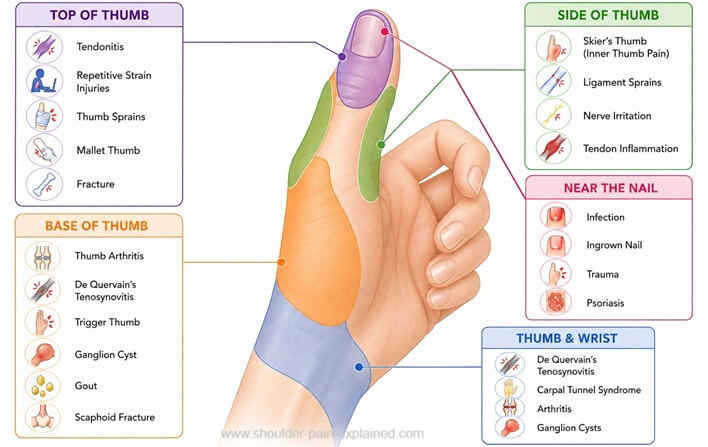
1. Top Of Thumb Pain
Pain on the top of the thumb is commonly linked to tendonitis, repetitive strain injuries, thumb sprains, mallet thumb or a fracture.
Pain in the top of the thumb often worsens with gripping, lifting and forceful pinching activities.
2. Pain In Base Of Thumb
Pain at the base of the thumb is one of the most common presentations. Common causes include thumb arthritis, De Quervain’s, trigger thumb and scaphoid fracture.
Base of thumb pain is often aggravated by opening jars, turning keys, lifting heavy objects and prolonged gripping tasks.
3. Side Of Thumb Pain
Pain along the side of the thumb may be caused by Skier’s thumb (inner thumb pain), ligament sprains, nerve irritation or tendon inflammation.
Side of thumb pain is commonly triggered by pinching, gripping sports equipment, twisting movements and pushing up through the hand.
4. Pain In The Thumb Nail
Pain near the nail is often related to infection, ingrown nail, trauma or Psoriasis.
Symptoms often worsen when pressing on the nail, typing, tapping surfaces or accidentally knocking the thumb.
5. Thumb And Wrist Pain
Pain affecting both the thumb and wrist commonly occurs with De Quervain’s tenosynovitis, carpal tunnel syndrome, arthritis and ganglion cysts.
Symptoms of thumb and wrist pain are frequently affected by lifting, texting, computer work, gaming, carrying children and repetitive twisting movements.
How To Treat Thumb Pain
The best way to treat thumb joint pain depends on the underlying cause, but many cases improve with conservative treatment.
#CommissionsEarned from Amazon on qualifying purchases
1. Rest & Activity Modification
Reducing aggravating activities allows irritated tissues to settle down and helps reduce swelling and pain in the thumb.
Helpful strategies include:
- Taking regular breaks
- Reducing texting/phone use
- Avoiding repetitive gripping
- Using ergonomic equipment
- Modifying sports activities
Complete rest is rarely necessary, but avoiding repeated irritation is very important or your thumb joint pain will likely return.
2. Ice & Heat
Ice and heat can both help to reduce pain in the thumb. Ice helps reduce inflammation and swelling, particularly after injury whereas heat is often more helpful for stiffness and arthritis.
General Guidelines:
- Ice: apply an ice pack 10-15 minutes, every couple of hours
- Heat: apply a heat pack for 15-20 minutes at a time
- Repeat several times daily as needed
3. Thumb Splints & Braces
Splints and braces help support the thumb joint and wrist, limit movement and reduce strain on irritated tendons and ligaments which helps to reduce pain in the thumb joint.
- Thumb Splints are more rigid and provide greater immobilisation and are best for acute injuries and severe pain. They are commonly used for Skier’s Thumb, fractures, trigger thumb, moderate to severe thumb sprains and after surgery
- Wrist/Thumb braces are usually softer and more flexible provide more general support while allowing the thumb to move so are best for ongoing support and mild to moderate symptoms. They are commonly used with conditions such as De Quervains tenosynovitis, Carpal Tunnel Syndrome, arthritis and tendonitis.
Prolonged immobilisation can cause stiffness and weakness, so splints and braces should be combined with exercises and activity modification.
4. Physical Therapy
Physical therapy can be highly effective for persistent pain in thumb joint and weakness and may include:
- Stretching and strengthening exercises
- Joint mobilisation
- Posture correction
- Ergonomic advice
- Activity modification
- Electrotherapy e.g. ultrasound and short wave diathermy
Physical therapy helps improve strength, flexibility and hand function while reducing pain, and also helps ensure the problem doesn’t return.
5. Medication
Common medications that can help with pain in the thumb include:
- Anti-inflammatory medication
- Pain relief medication
- Topical gels
- Corticosteroid injections
Always follow medical advice regarding medication use.
6. Lifestyle Changes
Improving general health can support healing and reduce inflammation to ensure you make a full recovery. Helpful changes include:
- Good sleep habits
- Smoking cessation
- Stress management
- Improved nutrition
- Regular exercise
- Weight management
7. Surgery
Surgery for pain in the thumb is usually only considered if conservative treatment fails or there is significant structural damage.
Common surgical procedures include:
- Ligament repair
- Tendon release
- Joint fusion
- Joint replacement
- Fracture fixation
- Nerve decompression
Most people with pain in thumb joint do not require surgery.
Thumb Pain Summary
Pain in the thumb can develop from many different problems including tendon irritation, arthritis, ligament injuries, fractures and nerve compression.
Thumb pain may develop gradually from overuse and repetitive strain, or it can come on suddenly after an injury.
Some of the most common thumb pain causes include De Quervain’s tenosynovitis, trigger thumb, thumb arthritis, repetitive strain injuries and sprains and carpal tunnel syndrome. The location of symptoms often provides important clues about the underlying condition.
Most cases of thumb joint pain improve well with early treatment including activity modification, splinting, physical therapy and exercises. However, severe pain, swelling, weakness or symptoms after injury should always be assessed by a medical professional.
Understanding what is causing your thumb pain is the first step toward finding the right treatment and getting back to pain-free movement.
You may also be interested in the following articles:
- Hand Pain Diagram
- Hand And Finger Pain
- Pain In Palm Of Hand
- Pain In Back Of Hand
- Pain In Forearm
- Pain From Shoulder To Hand
Related Articles
Shoulder Diagnosis
September 23rd, 2026
Wrist Diagnosis
May 12th, 2026
Elbow Diagnosis
February 26, 2026
Page Last Updated: May 12th, 2026
Next Review Due: May 12th, 2028

Visitor Comments
"Such an informative and valuable site. Clearly written and matches the guidance from my orthopedic surgeon. Even offers many rehab exercises. Thank you very much!" Izabela
"I am a massage therapist and found your website perfect. Very useful. Clear, easy understand. Big help. Thank you!" Viktoria
"This is a great site. Very informative" Marilyn
"I benefited a lot from your distinguished work, thank you." Sayed
"Hi
and thanks so much, great site! You
are doing a lot of good in the world with this helpful site, thanks again." Karen
The material on this website is intended for educational information purposes only. It should not delay or substitute medical advice, diagnosis or treatment. See our T&C's
Shoulder-Pain-Explained.com is a trading name of Wilson Health Ltd. All rights reserved. Terms & Conditions apply
© shoulder-pain-explained.com 2015-26 Last updated 30th September 2026
Contact Us About Us Blog Privacy Policy Advertising Policy Sitemap
