- Home
- Wrist Pain Diagnosis
- Wrist Fractures
- Recovery Tips
Broken Wrist Recovery Tips
Broken Wrist Recovery Tips: Speed Up Healing & Regain
Strength
Written By: Chloe Wilson BSc (Hons) Physiotherapy
Reviewed By: SPE Medical Review Board

Broken wrist recovery tips to reduce pain, restore movement and strength and get you back to normal as quickly and safely as possible.
A wrist fracture can be painful, frustrating and surprisingly limiting.
Even simple tasks like typing or making a cup of tea become difficult.
The good news? With the right approach, you can significantly improve your recovery time for broken wrist and reduce long-term stiffness.
In this guide, I’ll take you through everything you need to know about the recovery process, including realistic timelines, what actually slows healing down, our top 10 broken wrist recovery tips and the most effective wrist fracture exercises at each stage.
Understanding The Healing Process
Before we look at the 10 best broken wrist recovery tips, it helps to understand what your body is actually doing.
Bone healing is not just about the bone, it also involves the surrounding soft tissues, joints, muscles and nerves. A cast or splint is usually necessary for the first few weeks.
There are four stages of bone healing:

1. Inflammatory Phase (0–7 Days)
- Bleeding occurs around the fracture
- A clot (fracture haematoma) forms
- Pain, swelling and warmth are at their worst
2. Soft Callus Formation (1–3 Weeks)
- Soft tissue starts to bridge the fracture (soft callus)
- Early stability develops
- Pain begins to settle
3. Hard Callus Formation (3–8 Weeks)
- New bone replaces the soft callus
- Fracture becomes more stable
- Cast is often removed
4. Bone Remodelling (2–12 Months)
- Bone gradually reshapes and strengthens
- Function continues to improve
Healing continues long after the cast is removed which is why wrist fracture recovery time varies.
Broken Wrist Recovery Time: Realistic Expectations
So how long does it actually take? Let us clear this up properly because this is where most people get frustrated.
Average recovery time for broken wrist:
- Initial Bone Healing: 6–8 weeks
- Return To Light Function: 8–12 weeks
- Functional Recovery: 3–6 months
- Complete Remodelling: up to 12 months
Top Broken Wrist Recovery Tips
From my clinical experience, these are the strategies I consistently see make the biggest difference in broken wrist recovery outcomes:
1. Control Swelling Early
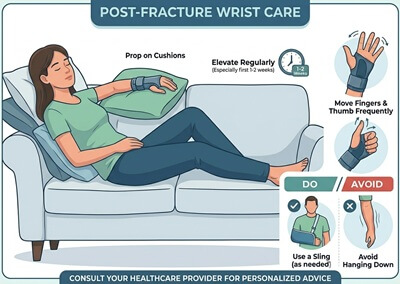
Persistent swelling is one of the biggest causes of long-term stiffness. What to do:
- Elevate regularly (especially first 1–2 weeks)
- Move your fingers and thumb frequently
- Avoid letting your arm hang down – use a sling
or prop the arm up on cushions
2. Maintain Movement Wherever You Can
Even if your wrist is immobilised, everything else should keep moving. Focus on:
- Fingers: full range bending and straightening
- Thumb mobility
- Elbow bending and straightening
- Shoulder movement
This prevents “secondary stiffness”, something that often delays recovery time for broken wrist more than the fracture itself.
3. Respect Pain - But Don’t Fear Movement
Pain is normal, but it should not completely stop you moving. Use this rule:
- Mild discomfort = OK
- Sharp or worsening pain = ease off
Overprotecting the wrist can lead to more stiffness and slower recovery
4. Start Rehab As Early As Is Safe
This is one of the most important broken wrist recovery tips. As soon as your clinician allows:
- Begin gentle wrist movements
- Focus on control, not force
Early movement helps “retrain” the joint and prevents long-term restriction. We lose strength and flexibility much quicker than we regain it so it is important to get going as soon as it is safe to do so.
5. Prioritise Movement Before Strength
A common mistake is jumping straight into strengthening, but if the joint is stiff:
- Strength won’t return properly
- Movement patterns become compensatory
First restore range of motion, then build strength.
6. Use “Little and Often” Rehab
This is far more effective than one long session. Ideal approach:
- 3–5 short sessions per day
- 5–10 minutes each
- Consistent, gentle repetition
This improves circulation and reduces stiffness without overloading the wrist.
7. Gradually Reload The Wrist
Your wrist needs load to recover, but it has to be progressive. Progression example:
- Light daily tasks e.g. holding a cup
- Weight-bearing through hands e.g. leaning
- Resistance exercises
- Impact/loading activities
Rushing this stage is a common cause of setbacks.
8. Rebuild Grip Strength Early

Grip strength loss is often underestimated.
Even after healing, weak grip can persist for months, affecting overall function so:
- Use putty or a ball
Early grip work speeds up broken wrist recovery significantly.
9. Optimise Nutrition & Lifestyle
Bone healing is metabolically demanding. Key factors:
- Good Nutrition: Protein, calcium and vitamin D all help tissue repair
- Sleep Quality: critical for healing
- Avoid Smoking: as it delays healing
Poor nutrition can quietly prolong wrist fracture recovery time.
10. Avoid These Common Recovery Mistakes
These are the biggest things I see delaying broken wrist recovery:
- Keeping the wrist completely still for too long
- Skipping rehab exercises
- Doing too much too soon
- Ignoring swelling
- Not regaining full movement
Broken Wrist Recovery Exercises
The right broken wrist recovery exercises will restore movement, strength and function. But timing and progression are key.
For each exercise, do 10-15 repetitions, 3-5 times a day and keep movements smooth and controlled.
Phase 1: Cast/Splint
Even though your wrist is immobilised, the rest of your arm should stay active. This helps maintain circulation, reduces swelling and can actually improve your overall broken wrist recovery time.
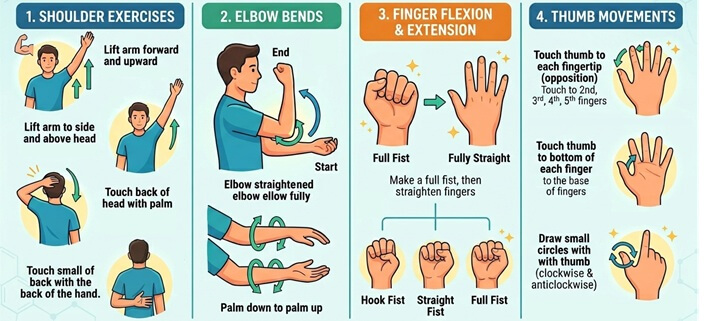
1. Shoulder Exercises
- Lift your arm forwards and upwards, as high as comfortable
- Lift your arm out to the side and up above your head
- Touch the back of your head with the pam of your hand,
- Touch the small of your back with the back of your hand
2. Elbow Bends
- Bend and straighten your elbow fully
3. Finger Flexion & Extension
- Make a full fist, then fully straighten your fingers
- Move through different finger positions (hook fist, straight fist, full fist)
4. Thumb Movements
- Touch your thumb to each fingertip in turn (opposition)
- Touch your thumb to the bottom of each finger in turn
- Draw small circles with your thumb, clockwise and anticlockwise
The thumb contributes hugely to grip strength, so don’t neglect it.
Phase 2: Early Movement
Once you are out of the cast, the focus here is regaining mobility and joint reactivation.
1. Wrist Flexion & Extension
- Bend wrist forward and back
- Stay within a comfortable range
2. Forearm Rotation (Pronation/Supination)
- Turn palm up and down
- Keep elbow tucked in
Phase 3: Mobility + Early Strength
The focus here is improving range and introducing load.
1. Assisted Wrist Stretching
- Use other hand to gently increase range in all directions (flexion, extension, pronation, supination, radial and ulnar deviation)
- Hold 20–30 seconds
2. Grip Strengthening
- Ball squeezes or therapy putty
3. Isometric Exercises
- Push against resistance without moving the wrist
Phase 4: Strength & Function
The main focus now is restoring full use of the wrist so you can return to all your usual activities.
1. Resistance Band Exercises
- Flexion, extension, deviation, pronation and supination
- Start light and progress
2. Weight-Bearing Exercises
- Leaning on hands e.g. table or wall
- Progress to full weight-bearing
3. Functional Tasks
- Carrying objects
- Pushing/pulling movements
- Sport-specific drills, if relevant
The key with all broken wrist recovery exercises is progression, not intensity.
When Can I Use My Wrist Again?
One of the most common questions around broken wrist recovery tips is “when can I get back to normal?”
The answer depends on healing, strength and confidence, not just time. Here is a realistic guide to help you understand your wrist fracture recovery time in terms of everyday activities:
1. Typing & Desk Work
- Often possible within 2–6 weeks depending on pain and mobility
- Start with short periods and build up gradually
2. Driving
- Usually safe around 6–8 weeks
- You must be able to grip the wheel comfortably and react quickly
- Always check with your doctor and insurance provider
3. Lifting & Carrying
- Light lifting: e.g. kettle, small bag 6–8 weeks
- Heavier lifting: 10–12+ weeks
- Progress gradually to avoid setbacks
4. Weight-Bearing e.g. pushing up from a chair
- Usually begins around 8–10 weeks
- Start gently and increase load over time
5. Sports & High-Impact Activities
- Non-Contact Sports: around 8–12 weeks
- Contact Sports: 3–6 months. Only return when strength and movement are fully restored
A good rule of thumb: if an activity causes sharp pain or increased swelling afterwards, your wrist isn’t quite ready yet.
Top Tip: Even if your bone has healed, your wrist may still be weak and stiff. The key to speeding up broken wrist recovery time is gradually reintroducing activities, not rushing straight back to full use.
Why Your Wrist Still Feels Stiff After Healing
This is one of the most common concerns during broken wrist recovery. Even after the bone heals:
- Joint capsule tightness remains
- Muscles weaken and shorten
- Swelling may persist
Without proper rehab, wrist stiffness can last months or even years. This is usually due to soft tissue tightness rather than the bone itself.
Possible Complications
- Persistent stiffness
- Chronic pain
- Reduced grip strength
- Malunion (bone heals poorly or in wrong position)
- Post-traumatic arthritis
When To Seek Medical Advice
While most people recover well following a fractured wrist, watch out for:
- Severe or increasing pain
- Pins and needles or numbness
- Excessive swelling that doesn’t settle
- Very limited movement after several weeks
- Signs of complications (e.g. deformity, instability)
Types of Wrist Fractures
Not all wrist fractures are the same and the type of fracture can affect your broken wrist recovery time.
- Distal Radius Fracture: most common, affecting the end of the radius (thumb side)
- Colles Fracture: bone tilts backwards, causing a visible “dinner fork” shape
- Smith’s Fracture: bone tilts forwards, usually from a fall onto a bent wrist
- Barton Fracture: corner of the distal radius breaks off
- Scaphoid Fracture: small bone on the thumb side, heals slowly due to poor blood supply
- Ulna Fracture: a break in the smaller forearm bone (pinky side)

More complex fractures tend to be intra-articular, where the break extends into the joint, and/or comminuted, where the bone breaks into multiple pieces
The more complex the fracture, the longer the recovery time for broken wrist.
Why Recovery Times Vary
In clinic, I see huge variation in wrist fracture recovery time, often due to:
- Type Of Fracture: e.g. simple vs displaced vs comminuted
- Surgical Vs Non-Surgical treatment
- Joint Involvement: intra-articular fractures take longer
- Age: healing slows with age
- Activity Levels: too little or too much both cause problems
One of the biggest myths is that once the cast comes off, you are “healed”. In reality, that’s just the start of functional recovery.
How To Speed Up Broken Wrist Recovery (Key Takeaways)
If you want to optimise your broken wrist recovery time, focus on:
- Early controlled movement
- Consistency with rehab exercises
- Gradual progression of load
- Managing swelling effectively
- Supporting healing with nutrition and sleep
The difference between a “good” recovery and a “great” one almost always comes down to rehab consistency, so follow out broken wrist recovery tips.
FAQ’s On Broken Wrist Recovery Tips
Here you will find answers to the most frequently asked questions about broken wrist recovery tips:
1. What
Is The Fastest Way To Recover From A Broken Wrist?
1. What Is The Fastest Way To Recover From A Broken Wrist?
The fastest way to recover is through early controlled movement, consistent rehab exercises and gradual progression of activity. Managing swelling, maintaining mobility and following a structured rehab plan all help speed up recovery time for broken wrist.
2. How Long Does Stiffness Last After A Broken Wrist?
2. How Long Does Stiffness Last After A Broken Wrist?
Stiffness can last anywhere from a few weeks to several months after a broken wrist. In some cases, mild stiffness may persist for up to a year. Regular exercises and stretching are key to restoring full movement and reducing long-term stiffness.
3. Do I Need Physical Therapy After A Broken Wrist?
3. Do I Need Physical Therapy After A Broken Wrist?
Physical therapy is often recommended, especially if you have stiffness, weakness or reduced function after your cast is removed. A structured rehab programme can help restore movement, strength and confidence more effectively than exercises alone.
4. What Happens If You Don’t Exercise A Broken Wrist?
4. What Happens If You Don’t Exercise A Broken Wrist?
If you don’t exercise your wrist after a fracture, it can become stiff, weak and difficult to use. This can lead to long-term loss of movement and function. Rehab exercises are essential for a full recovery and should be done regularly once advised.
5. Can A Broken Wrist Heal Without A Cast?
5. Can A Broken Wrist Heal Without A Cast?
Yes, some minor or stable fractures can heal without a full cast, often using a splint instead. However, most broken wrists do require some form of immobilisation to ensure proper healing and alignment. Always follow medical advice, as untreated fractures can heal incorrectly.
6. Should I Wear A Brace After My Cast Is Removed?
6. Should I Wear A Brace After My Cast Is Removed?
Yes, a wrist brace is often helpful after cast removal, especially in the early stages. It provides support, reduces discomfort and helps you gradually return to normal activities. However, it shouldn’t be worn all the time, as your wrist needs movement to regain strength and flexibility.
7. What Foods Help A Broken Wrist Heal Faster?
7. What Foods Help A Broken Wrist Heal Faster?
Foods rich in protein, calcium and vitamin D help support bone healing. Good options include dairy products, leafy greens, fish, eggs and lean meats. A balanced diet and adequate calorie intake are essential, as poor nutrition can slow down broken wrist recovery.
8. How Do I Know If My
Wrist Has Healed Properly?
8. How Do I Know If My Wrist Has Healed Properly?
A wrist has usually healed properly when pain has settled, movement has returned and strength is improving. You should be able to use your wrist for daily activities without significant discomfort. Medical confirmation is typically done with follow-up X-rays if needed.
A typical broken wrist recovery timeline is:
- Week 1–2: swelling & pain management
- Week 3–6: bone healing & protection
- Week 6–12: movement returns
- Month 3–6: strength & function improve
Broken Wrist Recovery Tips Summary
Recovering from a wrist fracture takes time but with the right approach, you can significantly improve your outcome.
Key Points:
- Most recovery time for broken wrist is 6–12 weeks for basic function
- Full recovery typically takes 3–6 months
- Mobility should be restored before strength
- Rehab exercises are essential, not optional
- Consistency is the biggest predictor of success
You may also be interested in the following articles:
- Carpal Tunnel Syndrome
- De Quervain Tenosynovitis
- Wrist Lumps & Bumps
- Trigger Finger
- Forearm Pain
- Pain In Back Of Hand
Related Articles
Wrist Diagnosis
May 12th, 2026
Shoulder Diagnosis
February 25th, 2026
Elbow Diagnosis
February 26, 2026
Page Last Updated: March 25th, 2026
Next Review Due: March 25th, 2028

Visitor Comments
"Such an informative and valuable site. Clearly written and matches the guidance from my orthopedic surgeon. Even offers many rehab exercises. Thank you very much!" Izabela
"I am a massage therapist and found your website perfect. Very useful. Clear, easy understand. Big help. Thank you!" Viktoria
"This is a great site. Very informative" Marilyn
"I benefited a lot from your distinguished work, thank you." Sayed
"Hi
and thanks so much, great site! You
are doing a lot of good in the world with this helpful site, thanks again." Karen
The material on this website is intended for educational information purposes only. It should not delay or substitute medical advice, diagnosis or treatment. See our T&C's
Shoulder-Pain-Explained.com is a trading name of Wilson Health Ltd. All rights reserved. Terms & Conditions apply
© shoulder-pain-explained.com 2015-26 Last updated 15th June 2026
Contact Us About Us Blog Privacy Policy Advertising Policy Sitemap
