- Home
- Hand Pain Diagram
- Hand Lumps
Lump On Hand
Written By: Chloe Wilson BSc (Hons) Physiotherapy
Reviewed By: SPE Medical Review Board

A lump on the hand is a really common problem that can occur anywhere in the hand.
Because the hand is a complex structure, lumps can arise from various tissues including joints, tendons, skin, bone, or blood vessels.
Whilst most hand lumps are completely benign (non-cancerous), understanding their location, texture, and accompanying symptoms give the best clues to the underlying cause.
The most common cause of a lump on the hand is a ganglion cyst, a benign fluid-filled swelling that develops from a joint or tendon sheath. Other common causes include Dupuytren's disease, carpal boss, osteoarthritis, trigger finger and epidermoid cysts.
This guide breaks down the most common causes of hand lumps by location and symptoms, and explains when they may need assessment.
Quick Guide: What A Lump On Hand Usually Means
- Soft / Moveable Lump: ganglion cyst or lipoma
- Hard Lump: bone spur, arthritis, Dupuytren’s
- Painful Lump: infection, gout, tendon tumour, inflammation
- Skin Lump: wart, cyst, dermatofibroma
- Vein Lump: thrombophlebitis or venous change
Most lumps are benign, but persistent or growing lumps should be assessed.
Lump On Hand By Location
1. Lump In Palm Of Hand
Palm lumps are usually due to tendon sheath or fascial thickening in the gripping side of the hand.
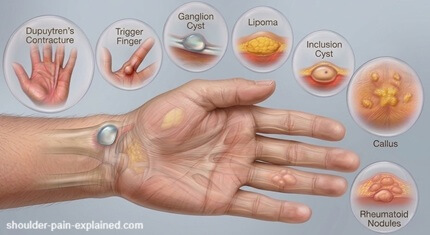
- Dupuytren’s Disease: firm nodules in palm fascia causing finger bending, esp ring and little finger
- Ganglion Cyst: soft, rubbery fluid-filled lump from tendon or joint
- Trigger Finger: flexor tendon thickening at finger base causing clicking/locking
- Giant Cell Tumour Of Tendon Sheath: firm slow-growing lump in tendon sheath
- Foreign Body Granuloma: inflammatory reaction to retained material e.g. splinter after injury
Palmar lumps are often firm, affect grip strength and hand function, and may change size over time. Find out more in the Lump In Palm Of Hand article.
2. Lump On Back Of Hand
Dorsal masses are highly visible and frequently interact with the extensor tendons or carpometacarpal joints.

- Ganglion Cyst: most common dorsal lump (60-70% cases), fluid-filled and variable size
- Carpal Boss: hard fixed bony lump at base of index/middle finger
- Osteoarthritis: bony enlargement from joint wear and spur formation
- Epidermoid Cyst: firm round skin/subcutaneous lump of trapped keratin skin cells with dark central pore
Back of hand lumps are often more visible with wrist extension or loading. Find out more in the Lump On Back Of Hand article.
3. Lump On Side Of Hand
Side of hand lumps usually involve joints or tendons along the thumb (radial) or little finger (ulnar) side.
- Thumb CMC Osteoarthritis: hard bony lump at the thumb base from degeneration
- Pisotriquetral Ganglion: fluid-filled cyst on ulnar side wrist
- ECU Tendon Sheath Ganglion: ganglion along the ulnar border of the wrist
- Gout Tophus: firm uric acid crystals around joints in chronic gout
- Collateral Ligament Thickening: firm lump in hand from chronic strain or previous injury
Lumps on the side of the hand are often linked with gripping or wrist loading and may become more noticeable during functional use of the hand.
4. Lump In Fingers
Because the fingers contain tightly confined anatomical compartments, even tiny finger lumps can rapidly restrict range of motion.
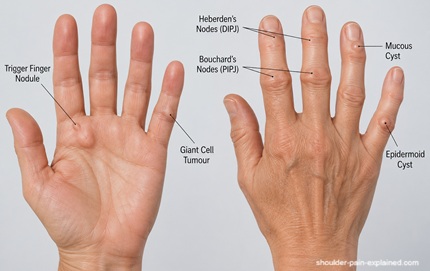
- Trigger Finger Nodule: thickened flexor tendon causing clicking/locking
- Epidermoid Cyst: firm, round skin or subcutaneous lump
- Heberden’s Nodes: hard bony enlargement at end finger joints (DIPJ)
- Bouchard’s Nodes: bony enlargement at middle finger joints (PIPJ)
- Mucous Cyst: translucent, fluid-filled lump near nail, linked with osteoarthritis
- Giant Cell Tumour: of tendon sheath, firm, fixed solid lump along finger tendons, often fixed and slow-growing
Finger lumps are often noticed early because even small lesions affect movement. Find out more in the Lump On Finger section.
Lump On Hand By Symptoms
Many types of hand lumps can develop in multiple places so it can be helpful to think about the specific symptoms associated with the lump on hand when trying to work out what is causing them.
1. Big Lump On Hand
A large lump on the hand usually reflects slow-growing benign mass or fluid collection.
- Ganglion Cyst: fluid-filled swelling, typically 1–3 cm but can occasionally exceed 5 cm
- Lipoma: benign fatty lump that grows slowly under the skin, usually 2–5 cm but sometimes larger Abscess: painful collection of pus caused by infection, typically ranging from 1–5 cm depending on severity and spread of infection.
- Gout Tophi: firm deposits of uric acid crystals, usually 1–3 cm but can become much larger in chronic gout.
- Soft Tissue Tumour: general term for abnormal growths in fat, muscle, or connective tissue, varying widely from a few centimetres to over 5 cm. Usually benign but may be malignant.
The size of a hand lump usually reflects duration, not severity.
2. Hard Lump On Hand
Hard lumps usually come from bone, joint degeneration or calcification and are typically fixed and non-compressible.
- Carpal Boss: hard, bony lump from bony overgrowth at the base of the index or middle finger
- Osteoarthritis: bony enlargement and spur formation due to joint degeneration, often producing hard nodules
- Gout Tophi: hard deposits of uric acid crystals around joints or tendons, irregular and rock-like
- Tumour (benign or malignant): abnormal growths arising from bone or soft tissue, which may feel hard if involves bone or calcified tissue.
- Dupuytren’s Nodule: firm fibrous thickening in the palmar fascia, can cause permanent finger flexion
A hard lump on the hand is usually immobile and non-compressible from structural or degenerative changes rather than fluid or infection.
3. Painful Lump On Hand
Many hand lumps are completely painless but they may start causing problems if there is inflammation, infection, or soft tissue irritation.
- Paronychia: nail fold infection causing a painful, swollen lump at the side of the fingernail, often associated with redness, heat, and sometimes visible pus.
- Inflamed Cyst: previously painless cyst becomes red, swollen, and tender when irritated or inflamed, often increasing in size
- Abscess: collection of pus from infection, typically presenting as a rapidly developing, hot, red, and very painful lump that may throb and worsen over time.
- Gout: uric acid crystal deposits around joints become acutely painful, swollen, and extremely tender
- Foreign Body Granuloma: chronic inflammatory lump forms around a retained splinter, glass or other material, which can become painful when pressed or during hand use
- Giant Cell Tumour: firm benign growth from the tendon lining, painful during gripping and hand use
Pain from a lump in the hand usually indicates active irritation.
4. Lump Under Skin On Hand
Lumps under the skin arise from cysts, growths or fibrous nodules sitting beneath normal skin (dermis) rather than surface skin changes.
- Ganglion Cyst: fluid-filled firm/rubbery swelling under the skin
- Dupuytren’s Nodule: firm fibrous thickening in the palmar fascia under the skin
- Giant Cell Tumour Of Tendon Sheath: firm, solid growth arising from the tendon lining, often fixed in position
- Epidermoid Cyst: slow-growing lump of trapped skin cells beneath the skin
- Foreign Body Granuloma: localised inflammatory reaction to a retained splinter or other material, forming a firm lump beneath the skin
- Lipoma: benign fatty lump in hand that sits under the skin, typically soft, mobile, and painless
A lump under the skin on the hand is usually slow-growing and benign.
5. Skin Lumps On Hand
Lumps on the skin of the hand rather than underneath the skin originate from the epidermis or dermis rather than deeper structures.
- Warts: rough, firm skin growth caused by the human papillomavirus (HPV), may contain small black dots
- Callus: thickened area of skin from repeated friction or pressure, typically hard, flat and yellowish
- Epidermoid Cyst: slow-growing lump of trapped skin cells, typically firm and round with dark central pore
- Dermatofibroma: benign fibrous skin nodule that feels firm and slightly raised, often darker in colour and may dimple inward when squeezed
- Pyogenic Granuloma: rapidly growing, red, vascular skin lump that bleeds easily with minor contact
- Skin Tags: soft, flesh-coloured growths attached by a small stalk, usually painless
- Skin Cancer: abnormal growth of skin cells that may present as a persistent, enlarging, or non-healing lump, sometimes with bleeding, crusting or colour change
Skin lumps on the hand are usually benign and visible on the surface rather than felt deep under the skin.
6. Lump In Vein On Hand
A vein lump in hand is usually due to superficial venous changes or vascular abnormalities affecting blood flow or vein structure.
- Superficial Thrombophlebitis: inflammation and partial clotting of a superficial vein, causing a firm, tender, cord-like lump along the course of the vein
- Post-Cannulation Vein Thickening: small firm lump or cord along a vein following an IV cannula or needle insertion, caused by local irritation and healing of the vein wall
- Venous Varix: localised vein dilatation forms a soft lump, often becoming more prominent when the hand is lowered and reducing when elevated
- Haemangioma: benign vascular growth made up of blood vessels, typically red or bluish lump in or under the skin that may feel soft or spongy
- Venous Malformation: congenital cluster of abnormally formed veins that presents as a soft, bluish, compressible lump
Most vein lumps in hand are benign vascular conditions.
When To See A Doctor
Most hand lumps are benign, but prompt assessment is important if there is:
- Rapid Growth: The mass is visibly increasing in size over a matter of days or weeks
- Neurological Symptoms: Associated numbness, sharp electric pain, shooting sensations, or tingling in the fingers
- Skin Changes: Ulceration, skin breakdown, bleeding, or unusual color changes over the surface of the lump on hand
- Significant Size: Any soft-tissue mass that measures greater than 5 cm in diameter
- Loss Of Function: Inability to fully open, close, or grip objects with your hand
- Immobility & Depth: A rock-hard lump that is deeply fixed to underlying bone or muscle tissue
Treatment For Lump In Hand
Treatment depends on the underlying cause and whether the lump is fluid-filled, solid, bony, or inflammatory and the functional impact on your daily life.
1. Conservative Management

- Observation: wait and watch, especially ganglion cysts and lipomas
- Activity Modification: avoid aggravating activities e.g. heavy gripping or high-impact wrist loading to reduce irritation
- Splinting: Targeted wrist or finger splints temporarily immobilize the area allowing localized tendon or joint inflammation to subside
- Pain Relief: Analgesia if required
Many benign lumps on hand are simply monitored unless they grow or become painful.
2. Interventional Treatment
- Aspiration: fluid is drained from a cyst with a sterile, high-gauge needle
- Steroid Injection: administered locally to reduce pain and inflammation
- Antibiotics/Drainage: if there is an infection
- Surgical Excision: removal of persistent cysts, giant cell tumours, carpal boss, Dupuytren's contracture or other symptomatic masses
These treatments are usually considered when symptoms are interfering with function.
Quick Way To Identify A Lump On The Hand
Most hand lumps can be narrowed down by looking at how they feel, where they are, and what symptoms they cause. This can often give a strong clue to the underlying cause before any imaging or medical assessment.
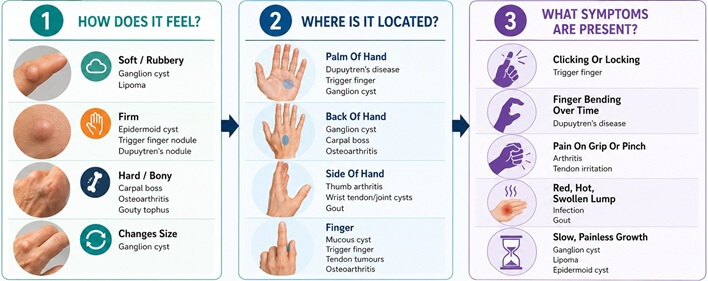
Step 1: How Does It Feel?
- Soft or rubbery: usually a ganglion cyst or lipoma
- Firm: often epidermoid cyst, trigger finger nodule, or Dupuytren’s nodule
- Hard or bony: carpal boss, arthritis, or gouty tophus
- Fluctuating in size: most commonly a ganglion cyst
Step 2: Where Is It Located?
- Palm Of Hand: Dupuytren’s disease, trigger finger, ganglion cyst
- Back Of Hand: ganglion cyst, carpal boss, osteoarthritis
- Side Of Hand: thumb arthritis, wrist tendon or joint cysts, gout
- Finger: mucous cyst, trigger finger, tendon tumours, osteoarthritis
Step 3: What Symptoms Are Present?
- Clicking or Locking: trigger finger
- Finger Bending Over Time: Dupuytren’s disease
- Pain On Grip Or Pinch: arthritis or tendon irritation
- Red, Hot, Swollen Lump: infection or gout
- Slow, Painless Growth: ganglion cyst, lipoma, epidermoid cyst
Lump On Hand Summary
A lump on the hand can arise from many different structures including skin, cysts, tendons, joints, bone, or blood vessels. The most useful way to understand it is by combining location, consistency, and symptoms rather than relying on appearance alone.
In most cases, the cause is benign and falls into a small group of common conditions such as ganglion cysts, Dupuytren’s disease, carpal boss, or tendon-related lumps.
However a persistent, painful, or rapidly growing lump in hand should always be assessed to confirm the diagnosis.
You may also be interested in the following articles:
- Lump In Wrist
- Hand Pain Diagnosis Chart
- Finger Pain
- Pain In Palm Of Hand
- Pain In Back Of Hand
- Pain In The Thumb
- Pain From Shoulder To Hand
Related Articles
Shoulder Diagnosis
February 25th, 2026
Wrist Diagnosis
May 12th, 2026
Elbow Diagnosis
February 26, 2026
Page Last Updated: June 15th, 2026
Next Review Due: June 15th, 2028

Visitor Comments
"Such an informative and valuable site. Clearly written and matches the guidance from my orthopedic surgeon. Even offers many rehab exercises. Thank you very much!" Izabela
"I am a massage therapist and found your website perfect. Very useful. Clear, easy understand. Big help. Thank you!" Viktoria
"This is a great site. Very informative" Marilyn
"I benefited a lot from your distinguished work, thank you." Sayed
"Hi
and thanks so much, great site! You
are doing a lot of good in the world with this helpful site, thanks again." Karen
The material on this website is intended for educational information purposes only. It should not delay or substitute medical advice, diagnosis or treatment. See our T&C's
Shoulder-Pain-Explained.com is a trading name of Wilson Health Ltd. All rights reserved. Terms & Conditions apply
© shoulder-pain-explained.com 2015-26 Last updated 15th June 2026
Contact Us About Us Blog Privacy Policy Advertising Policy Sitemap
