- Home
- Hand Pain Diagram
- Hand Lumps
- Lump On Finger
Lump On Finger
Written By: Chloe Wilson BSc (Hons) Physiotherapy
Reviewed By: SPE Medical Review Board

Finding a lump on your finger can be worrying, especially if it appears suddenly or starts changing in size or shape.
The good news is that in most cases they are completely harmless.
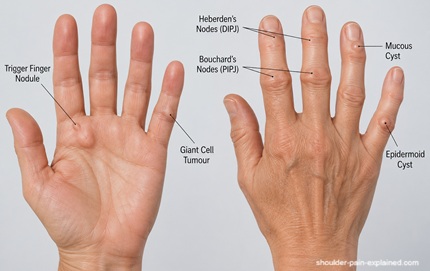
The most common cause of a finger lump is a mucous cyst (ganglion cyst), a small fluid-filled swelling that typically develops near the fingertip or nail.
The location, appearance and feel of the lump often provide important clues. For instance, a hard lump on finger joints may be linked with arthritis, while a lump on finger under skin might develop from the skin, tendons or surrounding soft tissues.
This guide will help you identify the most common causes of finger bumps, understand what symptoms to look out for, help you narrow down the possible diagnosis and understand when to seek medical advice.
What Does A Lump On Finger Mean?
A lump or bump on the finger usually refers to a small area of swelling or thickening in the skin, joint, tendon or deeper soft tissues. In most cases, it is caused by a benign condition such as a cyst, arthritis change or skin thickening rather than anything serious.

Should I Worry About A Lump On My Finger?
Most finger lumps are not dangerous and often develop slowly over time. However, you should be more cautious if the lump is rapidly growing, painful, red, hot, or affecting finger movement or nail shape, as these features may suggest infection or another condition that needs assessment.
Common Causes Of Finger Lumps
Most lumps on the finger are caused by a relatively small number of conditions. These are the causes that doctors most commonly consider first.
1. Mucous Cyst (Ganglion Cyst)

A mucous cyst is one of the most common causes of a finger lump, particularly in middle-aged and older adults.
These small cysts are a type of ganglion cyst that develop from the finger joint and contain thick, jelly-like fluid.
They almost always occur close to the end finger joint (DIP joint), which means they frequently appear beside or just below the nail.
Many people first notice a mucous cyst because of how it looks rather than because of pain. It often appears as a smooth rounded bump that slowly becomes more noticeable.
Typical features of a mucous cyst include:
- smooth, rounded appearance
- soft or slightly firm feel
- may change in size
- often appears near the nail
- can cause finger bumps with fluid
Because the cyst develops so close to the nail, pressure on the nail matrix can sometimes lead to ridging or distortion of the nail.
Mucous cysts are commonly associated with mild wear-and-tear changes within the nearby joint and often develop alongside early arthritis.
Find Out More: Ganglion Cysts
2. Arthritis Nodules

If you develop a hard lump on finger, particularly over a joint, arthritis becomes one of the most likely explanations.
Arthritis-related finger swellings tend to develop gradually and may affect one joint or several joints over time.
Unlike cysts, these lumps are often firmer and may develop alongside stiffness.
a. Heberden's Nodes
Heberden's nodes develop at the end finger joints, the DIP.
These hard enlargements occur as part of osteoarthritis and often become more noticeable over time. Some people develop them with very little discomfort, while others experience periods of aching and stiffness.
They are one of the most common causes of a visible finger knuckle bump.
b. Bouchard's Nodes
Bouchard's nodes affect the middle finger joints, the PIP
They tend to create more visible swelling and may interfere with grip and finger movement more than Heberden's nodes.
c. Rheumatoid Nodules
Rheumatoid nodules behave slightly differently. Rather than forming directly from the joint, they develop beneath the skin and often feel smoother and more rounded.
People with rheumatoid nodules may notice:
- firm of “doughy” nodules beneath the skin
- multiple affected fingers
- swelling and inflammation
- episodes of finger nodule pain
Arthritis nodules usually develop gradually rather than appearing suddenly and typically affect people with fairly advanced rheumatoid arthritis – nodules are rarely the first sign of disease.
3. Epidermoid Cyst

An epidermoid cyst, aka epidermal inclusion cyst, develops when surface skin cells become trapped beneath the skin and continue to multiply.
Over time this creates a small sac filled with keratin, which gradually enlarges and forms a lump.
Epidermoid cysts are one of the more common explanations for a lump on finger under skin.
People often describe epidermoid cysts as:
- smooth and rounded
- slightly firm
- painless
- slow growing
Many people initially mistake them for a ganglion cyst because they also create a visible lump, but epidermoid cysts are usually more solid and less likely to fluctuate in size.
They often develop after minor trauma such as previous cuts, puncture wounds or repetitive irritation. A deep finger lump under the skin that has slowly enlarged over months may fit this pattern.
4. Giant Cell Tumour Of Tendon Sheath
Despite the name, giant cell tumours are usually benign and are one of the more common solid lumps found in the fingers.
They develop from tissue surrounding the tendon sheath and typically grow slowly over time. Unlike a cyst, these lumps tend to feel firmer and are often less mobile.
People commonly describe them as:
- firm and smooth
- fixed beneath the skin
- painless initially
- slowly enlarging
Depending on their size and location, they may eventually cause discomfort or interfere with finger movement. Because they sit deeper than skin-related lumps, they often feel different when pressed.
5. Calluses
Calluses are areas of thickened skin that develop in response to repeated friction or pressure.
Although they are not true finger lumps, they are a very common reason people notice a raised area on the skin.
Calluses most commonly develop in people who:
- use tools regularly
- lift weights
- play racquet sports
- perform repetitive gripping tasks
They usually appear as firm, slightly rough areas of thickened skin rather than deeper lumps beneath the surface. If a callus develops over a finger joint, it may resemble a finger knuckle bump or even a small nodule.
Unlike most other causes in this guide, calluses affect the surface layers of skin rather than deeper tissues.
Less Common Causes Of Finger Lumps
Although most finger swellings are caused by cysts, arthritis or thickened skin, there are several less common conditions that may occasionally be responsible.
These causes often have additional features such as redness, skin changes, rapid onset or more widespread symptoms that help distinguish them from the more common conditions above.
1. Infection
Infections can sometimes cause swelling that resembles a finger bump, but they usually develop more quickly and are more likely to be painful.
Examples of finger swelling from infection include:
- Paronychia: infection around the edge of the nail causing swelling, tenderness and sometimes pus
- Cellulitis: a deeper skin infection that causes more widespread redness and swelling
- Herpetic Whitlow: a viral infection causing painful clusters of small fluid-filled blisters
- Felon: an infection of the fingertip pad that causes severe throbbing pain and swelling
If a lump on the finger becomes increasingly red, warm or painful over a short period, infection becomes more likely.
2. Warts
Warts are rough raised skin growths caused by viral infection.
They commonly develop on or around the fingers and may occasionally resemble a small finger bump, particularly near the nail. Unlike cysts, warts affect the surface layers of skin and usually have a rough texture.
3. Tumors (Benign & Cancerous)
Tumors are an uncommon cause of finger swellings.
Most are benign and grow slowly over time, but occasionally a lump may need further assessment, particularly if it changes rapidly, bleeds or continues enlarging.
Although cancer is uncommon, persistent or unusual lumps should always be checked.
4. Gout
Long-standing gout can occasionally lead to firm nodules called tophi developing around the finger joints.
These lumps are caused by uric acid crystal deposits and are more likely in people with a history of repeated gout attacks.
5. Lipoma
Lipomas are soft fatty growths beneath the skin.
They are uncommon in the fingers but can occasionally cause a soft, slow-growing lump in finger under skin.
6. Skin Bumps
Some skin conditions may create raised areas that resemble a digital lump without forming a true mass.
Examples include eczema, scabies and insect bites. These conditions usually affect the surface layers of skin and are more commonly associated with irritation, itching or skin changes than deeper swelling.
When To See A Doctor
Most finger bumps are harmless and do not require urgent treatment, but certain features should prompt assessment.
Seek medical advice if your finger lump:
- grows rapidly
- becomes increasingly painful
- turns red or hot
- causes numbness
- affects movement
- changes the appearance of the nail
- bleeds or does not heal
Persistent symptoms are often worth checking even if the lump itself is painless.
Differential Diagnosis: What Your Finger Lump Might Be
Finger lumps are often easier to understand by focusing on how they feel rather than their medical name. The table below groups the most likely causes based on texture, appearance and pattern.
| What It Feels Like | Likely Cause of Finger Lump | Where Finger Lump is Located |
|---|---|---|
| Soft and squishy (may change size) | Mucous cyst / early ganglion cyst | Near the nail or fingertip |
| Rubbery or firm (slow growing) | Epidermoid Cyst / Lipoma | Moving under the skin |
| Hard, bony and fixed | Arthritis nodules (Heberden's, Bouchard's, RA nodules) | Directly over finger joints |
| Painful, hot and rapid | Infection / Acute Gout flare | Anywhere on finger |
| Firm, smooth and deep | Giant cell tumour of tendon sheath | Along tendon or side of finger |
| Raised or thickened skin | Wart / Callus | Surface layer of the skin |
How To Treat Lumps On Fingers
Treatment for a finger mass depends on the underlying cause, but in many cases no active treatment is needed unless the lump is painful, growing or affecting hand function.
1. Self-Management
For many harmless finger lumps, simple measures are often enough:
- Monitor: for changes in size, pain or appearance
- Avoid Repeated Pressure: or irritation
- Protect The Area: if sore e.g. padded dressing, gel finger sleeve, or avoiding direct pressure when gripping
- Keep The Skin Clean: and avoiding picking or trauma
SAFETY ADVICE: DO NOT attempt to “pop” any finger lumps, especially mucous cysts as they connect directly to the joint space so there is a high risk of bacterial infection
2. Medical Treatment
When treatment is needed, it is aimed at the underlying cause rather than the lump itself:
- Pain Relief: or anti-inflammatory medication for discomfort or swelling
- Antibiotics: for bacterial infections e.g. paronychia or cellulitis
- Anti-Inflammatories: or urate-lowering treatment in cases of gout
- Targeted Treatment: of inflammatory or skin-related conditions if contributing
3. Minor Procedures
Some lumps on the finger may require a simple procedure if they persist, recur or cause significant symptoms:
- Aspiration: draining fluid from cysts such as mucous or ganglion cysts
- Surgical Excision: Removal of persistent or bothersome lumps such as epidermoid cysts or giant cell tumors
- Nail-Related Procedures: if a mucous cyst or other lesion is affecting nail shape or growth
4. Physical Therapy
If stiffness or reduced movement develops, physical therapy may help improve finger mobility and function, particularly in cases linked with arthritis.
Frequently Asked Questions
1. Can a lump on my finger go away on its
own?
1. Can a lump on my finger go away on its own?
It depends entirely on the cause. Ganglion and mucous cysts sometimes fluctuate in size and can occasionally disappear spontaneously if the fluid is naturally reabsorbed by the body. Calluses will fade if you remove the source of friction.
However, solid masses like giant cell tumors, epidermoid cysts, or bony arthritis nodules will not disappear on their own and typically require medical evaluation if they become bothersome.
2. Why
does the lump on my finger hurt when I press it?
2. Why does the lump on my finger hurt when I press it?
Tenderness usually indicates inflammation, pressure on a nerve, or an active infection. Bony arthritis nodules may ache during periods of joint inflammation, while fluid-filled cysts can become painful if they expand rapidly and stretch the surrounding tissue.
If the lump is hot, red, and intensely throbbing, it is highly likely a sign of a digital infection requiring prompt medical treatment.
3. Is
it safe to pop a fluid-filled bump on my finger?
3. Is it safe to pop a fluid-filled bump on my finger?
No, you should never attempt to pop or needle a finger lump at home. This is especially dangerous for mucous cysts, which connect directly to the underlying joint capsule. Piercing the skin introduces bacteria into the deep spaces of the finger, which can result in severe, deep-tissue infections or septic arthritis (joint infection) that may cause permanent joint damage.
4. Can
a lump under the skin of a finger turn out to be cancer?
4. Can a lump under the skin of a finger turn out to be cancer?
While it is understandable to worry, malignant (cancerous) tumors of the finger are exceptionally rare. The vast majority of solid or fluid-filled digital growths are completely benign, such as cysts, calluses, or benign giant cell tumors.
However, any new lump that grows rapidly, bleeds, causes unexplained numbness, or looks ulcerated should be evaluated by a healthcare professional immediately to rule out anything serious.
Lump On Finger Summary
A lump on finger is usually caused by a benign condition such as a cyst, arthritis-related change, skin thickening or soft tissue growth.
The most common causes include mucous cysts, arthritis nodules, epidermoid cysts and calluses.
Less commonly, infection, gout, warts and tumours may be responsible.
The feel of the lump, whether it is soft and squishy, hard and bony, or under the skin, often provides the best clue to its cause. Most finger lumps are harmless, but changes in size, pain or appearance should be assessed if there is any uncertainty.
You may also be interested in the following articles:
Related Articles

Shoulder Diagnosis
February 25th, 2026
Wrist Diagnosis
May 12th, 2026
Elbow Diagnosis
February 26, 2026
Page Last Updated: June 18th, 2026
Next Review Due: June 18th, 2028

Visitor Comments
"Such an informative and valuable site. Clearly written and matches the guidance from my orthopedic surgeon. Even offers many rehab exercises. Thank you very much!" Izabela
"I am a massage therapist and found your website perfect. Very useful. Clear, easy understand. Big help. Thank you!" Viktoria
"This is a great site. Very informative" Marilyn
"I benefited a lot from your distinguished work, thank you." Sayed
"Hi
and thanks so much, great site! You
are doing a lot of good in the world with this helpful site, thanks again." Karen
The material on this website is intended for educational information purposes only. It should not delay or substitute medical advice, diagnosis or treatment. See our T&C's
Shoulder-Pain-Explained.com is a trading name of Wilson Health Ltd. All rights reserved. Terms & Conditions apply
© shoulder-pain-explained.com 2015-26 Last updated 15th June 2026
Contact Us About Us Blog Privacy Policy Advertising Policy Sitemap
