- Home
- Shoulder Exercises
- Exercises for Neck Pain
Exercises For Neck Pain
Written By: Chloe Wilson BSc (Hons) Physiotherapy
Reviewed By: SPE Medical Review Board

If you are looking for exercises for neck pain, the good news is that gentle movement and strengthening can often make a big difference.
The key is choosing the right exercises and gradually building up what your neck can do.
Neck pain can sometimes be felt not only in the neck but also across the shoulders, shoulder blades or into the arm. This can happen when a problem in the neck irritates a nerve, so the exercises you choose need to take your symptoms into account.
In this guide, I'll take you through:
- Neck Range Of Motion Exercises: regain mobility and reduce stiffness
- Neck Strengthening Exercises: strengthen the muscles supporting your neck
- Neck And Shoulder Exercises: build strength and control through the whole area
- How To Get The Best Results: how often, how to progress and how to know if you are working at the right level
- What If Your Pain Gets Worse: what to do and when to see a doctor
A. Neck Range Of Motion Exercises
When your neck is stiff or painful, one of the first things I recommend working on is neck range of motion exercises.
The aim isn't to force your neck into its maximum movement. And it is much better to move your neck in one direction at a time rather than rolling it around in circles.
Always start exercises for neck pain in a good position, standing or sitting upright in a supportive chair with your shoulders over your hips, rather than slumped forwards.
Start with 5-10 repetitions of each exercise and repeat them several times throughout the day.
1. Neck Rotations

- Sit
or stand upright with your shoulders relaxed
- Slowly
turn your head to look over your right shoulder, as far as feels
comfortable
- Hold for 3 seconds, return to the middle and repeat to the left
Top Tip: Keep your shoulders facing forwards rather than turning your whole body.
Progression: Once this feels comfortable, place your
hand gently against your cheek after turning your head and use it to provide a
small amount of extra pressure. Don't force the movement or push into pain.
2. Neck Side Bends
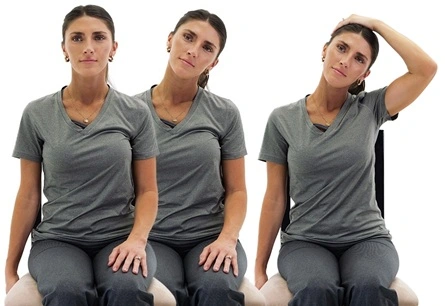
- Sit
upright and look straight ahead
- Slowly
tilt your right ear towards your right shoulder as far as comfortable
- Hold for 3 seconds, return to the starting position and repeat on the other side
Top Tips: Keep your shoulder relaxed rather than lifting it towards
your ear
: Don't worry if one side moves further than the other. The
movement should feel gentle rather than forced.
Progressions: Hold onto the bottom of your chair with
the hand on the side you are stretching. This gently keeps your shoulder down
and increases the stretch.
: Use your hand to bring the head further over to increase the stretch
3. Neck Flexion And Extension
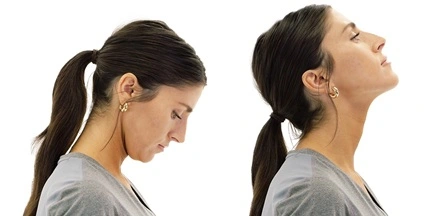
- Slowly
lower your chin towards your chest, feeling a gentle stretch down the back
of your neck
- Hold
for 3 seconds and return to the starting position
- Then
lift your chin up and gently look upwards so your neck bends backwards
- Return to neutral and repeat the whole exercise
You don't need to push into the end of the movement, particularly if looking up aggravates your symptoms. You can always just do the forward flexion part of the exercise.
If you are particularly stiff through your upper back as well as your neck, you may also find our guide to Upper Back Stretches useful.
B. Neck Strengthening Exercises
Strengthening exercises are really important as they help improve how well your neck supports your head during everyday activities.
This can be particularly useful if your neck pain keeps coming back or you find that your neck becomes tired or achy with prolonged sitting.
1. Neck Retractions
This is one of my favourite exercises for people with neck pain, or shoulder pain from neck problems. It helps combat forward head posture that is particularly common if you spend long periods in front of a computer, restores proper alignment and strengthens the neck stabilisers
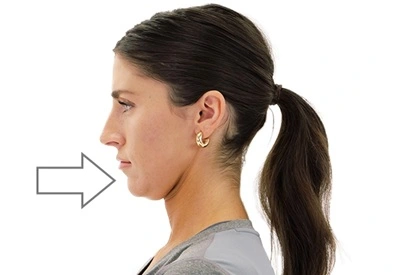
- Sit up tall, looking straight ahead
- Gently draw your chin in, as if you are giving yourself a
double chin, without tilting your head
- Hold for 3 to 5 seconds and relax
Top Tip: Imagine your chin is resting on a shelf and simply slide your chin inwards along the imaginary shelf. Keep looking straight ahead.
Progression: Once you can comfortably perform 20 repetitions, hold the chin-tucked position and place your hand gently against your chin. Apply a small amount of pressure backwards while using your neck muscles to maintain the position. Don't force the movement.
2. Isometric Neck Strengthening
Isometric exercises strengthen the neck muscles without requiring any neck movement, so are a useful option if movement is painful or when you are beginning to build strength.

- Sit upright, looking straight ahead
- Place your palm against your forehead
- gently press your head into your hand, without letting your head move
- Hold for around 5 seconds and relax
- Repeat with your hand against the back and then the side of your head
Top Tips: Your head should stay still, without tilting or bending
: Start with a gentle amount of pressure and gradually increase it - you don't need to push as hard as possible.
C. Neck And Shoulder Pain Exercises
Your neck and shoulders work closely together, so it often makes sense to exercise both areas rather than focusing exclusively on the neck.
This is particularly relevant if you have neck and shoulder pain or symptoms around the shoulder blades, or down the arm.
Related Article: Is Your Shoulder Pain Actually Coming From Your Neck?
1. Shoulder
Blade Squeezes
This exercise works the muscles that help control your shoulder blades and is a good beginner exercise if you spend a lot of time sitting or working at a computer.
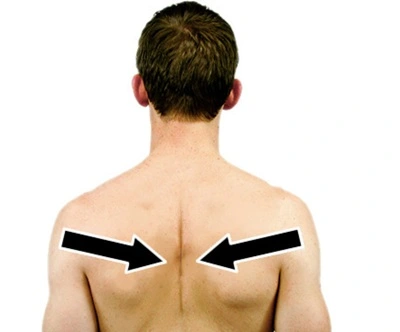
- Sit
or stand upright and let your shoulders relax
- Gently
draw your shoulder blades backwards, towards each other, and slightly
downwards
- Hold for 3–5 seconds and relax
Top Tips: Imagine pulling a piece of a string tied to the bottom
corner of your shoulder blade down and across towards
the opposite back pocket of your trousers
If you want to work more specifically on shoulder blade control, take a look at our guide to Scapular Stabilization Exercises.
2. Shoulder Openings
This a great exercise for neck and shoulder pain as it stretches the front of the shoulder and works the muscles that control the shoulder blades.
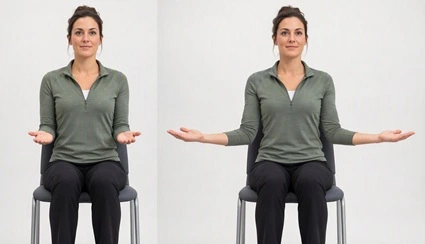
- Sit upright with your arms at a right angle in front of you, palms facing up and elbows by your side
- Keeping your elbows tucked in, draw your shoulder blades back and move your hands and lower arms out to the side
- Hold for 3 seconds and return to the starting position
Top Tip: Keep your neck relaxed throughout the movement rather than pushing your head forwards
3. Wall Slides
Wall slides are a useful way to challenge shoulder blade control during movement and improve posture.
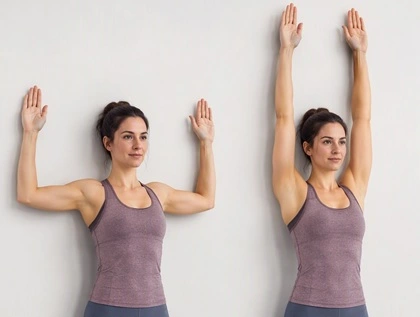
- Stand
with your back against a wall, head and upper back relaxed
- Place
your arms against the wall with your elbows
bent
- Slowly
slide your arms upwards
- Return to the starting position
Top Tip: Don't worry if your hands or elbows don't stay completely against the wall - focus on controlled movement rather than forcing the range.
Progression: As your control improves, gradually increase the range of movement or slow the exercise down.
If you have restricted movement around the shoulder, our Shoulder Mobility Exercises may be useful alongside these exercises.
How To Get The Most From Neck Pain Exercises
How often you exercise, how you progress and how you respond to the exercises all matter. You don't need to do a huge exercise session to make progress. Consistency is usually more important.
1. How Often Should You Do Neck Pain Exercises?
In general, I recommend doing gentle mobility exercises little and often, particularly if your neck becomes stiff after sitting for a long time. Aim for at least 2–3 sessions a day.
Strengthening and stability exercises can usually be started with one set a day, gradually increasing the number of repetitions as they become easier.
You don't need to do every exercise in this article. I'd rather you choose a small number that you can perform consistently and gradually progress them than try to squeeze a dozen exercises into every session.
Once your pain and mobility have improved, don't immediately stop exercising altogether. Gradually reducing the frequency to around 3 times a week can help maintain the strength and control you've built up. If your symptoms start returning, you can increase the frequency of your exercises for neck pain again.
2. How Do You Progress Exercises For Neck Pain?
You don't need to make your exercises harder simply because you've been doing them for a certain number of days.
Instead, look for signs that your current level is becoming easier. You may be able to perform more repetitions with good control, move further without aggravating your symptoms or complete the exercise with less effort.
You can then progress your exercises for neck pain gradually by:
- Increasing the number of repetitions
- Increasing the range of movement
- Holding a position for slightly longer
- Increasing resistance or pressure
- Making the movement slower and more controlled
You don't need to change everything at once. Pick one way to make an exercise slightly more challenging and see how your symptoms respond.
3. How Do I Know If I Am Working At The Right Level?
This is one of the most commonly asked questions about doing exercises.
In general, neck exercises may feel a little stiff to start with but they shouldn't significantly aggravate your symptoms. The first few repetitions may feel a little uncomfortable, but once you get going, you should find your symptoms actually start to improve.
A small amount of muscle soreness after strengthening exercises can be normal, but your neck pain should not progressively worsen from session to session.
Our guide to How To Exercise At The Right Level covers:
- Where To Start
- How To Increase Repetitions Safely
- Signs To Watch For
- Pain During & After Exercise: What Is Normal And What Isn't
- When To Stop
- How To Progress Exercises Safely
4. What If Neck Exercises Make My Pain Worse?
It is fairly common for a stiff or sensitive neck to feel slightly different when you first start doing exercises for neck pain.
However, there is a difference between mild, temporary discomfort and symptoms that are clearly being aggravated.
If an exercise is painful, or your symptoms are worse 20–30 minutes after doing the exercises, ease off a bit next time. Try reducing the range of movement, number of repetitions or resistance. If that doesn't help, stop that particular exercise and try a gentler option.
If you have pain, tingling, numbness or weakness extending into your arm, be particularly cautious about exercises that reproduce or increase those symptoms.
If symptoms repeatedly worsen despite modifying the exercises for neck pain, it's worth getting assessed rather than simply continuing to push through.
When Should You See A Doctor For Neck Pain?
Most cases of neck pain do not require extensive investigation, but there are situations where it is important to get professional advice.
You should seek medical assessment if you have:
- Significant or worsening weakness in your arm or hand
- Persistent or worsening numbness or tingling
- Severe pain following an injury or accident
- Problems with balance or walking
- Severe headache or other unusual symptoms alongside your neck pain
- Neck pain that is getting progressively worse rather than settling
Neck Pain Exercises For Shoulder And Arm Symptoms
Neck pain isn't always limited to the neck. Some people experience pain, tingling, numbness or other symptoms that travel from the neck into the shoulder, arm or hand. This can sometimes happen when a nerve in the neck becomes irritated.
If your symptoms are coming from the neck, aggressively stretching the neck isn't necessarily the answer. In fact, if an exercise causes your arm symptoms to travel further down your arm, I would stop that exercise rather than trying to push through it.
Instead, the initial aim may be to find movements that keep your symptoms manageable while gradually improving neck and shoulder strength and control.
Check out our article on Pain From Shoulder To Hand.
A Useful Rule For Arm Symptoms
Pay attention to where you feel your symptoms, not just how intense they are.
For example, if an exercise causes mild discomfort in your neck but your arm symptoms remain unchanged or improve, that is usually more reassuring than an exercise that feels fine in the neck but causes pain or tingling to spread further down your arm.
This isn't a substitute for an assessment, but it is a useful thing to monitor when you are exercising.
Persistent numbness, significant weakness or worsening neurological symptoms should be assessed by a healthcare professional.
If you are unsure whether your symptoms are coming from your neck, shoulder or another structure, an assessment can help identify the most appropriate exercises. Check out our article on Shoulder Pain From Neck Problems
Frequently Asked Questions
1. Where Should I Start With Neck Pain Exercises?
1. Where Should I Start With Neck Pain Exercises?
If you're not sure which exercises for neck pain to choose, keep things simple.
If your neck is painful or stiff: Start with gentle neck rotation, side bending and flexion. These neck range of motion exercises are a good way to get your neck moving without immediately placing much demand on it.
Once movement feels more comfortable: Add neck retractions and gentle isometric strengthening.
If you also have neck and shoulder pain: Add shoulder blade squeezes and shoulder openings.
As your strength and control improve: Progress to exercises such as wall slides and gradually make your strengthening exercises more challenging.
The right combination depends on what is causing your pain and whether you have symptoms extending into your shoulder or arm.
2. Should I Exercise My Neck If It Hurts?
2. Should I Exercise My Neck If It Hurts?
In many cases, yes, although you may need to modify the exercises. Gentle movement can help prevent your neck from becoming increasingly stiff, while strengthening can improve its ability to cope with everyday activities.
You shouldn't have to force painful movements, though. If an exercise significantly increases your pain or causes symptoms to spread into your arm, reduce or stop it and seek advice if the problem persists.
3. Can Neck Exercises Help Shoulder Pain?
3. Can Neck Exercises Help Shoulder Pain?
They can, particularly when your shoulder pain is actually being referred from the neck. The nerves supplying the shoulder and arm originate from the neck, so irritation in this area can sometimes cause symptoms further down the limb.
However, shoulder pain can have many different causes. If you are unsure whether your pain is coming from your neck or shoulder, an assessment can help determine which exercises are appropriate.
4. What Exercises Should You Avoid With Neck Pain?
4. What Exercises Should You Avoid With Neck Pain?
There isn't a single list of exercises that everyone with neck pain needs to avoid. An exercise that is appropriate for one person may aggravate another person's symptoms.
As a general rule, I would avoid forcing your neck into painful end-range positions or continuing an exercise that clearly increases your symptoms. Be particularly cautious if an exercise causes pain, tingling or numbness to spread further down your arm, or if it produces new weakness.
The aim isn't to avoid movement altogether. It is to find a level of movement and strengthening that your symptoms tolerate and then gradually build from there.
Exercises For Neck Pain Summary
The best exercises for neck pain usually combine gentle movement with gradual strengthening. Start with neck range of motion exercises if you feel stiff, then progress to neck strengthening and neck and shoulder exercises as your symptoms allow.
If your neck pain is accompanied by pain, tingling or numbness into your shoulder or arm, the exercises you choose may need to be modified. Take a look at Is Your Shoulder Pain Actually Coming From Your Neck? to learn more about the signs that your neck may be the source of your symptoms.
You may also find these guides useful:
- Upper Back Stretches: if stiffness or tightness extends between your neck and shoulder blades
- Scapular Stabilization Exercises: for improving shoulder blade strength and control
- Shoulder Mobility Exercises: if you also have restricted movement around the shoulder
- How To Progress Exercises Safely: for guidance on increasing repetitions, range and resistance without overdoing it (Coming Soon)
Remember, you don't need to do every one of the exercise for neck pain in this guide. Choose a few that suit your symptoms, perform them consistently and gradually build up what your neck and shoulders can comfortably manage.
You may also be interested in the following articles:
Related Articles

Shoulder Problems
January 29, 2026

Shoulder Diagnosis
September 23rd, 2026

Rehab Exercises
May 21, 2024
Medical & Scientific References
- Exercises For Neck Problems: NHS Inform UK
- Practical Tips And Simple Exercises To Prevent Neck Pain. Harvard Health Publishing. Harvard Medical School
- Effects Of Shoulder Stabilization Exercise On Pain And Function In Patients With Neck Pain. Journal Of Physical Therapy Science.
Page Last Updated: October 7th, 2026
Next Review Due: October 7th, 2028

Visitor Comments
"Such an informative and valuable site. Clearly written and matches the guidance from my orthopedic surgeon. Even offers many rehab exercises. Thank you very much!" Izabela
"I am a massage therapist and found your website perfect. Very useful. Clear, easy understand. Big help. Thank you!" Viktoria
"This is a great site. Very informative" Marilyn
"I benefited a lot from your distinguished work, thank you." Sayed
"Hi
and thanks so much, great site! You
are doing a lot of good in the world with this helpful site, thanks again." Karen
The material on this website is intended for educational information purposes only. It should not delay or substitute medical advice, diagnosis or treatment. See our T&C's
Shoulder-Pain-Explained.com is a trading name of Wilson Health Ltd. All rights reserved. Terms & Conditions apply
© shoulder-pain-explained.com 2015-26 Last updated 30th September 2026
Contact Us About Us Blog Privacy Policy Advertising Policy Sitemap
