- Home
- Shoulder Exercises
- Should You Exercise When It Hurts
Should You Exercise When It Hurts? A Guide To Exercising
With Shoulder Pain
Should You Exercise When It Hurts?
Written By: Chloe Wilson BSc (Hons) Physiotherapy
Reviewed By: SPE Medical Review Board

Should you exercise when it hurts? If you have shoulder pain, one of the hardest things to work out is whether you should keep exercising when it hurts or stop.
You may have been told that exercise is important for your recovery, but what happens if an exercise actually causes pain? Should you push through it, reduce the exercise or stop altogether?
The answer isn't simply “no pain, no gain” but nor is it “never exercise if it hurts”. Some discomfort can be normal when you are working on a painful or stiff shoulder, particularly when you first start exercising.
However, pain that continues to build, significantly affects your activities or is worse for a prolonged period afterwards is a sign that you may be doing too much.
What To Expect?
- How Shoulder Exercises Should Feel: when they are done right
- How To Tell If You Are Working At The Right Level: signs to watch for
- Is It Ok To Have Pain When Exercising: and how to know if you are doing too much
- How You Can Modify Exercises If They Hurt: and what signs mean you should stop altogether
- How Much Should You Exercise: how many different exercises and repetitions should you do
- How To Safely Progress Exercises With Shoulder Pain: when and how to progress safely
Quick Overview: Should You Exercise If Your Shoulder
Hurts?
With most cases of shoulder pain, the answer is yes, you should exercise! Exercise is an important part of recovering from many shoulder problems, and avoiding movement will often make your shoulder stiffer, weaker and less able to cope with everyday activities.
It is actually really important to put the right stresses and strains through the shoulder as it heals, so that it heals properly. Otherwise you can end up with problems such as tissue scarring, persistent inflammation, muscle wasting or chronic stiffness.
However, exercising with shoulder pain doesn't mean you should simply ignore your symptoms and push as hard as possible.
The aim is to keep the shoulder moving, find the right amount of challenge and gradually rebuild strength and tolerance without repeatedly aggravating your symptoms.
What Should Shoulder Exercises Feel Like?
It is normal to get some mild pain or discomfort when starting shoulder exercises, particularly if your shoulder is stiff, weak or hasn't been moving much. The first few repetitions in particular may feel uncomfortable but this often eases as you get your shoulder moving so don’t quit too soon!
When you are working at the right level you may notice:
- Your muscles working hard or becoming tired
- A gentle stretch when working on mobility or stretching exercises
- Mild aching around the shoulder
- Slight discomfort or awkwardness as you move into a restricted range
These sensations are all very normal and are usually nothing to worry about. In fact, they are often a sign that they are helping.
Pain is an important signal, but it doesn't automatically mean that you are damaging your shoulder.

However, you don’t want to be repeatedly forcing through sharp, catching or increasingly painful symptoms, particularly if the pain is getting worse with every repetition.
How Do You Know If You Are Exercising At The Right Level?
This is one of the most useful things to learn when exercising with shoulder pain. Rather than judging an exercise only by how it feels at that moment, look at your shoulder's response across the whole day.
Ask yourself these four questions.
1. How Does It Feel During The Exercise?
Does the discomfort stay manageable, improve as you warm up or gradually become worse?
Can you continue with a controlled movement, or are you tensing up, compensating or rushing because it hurts?
2. How Does It Feel Immediately Afterwards?
Does your shoulder settle reasonably quickly, or are you left with significantly more pain?
A small, temporary increase in symptoms can happen after exercise. The important thing is that it settles rather than continuing to build.
3. How Does It Feel Later That Day?
Can you carry on with your usual activities, or has exercising made everyday movements noticeably more difficult?
For example, if you could comfortably get dressed, work or prepare a meal before exercising but struggle afterwards because your shoulder has flared up, that is useful feedback that the workload may have been too high.
4. How Does It Feel The Next Morning?
This is one of my favourite ways of judging whether someone has done too much.
If your shoulder is around its usual level the next morning, that's reassuring.
If it is significantly more painful, stiff or restricted, or your sleep has been affected, your previous session may have been more than your shoulder could comfortably tolerate.
This doesn't necessarily mean you've damaged anything. It may simply mean you need to reduce the workload and build up more gradually.
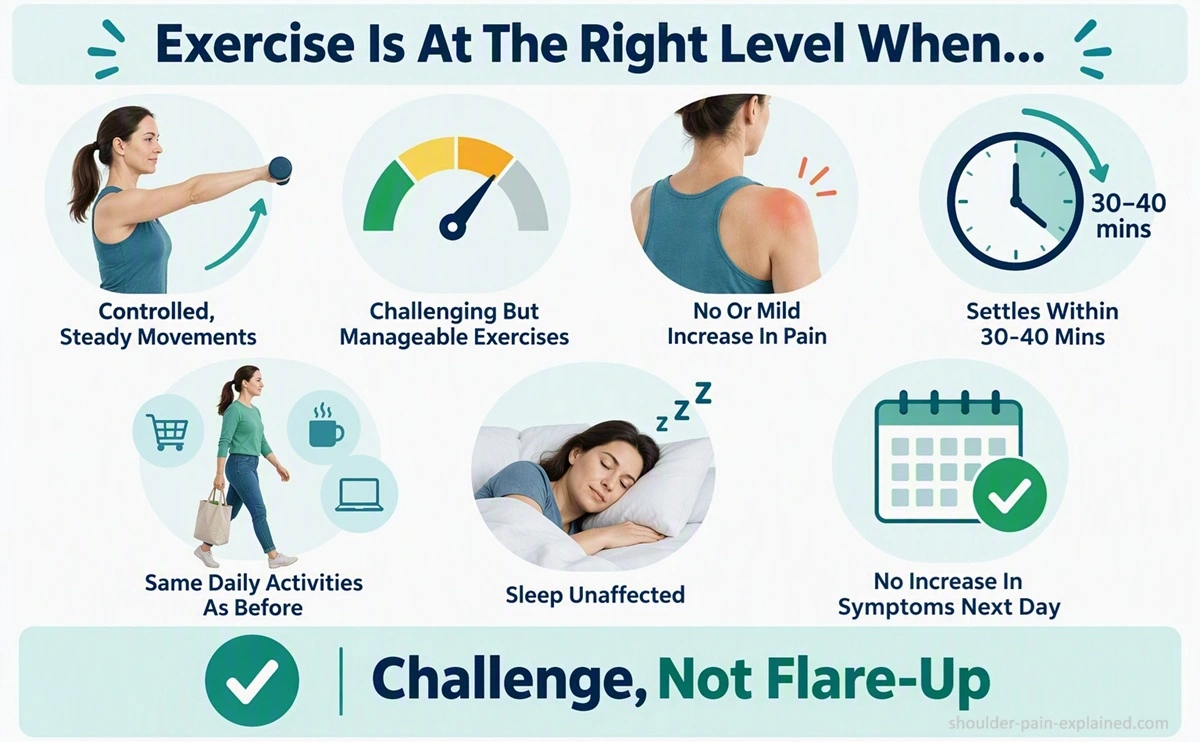
You know you are working at the right level when:
- You can do your shoulder exercises in a controlled, steady manner
- The exercises are challenging but manageable
- There is no increase or only a mild increase in pain during exercise
- Your symptoms have returned to normal within 30-40 minutes
- You can do the same daily activities as you were doing before you exercised
- Your sleep is unaffected
- There is no increase in symptoms the next day
How Much Pain Is OK During Shoulder Exercises?
There isn't one magic pain score that is safe for everyone with shoulder pain but a 0–10 pain scale can be useful as a guide:
- 0–3: Mild discomfort that is generally manageable is usually fine
- 4–5: Moderate discomfort that may mean you need to reduce the intensity
- 6–10: Significant pain often means stopping or changing the exercise is usually sensible
As a general rule, aim to keep your pain in the 0-3 range, but don't become too focused on the number as we all perceive pain slightly differently. How your shoulder responds is more important than the number itself.
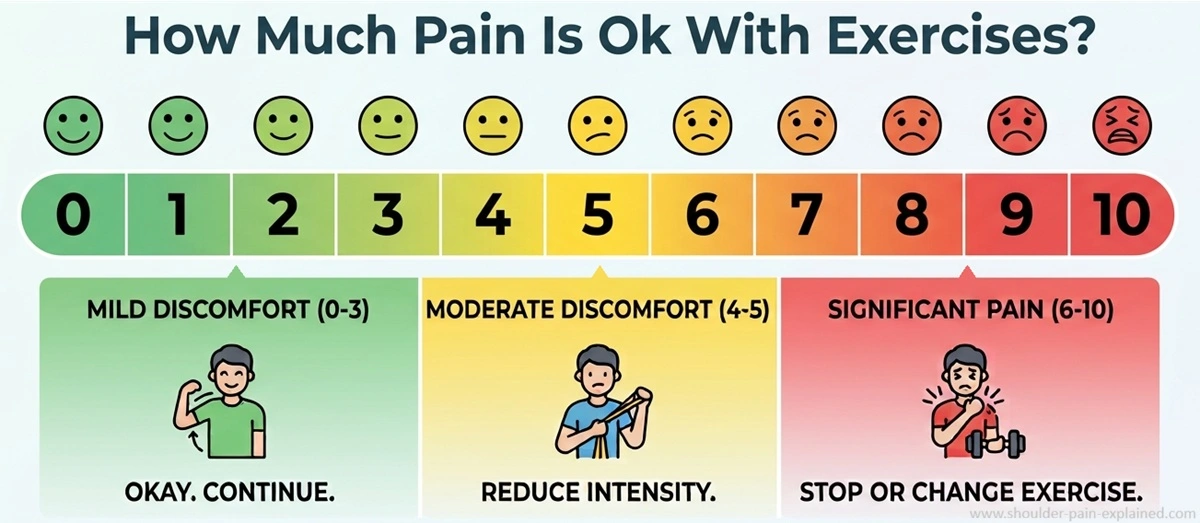
For example, a brief 4/10 discomfort that remains controlled and settles quickly afterwards is very different from pain that starts at 2/10 and steadily increases to 6/10 as you continue.
What you want to avoid is a significant flare-up that lasts for hours, affects your normal activities or leaves you substantially worse the following day.
How Do You Know If You Are Doing Too Much?
There are several clues that your current exercise level may be too high and needs adjusting:
- Sharp Pain: an intense sharp or catching pain from shoulder exercises is often a warning sign that you are moving the shoulder incorrectly
- High Pain Levels: exercise causes your pain levels to go above a 5 on the pain scale
- Your Symptoms Spread: you notice the pain travelling further down your arm
- New Symptoms Appear: such as tingling or numbness
- Symptoms Do Not Settle: increased symptoms fail to settle within 30-45 minutes or are worse the next day
- Sleep Issues: you have trouble falling asleep or staying asleep due to the increase in pain
- Extreme Fatigue: you feel completely wiped out or can’t move properly after doing your exercises
- Daily Activities Affected: you notice you can’t do the things you normally do after exercising
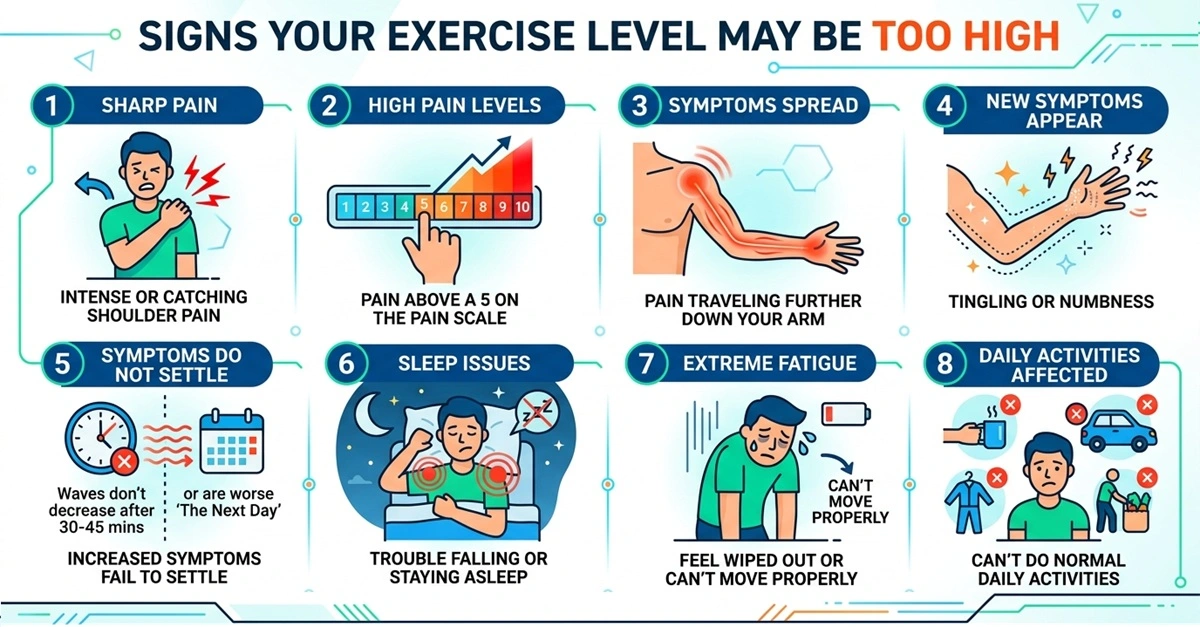
If this keeps happening, don't simply push harder and hope your shoulder will adapt. Your symptoms are giving you useful information about the amount of exercise your shoulder can currently tolerate.
What Can Help If An Exercise Hurts?
In most cases, pain does not mean you should stop exercising altogether. Often, you simply need to modify the exercise. Try one or more of the following:
- Reduce The Range Of Movement: You don’t have to move through the full range straight away. Work within a manageable range and gradually increase how far you move as you shoulder allows
- Reduce The Number Of Repetitions: For example, if 15 repetitions aggravates your shoulder, try 8 or 10 instead
- Slow The Movement Down: Slower, controlled movements can make an exercise more manageable and give you greater control over the painful part of the movement
- Reduce The Resistance: If you are using weights or resistance bands, try a lighter resistance
- Reduce The Number Of Exercises: You don't have to complete a long list of exercises in every session. If you're doing several exercises and your shoulder is consistently flaring up afterwards, reducing the overall workload may help
- Take Longer Rest Breaks: You may need more recovery time between exercise sets or sessions
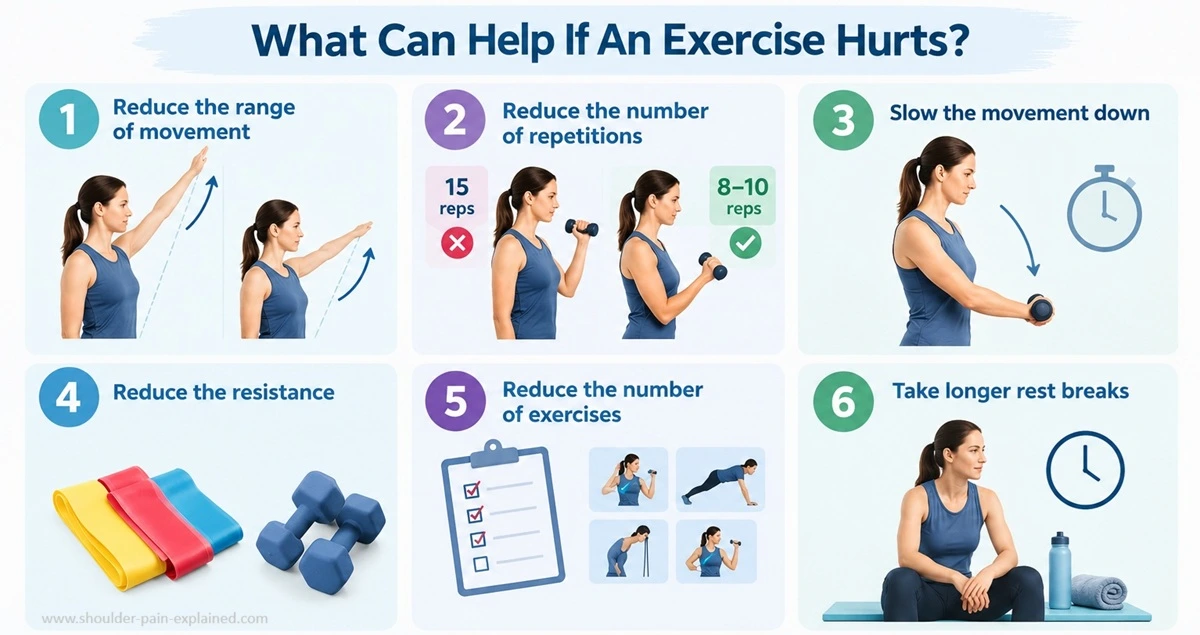
This is a much better approach than stopping all exercise, and shouldn’t be seen as a negative thing. Adjusting the workload is part of rehabilitation.
However, if an exercise remains painful despite these changes, leave it for now and try something else.
When Should You Stop A Shoulder Exercise?
There is an important difference between reducing an exercise and stopping completely. In many cases, reducing the range, repetitions or resistance is enough.
However, stop an exercise and seek professional advice if you develop:
- Severe or rapidly worsening pain
- New or increasing weakness
- Numbness or persistent pins and needles
- A feeling that the shoulder is giving way or repeatedly slipping out
- Significant swelling or a change in the shape of the shoulder
- Severe pain following an injury
You should also seek urgent medical help for symptoms such as chest pain, significant shortness of breath, fainting or sudden neurological symptoms rather than assuming they are coming from your shoulder.
How Many Exercises Should You Do With Shoulder Pain?
You do not need a huge list of exercises to make progress. For someone just starting out with exercises for shoulder pain, as a physical therapist I would usually recommend starting with around 3-5 different exercises.
That way you are doing enough to start getting an effect without overloading your muscles and joints.
What exercises you do will depend on what is causing your shoulder pain, but may include:
- Shoulder Mobility Exercises: to help increase range of motion and decrease stiffness
- Shoulder & Arm Stretches: stretch out the shoulder, neck and upper back muscles
- Rotator Cuff Exercises: Improve shoulder strength
- Scapular Stabilization Exercises: Improve the strength and control of the shoulder blades
- Exercises For Neck Pain: neck and shoulder pain are often linked so neck exercises can really help
- Resistance Band Exercises: for those who are ready for more of a challenge
The important thing is not the number of exercises but whether you can perform them well and recover from the overall workload. Over time, you should be able to gradually add in more exercises.
If you are not sure where to start, it is worth getting assessed by a physical therapist who can assess your shoulder and develop an appropriate rehabilitation program for you.
How Many Repetitions Should You Do?
With any new incident of shoulder pain, you want to start with a low number of repetitions and see how your shoulder responds.
It will depend on what sort of exercises you are doing as to how many you should aim for. There is no one right level that works for everyone but here is a helpful guide of where to start.
Movement &
Strengthening Exercises
With strengthening and range of motion exercises for shoulder pain, a good place to start is 5-10 repetitions of each exercise and see how your shoulder feels.
As the exercise becomes easier, you can increase the repetitions, range or resistance depending on what you are trying to achieve. Take it slowly, only increase by a couple of repetitions every few days as able.
Most people can aim to get up to around 25-30 repetitions of movement and strengthening exercises, but it might take a few weeks to get there.
The important thing is that you can complete the exercise with good control without your symptoms becoming progressively worse before adding in more repetitions.
Static Stretching
Exercises

If you are working on static stretching exercises to target tight muscles or soft tissues rather than stiff joints, it works a little differently.
A static stretch is when you hold your shoulder still in a stretched position for a set amount of time without moving. This gradually lengthens muscle fibres and connective tissue over time and increases flexibility.
With static stretches, you want to start off by holding each stretch for 15-20 seconds. The stretch should feel uncomfortable but not painful. Repeat each stretch 3 times.
Once you are happy at this level, gradually increase the length of time you hold each stretch by a couple of seconds every couple of days.
You are aiming to build up to holding each stretch for 30 seconds. Some people find they can get straight up to 30 second holds almost immediately.
You don’t need to increase the number of repetitions for stretches, but you should gradually be able to increase how far you stretch. Studies have shown that 3 repetitions with a 30 second hold gives the maximum benefit for the least effort.
When & How Should You Progress Shoulder Exercises?
You don't need to make an exercise harder simply because you've been doing it for a certain number of days. Instead, look for signs that your current level is becoming easier.
Good signs that you are ready to progress shoulder exercises are:
- You can perform more repetitions comfortably
- Your movement is becoming smoother
- You have better control
- The exercise requires less effort
- Your shoulder recovers more quickly afterwards
- You can perform your everyday activities more easily
When this happens, there are lots of options for how to progress your shoulder exercises:
- Increase the number of repetitions
- Increase the range of movement
- Add a small amount of resistance e.g. weight or resistance bands
- Hold a position for longer
- Slow the movement down
- Progress to a more challenging version of the exercise
Only change one thing at a time where possible. For example, if you can comfortably complete 10 repetitions with good control, you might increase the repetitions before adding more resistance.
If the new level causes a clear flare-up, drop back to the previous level and build again.
FAQ's
1. Does Pain During Exercise Mean You Are Damaging Your
Shoulder?
1. Does Pain During Exercise Mean You Are Damaging Your Shoulder?
No, pain during exercise is not always a sign of damage. Pain is influenced by many factors, including sensitivity, stiffness, weakness and how much load your shoulder is used to. Some manageable discomfort can occur when you are gradually restoring movement, strength and confidence in a painful shoulder.
What matters is the overall pattern. Mild discomfort that settles is very different from sharp or progressively worsening pain, or symptoms that leave you significantly worse afterwards or the following morning.
2. Can Exercise Make Shoulder Pain Worse?
2. Can Exercise Make Shoulder Pain Worse?
Yes, but there is an important difference between a temporary increase in symptoms and a genuine flare-up. A new exercise can make your shoulder ache more for a short while because you have asked it to do something it isn't used to. This should gradually settle.
If exercise consistently causes a large increase in pain or your shoulder becomes progressively worse over several days, the exercise or overall workload needs adjusting.
3. Why Does My Shoulder Hurt More After Exercise?
3. Why Does My Shoulder Hurt More After Exercise?
Some temporary aching after exercise is quite common, especially when you've started a new exercise or increased the workload. You may be moving the shoulder through a greater range than it is used to, or loading a weak muscle more.
Depending on the underlying cause of your shoulder problem, there may be some swelling in the joint, soft tissue inflammation or micro-damage to some of the soft tissues that makes movement uncomfortable. But this should gradually ease off as you recover.
4. How Often Should You Exercise With Shoulder Pain?
4. How Often Should You Exercise With Shoulder Pain?
This depends on what you are doing but consistency is key.
Mobility exercises can often be performed more frequently because they place relatively little load on the shoulder. Ideally you want to do them regularly during the day, rather than one long session.
Aim for 2-4 sessions per day of mobility exercises. You don’t have to do all your exercises in one go, you can split them into different sets, but it is the frequency and regularity that make the most difference
Strengthening exercises are more demanding and usually need recovery time between sessions so once or twice a day is usually about right.
Remember, let your shoulder's response guide you. You should be able to recover between sessions without a continuing build-up of pain or stiffness.
5. What If I Can't Exercise Without Pain?
5. What If I Can't Exercise Without Pain?
If every exercise causes significant pain, don't assume you simply need to push through it. The exercise may be too difficult, the range may be too large, or it may not be appropriate for your particular shoulder problem. Try reducing the difficulty first. You could reduce the range of movement, use less resistance, do fewer repetitions or choose a simpler variation.
If even very gentle movement causes significant pain, or you are unsure which exercises are appropriate for your shoulder, getting an individual assessment is a better option than repeatedly trying to exercise through it.
6. Should You Push Through Shoulder Pain?
6. Should You Push Through Shoulder Pain?
There is a difference between working through some discomfort and forcing your way through pain that is telling you to stop. Rehabilitation often requires you to challenge a shoulder that is weak, stiff or sensitive, so avoiding every sensation isn't necessary.
However, deliberately pushing through sharp, severe or increasingly painful symptoms is unlikely to be helpful. The aim is to gradually increase what your shoulder can tolerate, not to see how much pain you can withstand.
If your shoulder becomes significantly more painful afterwards, affects your normal activities or is noticeably worse the following morning, you've probably done more than it currently tolerates. Try reducing the repetitions, resistance, range or overall amount of exercise and see whether your symptoms respond better.
7. Should I Exercise If My Shoulder Hurts Every Day?
7. Should I Exercise If My Shoulder Hurts Every Day?
Yes, in many cases. Having daily shoulder pain does not automatically mean that rest is the best approach. For some persistent shoulder problems, regular movement and strengthening are an important part of recovery.
The important question is whether exercise is helping you gradually do more or repeatedly making your symptoms worse. If your shoulder remains at a similar level or settles after exercise, you may be working appropriately. Persistent or worsening pain is worth getting assessed.
The Bottom Line: Should You Exercise When It Hurts?
So, should you exercise when it hurts? Sometimes, yes. Some mild, manageable discomfort can be part of exercising a painful or stiff shoulder. Pain during exercise does not automatically mean you are causing damage.
What matters is how your symptoms respond. If the discomfort remains manageable, your movement stays controlled and your shoulder settles quickly afterwards, you are probably working at an appropriate level.
If the pain keeps increasing, your shoulder is significantly worse later that day or is more painful and restricted the following morning, reduce the workload and build back up more gradually.
The goal with exercises for shoulder pain isn't to eliminate every sensation of pain but nor is it to prove how much pain you can tolerate. The aim is to gradually increase what your shoulder can comfortably do.
If you are struggling to find the right level, or your symptoms are consistently getting worse despite modifying your exercises, it is definitely worth getting your shoulder assessed.
You may also be interested in the following articles:
- Shoulder Pain Diagnosis Charts
- Common Causes Of Shoulder Pain
- Shoulder Pain When Lifting Arm
- Shoulder Pain At Night
- Is Your Shoulder Pain Actually Coming From Your Neck
Related Articles

Shoulder Diagnosis
September 23rd, 2026

Wrist Diagnosis
May 12th, 2026

Elbow Diagnosis
February 26, 2026
Medical & Scientific References
- Physio Findings: Exercise Pain Doesn’t Equal Tissue Damage. Frontline - Chartered Society Of Physiotherapy
- Muscle Tenderness From Exercise: Mechanisms? The Journal Of Physiology
- Physical Activity as Cause and Cure of Muscular Pain: Evidence of Underlying Mechanisms. Exercise & Sports Science Reviews
- Should Exercises Be Painful In The Management Of Chronic Musculoskeletal Pain? A Systematic Review And Meta-Analysis. British Journal Of Sports Medicine
- Should Exercise Gain Require Pain? UCLA Health
Page Last Updated: October 14th, 2026
Next Review Due: October 14th, 2028

Visitor Comments
"Such an informative and valuable site. Clearly written and matches the guidance from my orthopedic surgeon. Even offers many rehab exercises. Thank you very much!" Izabela
"I am a massage therapist and found your website perfect. Very useful. Clear, easy understand. Big help. Thank you!" Viktoria
"This is a great site. Very informative" Marilyn
"I benefited a lot from your distinguished work, thank you." Sayed
"Hi
and thanks so much, great site! You
are doing a lot of good in the world with this helpful site, thanks again." Karen
The material on this website is intended for educational information purposes only. It should not delay or substitute medical advice, diagnosis or treatment. See our T&C's
Shoulder-Pain-Explained.com is a trading name of Wilson Health Ltd. All rights reserved. Terms & Conditions apply
© shoulder-pain-explained.com 2015-26 Last updated 12th October 2026
Contact Us About Us Blog Privacy Policy Advertising Policy Sitemap
