- Home
- Hand Pain Diagram
- Hand Lumps
- Side Hand Lumps
Lump On Side Of Hand
Written By: Chloe Wilson BSc (Hons) Physiotherapy
Reviewed By: SPE Medical Review Board

A lump on the side of the hand is a common problem and can come from many structures including joints, tendons, nerves, skin, and bone.
In most cases, these lumps are benign, but the exact cause depends on where the lump is located, how it feels, and whether it is painful or changing over time.
This guide explains the most common causes of a lump on the side of the hand, including both thumb-side (radial) and little-finger-side (ulnar) conditions, how to quickly narrow down the most likely causes and how to know if it is something serious.
What Does A Lump On Side Of Hand Usually Mean?
Most lumps or bumps on the side of the hand are not serious and are caused by:
- Fluid-filled cysts from joints or tendons
- Benign soft tissue tumors
- Tendon irritation or overuse
- Bone or joint changes after injury or arthritis

The location of the lump is one of the most important clues in narrowing down the cause.
- Thumb Side Of Hand: more often tendon and thumb joint-related
- Little Finger Side Of Hand: more often tendon sheath thickening or fracture-related
- Either Side: commonly cysts, lipomas, or tendon sheath tumours
Quick Diagnostic Guide: What Your Lump Might Be
The feel of the lump, whether it moves, and any associated symptoms can often provide useful clues about the underlying cause.
While a proper diagnosis may require examination or imaging, this quick guide can help narrow down the most likely causes of a lump on the side of the hand.
| Feature | Most Likely Cause Of Hand Lump |
|---|---|
| Soft, squishy, changes size | Ganglion cyst, lipoma |
| Firm, attached to tendon | Giant Cell Tumor of the Tendon Sheath (GCTTS) |
| Hard, bony lump | Arthritis or fracture healing |
| Pain after injury | Fracture or dislocation |
| Tingling or electric pain | Schwannoma or neuroma |
| Slow growing deep lump | Rare malignant tumor (e.g., sarcoma - extremely rare) |
Causes Of Side Hand Lumps
Some hand lumps will only appear on the thumb side of the hand, some only on the little finger side and others can occur on both sides. It depends on the underlying cause of the lump
A. Lump On Either Side Of The Hand
Let’s start by looking at conditions that can cause lumps to develop on both the thumb (radial) and little finger (ulnar) side. These causes can develop on either side of the hand because they involve structures present throughout the hand.
1. Ganglion Cyst
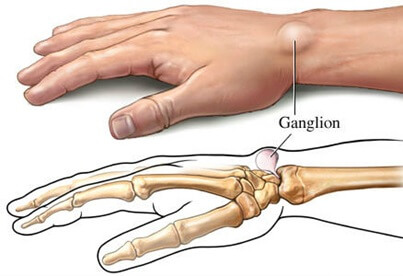
The most common cause of a lump on the side of the hand is a ganglion cyst.
It forms when joint or tendon fluid leaks out and collects in a small sac. These cysts are dynamic in nature, often changing size depending on activity and joint pressure.
Typical features of a ganglion cyst lump:
- Round, smooth lump under the skin
- May feel firm or soft depending on tension
- Can fluctuate in size
- Often painless but may ache with use
Find out more about the causes, symptoms and treatment of Ganglion Cysts in the hand.
2. Giant Cell Tumour Of Tendon Sheath (GCTTS)
Another common cause of a lump on the side of the hand is a giant cell tumor of the tendon sheath aka localized tenosynovial giant cell tumor.
A GCTTS is a benign solid tumor arising from the tendon lining. Unlike a cyst, it is made of solid tissue and is usually closely attached to the tendon, making it less mobile.
Typical features of a giant cell tendon sheath tumor:
- Firm, rubbery lump
- Slow, steady growth
- Usually painless
- May interfere with tendon movement if large
3. Epidermoid Cyst
Another possible cause of side hand lumps is an epidermoid cyst, aka inclusion cyst. An epidermoid cyst forms when skin cells become trapped beneath the surface and continue to produce keratin. It is often associated with minor trauma or repetitive micro-injury.
Typical features of epidermoid cyst lumps:
- Round, firm lump under skin
- Slow growth over time
- May become inflamed or tender
- Occasionally has a small dark central pore
4. Lipoma

A lipoma is a benign fatty tumor located in the subcutaneous tissue that can develop anywhere.
Typical features of a lipoma lump:
- Soft, doughy consistency
- Freely mobile under skin
- Painless
- Grows very slowly
In the hand, it is a less common cause of lumps than in other body regions but typically remains harmless and slow-growing.
5. Peripheral Nerve Sheath Tumours
There are two types of peripheral nerve sheath tumors that can cause a lump on the side of the hand. Schwannomas are benign tumours that grow along a nerve, while neuromas form after nerve injury and represent abnormal nerve healing. Both can produce nerve-type symptoms.
Typical features:
- Lump develops along a nerve pathway
- Tingling or electric shock sensation when pressed
- Schwannoma: slow-growing, usually painless
- Neuroma: often painful or hypersensitive after trauma
6. Foreign Body Granuloma
A foreign body granuloma on the hand develops when the immune system reacts to retained material such as glass, wood, or metal after a small injury. The body walls off the irritant, forming a persistent lump.
Typical features of a foreign body granuloma:
- Firm, localised lump
- History of puncture or minor trauma
- May be intermittently inflamed or tender
7. Fracture Or Dislocation
Trauma to the hand can lead to swelling, deformity or bone healing changes that feel like a bump on the side of the hand. In some cases, altered joint alignment can leave a permanent prominence.
Typical features of a bony injury:
- Clear history of injury
- Swelling, bruising, or deformity
- Pain with movement or grip
- Possible long-term bony lump after healing
8. Malignant Tumours
Malignant tumours in the hand are rare but important not to miss. They typically arise from deep soft tissues e.g. soft tissue sarcoma, or bone e.g. osteosarcoma, and tend to grow progressively over time.
Red flag warning features:
- Deep, firm, fixed lump
- Gradual, persistent growth
- Pain at rest or night pain
- Skin changes (ulceration or bleeding)
B. Lump On Thumb Side Of Hand
A lump on the thumb side of the hand (radial side) is common as that side of the hand is highly involved in gripping and pinching, making it prone to degenerative and tendon-related conditions.
1. Thumb Base Osteoarthritis
The most common cause of a hard lump on the thumb side of the hand is arthritis.

Thumb CMC osteoarthritis occurs due to progressive cartilage wear at the base of the thumb.
Typical features of CMC arthritis:
- Bony bump at thumb base
- Pain with gripping or twisting
- Weak pinch strength
- Progressive stiffness
As the carpometacarpal joint degenerates, bone changes and instability can create a visible bump and pain during pinch activities.
2. De Quervain’s Tenosynovitis
A common cause of a lump on the thumb side of the hand is De Quervain’s tenosynovitis. This is an overuse condition affecting the thumb tendons at the wrist.
Thickening and inflammation can create a localised swelling that may feel like a lump on the thumb side of the hand.

Common features of De Quervains are:
- Pain on thumb side of wrist
- Worse with lifting, twisting or gripping
- Tender swelling over tendons
- Usually caused by repetitive strain
Find out more about the causes, symptoms and best treatment options for De Quervains Tenosynovitis.
3. Trigger Thumb
Trigger thumb occurs when the flexor tendon becomes thickened and catches under a pulley system, creating a nodular lump at the base of the thumb.
Typical features of trigger thumb:
- Clicking or locking thumb
- Tender lump at base of thumb
- Morning stiffness
- Pain with movement
Find out more about the causes and treatment for Trigger Finger.
4. Thumb Fractures
A less likely but important possibility of thumb bumps are Bennett and Rolando fractures. These fractures affect the base of the thumb metacarpal and typically occur after high-energy trauma.
Because they involve the joint surface, deformity and swelling on the outer side of the hand can be significant.
Features of thumb fractures:
- Sudden severe pain after injury
- Swelling and deformity
- Reduced thumb movement
- Difficulty gripping
C. Lump On Little Finger Side Of Hand
Lumps on the pinky finger side of the hand (ulnar side) are often related to tendon, fascia or fracture injuries.
1. Dupuytren’s Disease
Dupuytren’s contracture causes thickening of the palmar fascia, leading to firm nodules and cords.
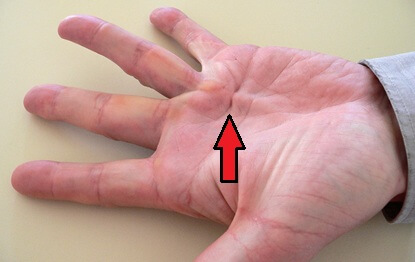
It can gradually pull the fingers into flexion and typically affects the ring and pinky fingers.
Common signs of Dupuytren's:
- Firm nodules in palm
- Gradual finger bending
- Usually painless
- Slowly progressive
Find out more about the causes, symptoms and treatment options for Dupuytren's Contracture.
2. Fifth Metacarpal Fracture
Another common cause of a bump on the inner side of the hand is a Boxer’s fracture which involves the neck of the fifth metacarpal, usually after punching or direct trauma. Healing changes or deformity can leave a persistent lump or knuckle flattening.
Features of a Boxers fracture:
- Swelling over knuckle after injury
- Flattened knuckle appearance
- Pain with gripping
- Weakness in hand use
Find out more about the causes, treatment and recovery from a Boxer's Fracture.
3. Accessory Muscle
Another possible cause of a lump on the pinky finger side of the hand is an accessory abductor digiti minimi muscle. An accessory muscle is a normal anatomical variation that may present as a soft lump on the ulnar side of the hand. It is harmless and often only noticeable during muscle contraction.
Features of an accessory muscle on the side of the hand:
- Soft muscular bulge
- More visible with movement
- Painless and stable
When To See A Doctor
A lump on the side of the hand should be assessed if it:
- Is increasing in size
- Feels firm, deep, or fixed
- Causes persistent or night pain
- Produces numbness or tingling
- Follows significant trauma with ongoing symptoms
- Affects grip strength or hand function
- Shows skin changes such as ulceration or bleeding
Most Likely Causes Of Hand Lumps
It can be helpful to understand the overall likelihood of each cause of a lump on the side of the hand ranked by clinical frequency:
- Ganglion Cyst: most common overall
- Giant Cell Tumor Of Tendon Sheath: common solid lump in fingers
- Degenerative Joint Changes: especially thumb base
- Dupuytren’s Disease: palm side, little finger side
- Fracture-Related Lumps: after trauma
- Lipoma: less common in hand than elsewhere
- Nerve-Related Tumors: rare
- Malignancy: very rare
How To Treat Side Hand Lumps
Treatment for a lump on the side of the hand depends entirely on the underlying cause. In many cases, especially with benign conditions, management is conservative at first, with further treatment guided by symptoms, size, and impact on hand function.
In most cases, treatment is not aimed at removing the lump itself, but rather at:
- Reducing pain
- Improving hand function
- Preventing progression
- Confirming diagnosis when needed
Let’s look at the best treatment options for different types of hand lumps.
1. Treatment For Cysts
Most cyst-related lumps in the hand are benign and do not require treatment if they are not painful or limiting function. Many remain stable or fluctuate in size over time.
Typical management options for ganglion and epidermoid cysts:
- Observation and reassurance if symptoms are mild
- Activity modification if aggravated by loading or pressure
- Aspiration (fluid drainage), although recurrence is common
- Surgical removal if persistent, painful, or functionally limiting
2. Treatment For Tendon-Related Conditions
Tendon related conditions such as GCTTS, trigger thumb and De Quervains, are usually related to tendon irritation, thickening, or overuse. Treatment is often aimed at reducing inflammation and mechanical stress on the affected tendon.
Typical management options:
- Activity modification and load reduction
- Splinting to reduce tendon irritation
- Anti-inflammatory medication for symptom relief
- Corticosteroid injection in selected cases
- Surgical release or excision if symptoms persist or worsen
3. Treatment For Joint-Related Conditions
Side hand lumps arising from joints or bones are usually related to structural changes such as bone enlargement, joint misalignment or healing bone (callus formation).
Treatment for lumps from arthritis, joint instability, fractures or dislocations focus on function and pain control rather than removing the lump itself.
Typical management options:
- Load modification and activity pacing
- Analgesia for pain control
- Splinting or bracing for support and stability
- Hand therapy to maintain strength and mobility
- Surgical intervention only in severe arthritis,
instability, or complex fractures
4. Treatment For Nerve-Related Lumps
Nerve-related lumps, schwannomas or neuromas, may be painless or associated with tingling, sensitivity, or nerve-type pain. Management depends on symptom severity and functional impact.
Typical management options:
- Observation if symptoms are mild and stable
- Desensitisation techniques and symptom management for painful neuromas
- Surgical excision for enlarging or symptomatic schwannomas
- Specialist referral if there are progressive neurological symptoms
5. Treatment For Post-Traumatic Lumps
Lumps on side of hand following injury are often due to swelling, bone healing, or changes in joint alignment. Management of fractures or dislocations depends on whether the injury is acute or already healed.
Typical management options:
- Immobilisation in the early stages of injury
- Gradual mobilisation once healing allows
- Hand therapy to restore movement and strength
- Surgical fixation in displaced or unstable fractures
- Long-term management if residual bony prominence remains
6. Treating Rare But Serious Causes
Although rare, malignant tumours require prompt investigation and specialist management. Early identification is important to ensure appropriate treatment and to rule out more serious pathology.
Typical management pathway:
- Urgent imaging (ultrasound and/or MRI)
- Specialist referral (orthopaedic or hand oncology team)
- Biopsy to confirm diagnosis
- Surgical removal with or without further oncological treatment depending on findings
Frequently Asked Questions (FAQ)
Here you will find answers to the questions most commonly asked about lumps on the side of the hand.
1. Is A Lump On My Hand Likely To Be Cancer?
1. Is A Lump On My Hand Likely To Be Cancer?
No, a lump on side of hand is very unlikely to be malignant. The vast majority of lumps on the hand are benign (non-cancerous). While the word "tumour" is often used in medical reports, it simply refers to a swelling or growth and does not mean cancer. Malignant tumours in the hand are extremely rare.
2. Can I Pop A Ganglion Cyst At Home?
2. Can I Pop A Ganglion Cyst At Home?
No, you should never try to pop or drain a cyst yourself. Attempting to rupture a cyst with pressure or puncturing it with a needle can lead to severe infection, tissue damage, and may not prevent it from returning.
3. Why Does My Lump Change Size?
3. Why Does My Lump Change Size?
If your lump on side of hand changes size, it is often a sign that it is a ganglion cyst. These are fluid-filled sacs connected to a joint or tendon; they may grow larger when you use that joint repeatedly and shrink or disappear when the area is at rest.
4. When Should I See A Doctor About A Hand Lump?
4. When Should I See A Doctor About A Hand Lump?
You should schedule an appointment if you notice any of the following "red flags":
- The side hand lump is rapidly increasing in size
- It feels hard, fixed (does not move), or deep
- You experience persistent pain, night pain, or numbness/tingling
- It interferes with your daily hand function or grip strength
- There are skin changes, such as ulceration,
bleeding, or redness/warmth.
5. How Are Hand Lumps Usually Diagnosed?
5. How Are Hand Lumps Usually Diagnosed?
Most hand lumps can be diagnosed by a doctor during a physical examination. If the diagnosis is unclear, they may order an ultrasound, X-ray, or MRI to see what is happening beneath the skin. A biopsy is rarely needed unless the doctor suspects something unusual.
6. Do I Need Surgery To Remove A Lump On My Hand?
6. Do I Need Surgery To Remove A Lump On My Hand?
In most cases, no. Many benign hand lumps, like small ganglion cysts or lipomas, can be left alone if they are not painful or causing functional problems. Treatment is usually only recommended if the lump causes discomfort, limits your movement, or if you are concerned about its appearance.
Lump On Side Of Hand Summary
A lump on the side of the hand is usually caused by a benign condition such as a cyst, tendon sheath tumour, or degenerative joint change. Less commonly, it may be related to nerve irritation, trauma, or rare tumours.
The location and feel of the lump are the most useful clues in identifying the cause, and most cases can be managed effectively once properly diagnosed.
Serious causes are rare, but should be considered when a lump is deep, fixed, progressively enlarging, or associated with systemic or neurological symptoms.
You may also be interested in the following articles:
- Lump On Hand Guide
- Finger Lumps
- Hand Pain Diagnosis Chart
- Pain In Palm Of Hand
- Pain On Back Of Hand
- Pain From Shoulder To Hand
Related Articles
Shoulder Diagnosis
February 25th, 2026
Wrist Diagnosis
May 12th, 2026
Elbow Diagnosis
February 26, 2026
Page Last Updated: June 17th, 2026
Next Review Due: June 17th, 2028

Visitor Comments
"Such an informative and valuable site. Clearly written and matches the guidance from my orthopedic surgeon. Even offers many rehab exercises. Thank you very much!" Izabela
"I am a massage therapist and found your website perfect. Very useful. Clear, easy understand. Big help. Thank you!" Viktoria
"This is a great site. Very informative" Marilyn
"I benefited a lot from your distinguished work, thank you." Sayed
"Hi
and thanks so much, great site! You
are doing a lot of good in the world with this helpful site, thanks again." Karen
The material on this website is intended for educational information purposes only. It should not delay or substitute medical advice, diagnosis or treatment. See our T&C's
Shoulder-Pain-Explained.com is a trading name of Wilson Health Ltd. All rights reserved. Terms & Conditions apply
© shoulder-pain-explained.com 2015-26 Last updated 15th June 2026
Contact Us About Us Blog Privacy Policy Advertising Policy Sitemap
