- Home
- Shoulder Exercises
- Wrist Strengthening Exercises
Wrist Strengthening Exercises
Written By: Chloe Wilson BSc (Hons) Physiotherapy
Reviewed By: SPE Medical Review Board

Wrist strengthening exercises are a great way to build wrist and hand strength and stability, improve grip and make everyday activities easier.
Whether your wrists feel weak, you want to improve your performance in the gym, or you are recovering from wrist pain, the right exercises can help you gradually build strength and control.
In this guide, I'll take you through four stages of wrist muscle exercises, starting with gentle isometric exercises before progressing to resistance bands and weights. You can work through the stages as your strength improves, choosing the exercises and resistance that suit your current ability.
Why Is Wrist Strength So Important?
Your wrist connects your hand to your forearm, allowing you to grip, lift and manipulate objects. Many of the muscles that control wrist movement actually start in the forearm, with tendons crossing the wrist to attach to bones in the hand.
These muscles work together to control six main movements:
- Wrist Flexion: Bending your palm towards the underside of your forearm
- Wrist Extension: Bending the back of your hand towards the top of your forearm
- Radial Deviation: Moving your wrist sideways towards your thumb
- Ulnar Deviation: Moving your wrist sideways towards your little finger
- Pronation: Rotating your forearm so your palm faces downwards
- Supination: Rotating your forearm so your palm faces upwards

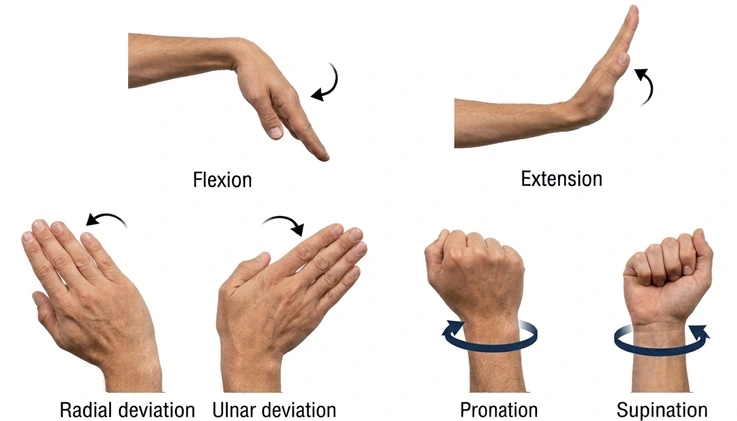
These movements help control your hand when lifting, carrying, using tools and performing everyday tasks such as turning a key or picking up a mug. Wrist and forearm strength is also important for sports such as tennis, climbing and weight training.
Targeted exercises for wrist strength can improve your ability to tolerate these demands.
Stages Of Wrist Strengthening Exercises
We are going to cover four types of wrist strengthening exercises so that you build strength safely and effectively.
- Isometric Exercises: Contract your wrist muscles without moving your wrist. You provide resistance with your other hand
- Resistance Band Wrist Exercises: Move against the tension of an elastic band to build strength through a controlled range of movement
- Dumbbell & Weight Exercises: Use a light dumbbell or another suitable weight to progressively challenge your wrist muscles
- Gyroscope Balls: handy tool that helps build wrist, forearm and hand strength and control
You don't have to complete every stage in order. Choose exercises that suit your symptoms and current ability, progressing when you can maintain good technique comfortably.
We'll start by looking at the best wrist strengthening exercises at each stage and then we will also look at:
- Benefits Of Wrist Strengthening Exercises: how regular exercises can help
- Who Should Do Wrist Exercises: what things they can help with
- Top Tips For Best Results: from your wrist muscle exercises
- FAQS: answers to your most common questions
Best Wrist Strengthening Exercises
Important: If you are doing strengthening exercises for wrist pain, the right approach depends on what is causing your symptoms. Stop if an exercise causes sharp or increasing pain. Significant swelling, pain following an injury, numbness or unexplained weakness may require professional assessment.
Stage 1: Isometric Wrist Strengthening Exercises
Isometric wrist muscle exercises are a really useful starting point if you are new to wrist strengthening exercises or need a way to begin building strength without repeatedly moving your wrist through its full range.
For these exercises, you will use your other hand to provide resistance. The aim is to gently push against your hand without allowing your wrist or forearm to move.
Start with 5 repetitions, holding each contraction for 5–10 seconds. Use a comfortable effort rather than pushing as hard as possible.
1. Isometric Wrist Flexion
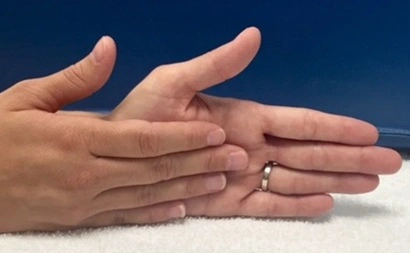
- Rest your forearm on a table, thumb pointing up
- Place your opposite hand against your palm
- Gently try to bend your wrist forwards while resisting the movement with your other hand
2. Isometric Wrist Extension
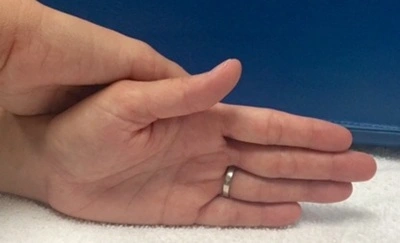
- Rest your forearm on a table, thumb pointing up
- Place your opposite hand against the back of your hand
- Gently try to bend your wrist backwards while resisting the movement with your other hand
3. Isometric Wrist Pronation
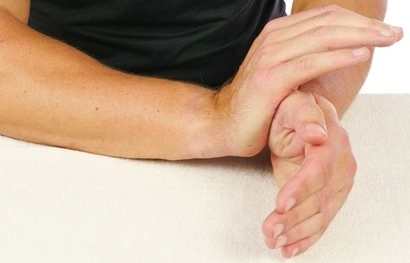
- Rest your forearm on a table, thumb pointing towards the
ceiling
- Place your opposite hand against the front of your wrist and
base of the thumb
- Gently try to rotate your wrist to turn the palm down while resisting the movement
4. Isometric Wrist Supination
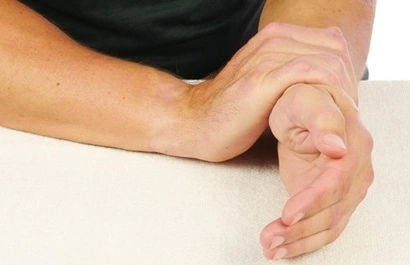
- Rest your forearm on a table, thumb pointing up
- Place your opposite hand against the back of your wrist
- Gently try to rotate your wrist to turn the palm upwards while resisting the movement
5. Isometric Radial Deviation
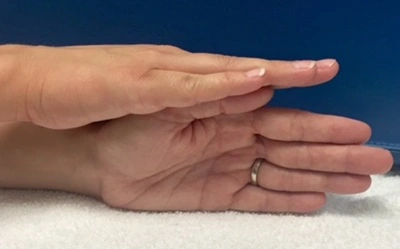
- Rest your forearm on a table with your thumb pointing
upwards
- Place your opposite hand against the thumb side of your hand
- Gently try to lift your hand up while resisting the movement
6. Isometric Ulnar Deviation
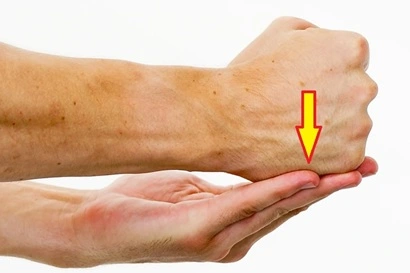
- Rest your forearm on a table, thumb pointing up and make a fist
- Place your opposite hand underneath your fist
- Gently push the side of your fist down while resisting the movement with your other hand
When To Progress: Once you can perform these isometric exercises for wrist strength comfortably with good control, you may be ready to introduce resistance band wrist exercises. You don't have to master every isometric exercise first; progress according to your symptoms and ability.
#CommissionsEarned from Amazon on qualifying purchases
Stage 2: Resistance Band Wrist Strengthening Exercises
Resistance band wrist exercises strengthen the muscles through movement rather than static contractions. Choose a light band initially and keep your movements slow and controlled. Resistance bands are readily available from places like Amazon.
Starting Position For Resistance Band Wrist Exercises: For each of these exercises, start by securing one end of the band underneath your foot, and hold the other end in your hand. Top tip, you can tie knot in the band to make a loop either end to make it more secure.
Aim for 10-15 repetitions of each wrist band exercise, adjusting the resistance and number of repetitions to suit your ability.
1. Resistance Band Wrist Flexion
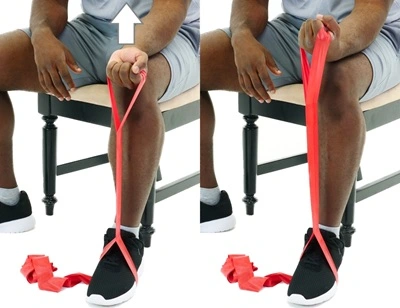
- Sit with your forearm resting on your thigh, palm facing
upwards, holding the band firmly
- Bend your wrist upwards, pulling against the band, while
keeping your forearm still
- Hold for 3 seconds and slowly lower the hand back down as far as it will go
2. Resistance Band Wrist Extension
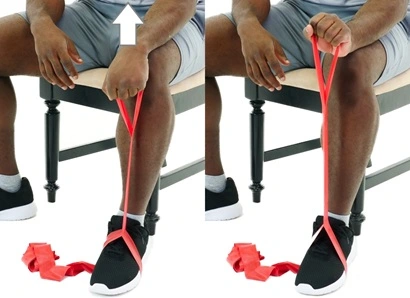
- Sit with your forearm resting on your thigh with your palm
facing downwards
- Slowly lift the back of the wrist upwards, pulling against
the band, keeping your forearm still
- Hold for 3 seconds and slowly lower the hand back down
3. Resistance Band Pronation
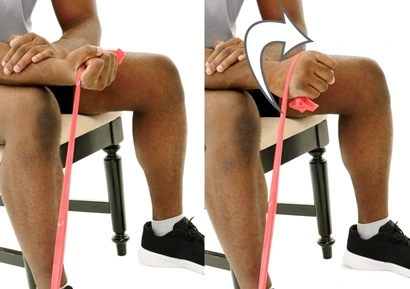
- Sit with your forearm resting on your thigh, palm facing
upwards
- Twist your wrist to turn your palm downwards, pulling
against the band, while keeping your forearm still
- Hold for 3 seconds and slowly turn the palm back up
4. Resistance Band Supination
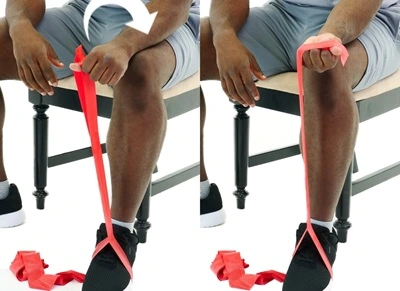
- Sit with your forearm resting on your thigh, palm facing downwards
- Twist your wrist to turn your palm upwards, pulling against
the band, while keeping your forearm still
- Hold for 3 seconds and slowly turn the palm back down
5. Resistance Band Radial Deviation
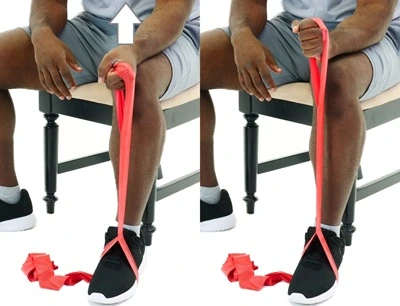
- Sit with your forearm resting on your thigh, thumb up
towards the ceiling, wrist straight
- Lift your hand up, pulling against the back, without moving
your forearm
- Hold for 3 seconds and slowly lower your hand back down
6. Resistance Band Ulnar Deviation
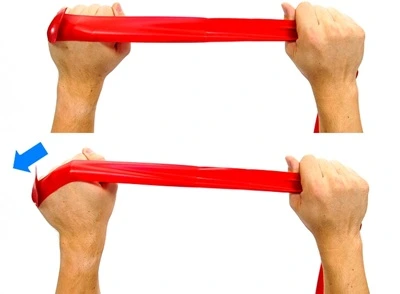
- Hold the band in both hands and rest your forearms on a
table, palms facing down
- Keeping one hand still, move the other wrist towards the pinky
side, without moving your forearm
- Hold for 3 seconds and slowly return your hand to the starting position
Top Tips: Don’t expect there to be as much movement with
this one
: You can work both hands at the same time by moving both
hands out towards the little finger side of the wrist at the same time
How To Progress Resistance Band Exercises
As your strength improves, you can progress resistance band wrist exercises by:
- Increasing the number of repetitions
- Slowing down the movement: moving slowly requires more control so works the muscles harder
- Progress to a stronger resistance band - find bands on Amazon
Change one thing at a time and see how you go with these wrist band exercises.
Stage 3: Dumbbell Wrist Weight Exercises
Wrist weight exercises provide a measurable resistance that you can gradually increase. You don't need heavy weights, a light dumbbell or a full tin can may be sufficient to begin with.
Aim for 2 sets of 10–15 repetitions initially, adjusting the load and repetitions to suit your ability.
Starting Position: For each of these wrist exercises with weights, rest your forearm on a table or your thigh, with your hand over the edge, holding a weight.
1. Wrist Flexion Curls
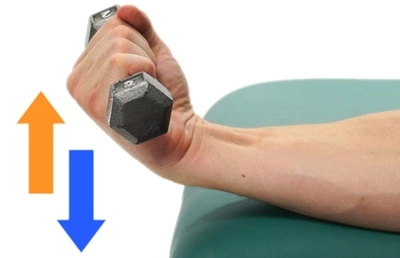
- Rest your forearm off the edge of a table, palm facing up
- Bend your wrist upwards, bringing your palm towards your
forearm
- Hold for 3 seconds and slowly lower the weight back down
2. Wrist Extension Curls
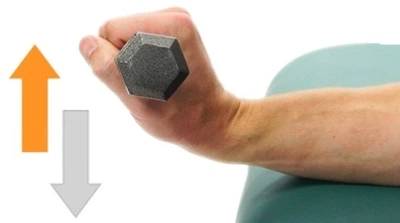
- Rest your forearm off the edge of a table, palm facing down
- Lift the back of your hand upwards
- Hold for 3 seconds and slowly lower back down
3. Dumbbell Pronation/Supination
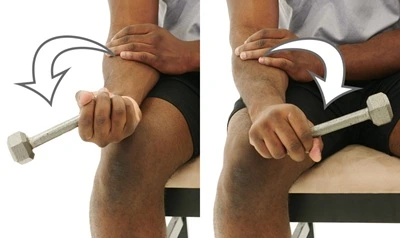
- Rest your forearm on a table or your thigh
- Slowly turn your palm to face the ceiling as far as you can, then slowly turn
the palm back down
- Repeat the movement slowly each way
4. Dumbbell Radial/Ulnar Deviation
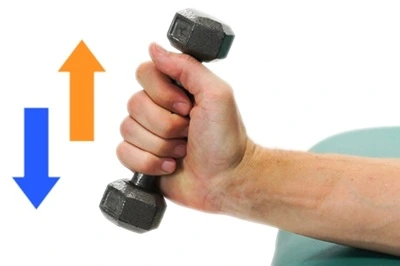
- Rest your forearm on a table with your hand off the edge,
thumb pointing up to the ceiling
- Bend your wrist up to the ceiling and then slowly lower it
back down as far as possible
- Repeat the up and down movement slowly each way
How Much Weight Should You Use?
Choose a weight that makes the final few repetitions challenging without affecting your technique. If you can't complete the movement smoothly, reduce the weight. If wrist exercises with weights become easy and your wrist recovers comfortably, increase the resistance gradually.
You can also progress wrist weight exercises by adding repetitions or slowing down the movement.
Remember that the goal is controlled strengthening, not lifting the heaviest weight possible.
Stage 4: Wrist Strengthening Exercises With A Gyro Ball

Gyro balls, aka Gyroscopic Wrist Trainers, are handheld devices that use a spinning rotor to create resistance as you move your wrist.
They can provide an alternative way to challenge the wrist, forearm and grip muscles and can be a really great way to improve wrist strength.
To use one, start the rotor according to the manufacturer's instructions, then move your wrist in a controlled circular motion to maintain the spin. The faster the rotor spins, the greater the resistance can become. Simply spend 1-3 minutes using the gyroball a couple of times day
Power balls may be useful for people who want to develop forearm endurance and coordination for activities such as climbing, tennis and playing musical instruments. They also help to stimulate blood flow which can aid healing and reduce the risk of repetitive strain injuries
Start with short sessions and stop if your wrist becomes painful.
There are lots of different gyroscope balls on the market to choose from, although this is a case where you get what you pay for. Cheaper versions tend to be less good quality so it is worth spending a bit more.
Benefits Of Wrist Strengthening Exercises
Regular wrist strengthening exercises can help
- Improve Grip And Lifting Ability: helps support hand position when carrying bags, lifting weights or using tools
- Build Wrist Stability: Improve control during pushing, pulling and weight-bearing activities
- Support Sporting Performance: Prepare the wrist and forearm muscles for activities such as tennis, climbing and golf
- Improve Everyday Function: Build capacity for tasks involving repeated gripping, lifting and carrying e.g. gardening, cooking and typing
- Support Rehabilitation: Form part of a suitable rehabilitation programme for some causes of wrist pain.
Who Should Do Wrist Strengthening Exercises?
Wrist strengthening exercises can be useful for:
- People With Weak Wrists: To build strength for gripping, lifting and carrying
- People Who Play Sports: To prepare the wrist and forearm for repeated physical demands
- People Who Lift Weights: To improve control of the wrist during resistance training
- People Recovering From Wrist Pain: When strengthening is appropriate for the underlying condition and stage of recovery
- People Who Use Their Hands Repeatedly: To improve strength and tolerance for demanding work or hobbies
If you are doing strengthening exercises for wrist pain, choose exercises according to your diagnosis, symptoms and current function. You may need to begin with gentle movements or follow a specific programme recommended by your healthcare professional.
Top Tips For Getting The Most From Wrist Strengthening
Exercises
- Start At The Right Level: Begin with wrist muscle exercises you can perform comfortably and progress to bands or weights when appropriate.
- Use Controlled Movements: Move slowly and smoothly. Avoid swinging weights, jerking bands or compensating with your elbow and shoulder.
- Start With Light Resistance: you don't need heavy loads to strengthen the muscles around it. Begin with a light band or weight and increase the challenge gradually
- Train All Six Movements: Wrist flexion and extension are important, but the forearm also needs to rotate and the wrist needs to move sideways.
- Progress Gradually: Increase repetitions or resistance one step at a time, checking how your wrist responds.
- Don't Ignore Increasing Pain: Stop or modify an exercise if pain becomes sharp, increases during the session or leaves your wrist noticeably worse afterwards. Persistent pain, swelling, numbness or unexplained weakness may need professional assessment.
- Allow Time For Recovery: Muscles need time to recover between strengthening sessions
- Address The Cause Of Wrist Pain: If you have wrist pain as well as weakness, make sure you know what is causing that pain – check out the wrist pain diagnosis chart article for help
Frequently Asked Questions
Let's look at some of the most frequently asked questions about the best wrist strengthening exercises.
1. What Are The Best Wrist Strengthening Exercises?
1. What Are The Best Wrist Strengthening Exercises?
The best wrist strengthening exercises depend on your current strength, symptoms and goals. Wrist flexion and extension exercises target the muscles that bend and straighten your wrist, while pronation, supination and side-to-side movements strengthen other important movement patterns.
Isometric exercises can be a useful starting point, with resistance bands and weights providing ways to progress.
2. Are Wrist Strengthening Exercises Good For Wrist Pain?
2. Are Wrist Strengthening Exercises Good For Wrist Pain?
Wrist strengthening exercises can help with some causes of wrist pain, particularly when weakness or reduced load tolerance is part of the problem. However, the appropriate exercises depend on the underlying condition and stage of recovery.
If your pain follows an injury, is severe or persistent, or is accompanied by swelling, numbness or significant weakness, seek professional assessment before starting a programme. And check out our Wrist Pain Diagnosis Chart article for help working out what is wrong.
3. Should I Use Resistance Bands Or Weights To Strengthen My
Wrists?
3. Should I Use Resistance Bands Or Weights To Strengthen My Wrists?
Both can improve wrist strength. Resistance band wrist exercises provide elastic resistance, while wrist exercises with weights allow you to increase the load in small increments. Neither is automatically better.
Choose the option that lets you perform the movement comfortably, with good control and without worsening your symptoms.
4. How Often Should I Do Wrist Strengthening Exercises?
4. How Often Should I Do Wrist Strengthening Exercises?
For general strengthening, one or two sessions a day is a good place to start, allowing recovery between sessions. Begin with a manageable number of wrist muscle exercises and repetitions, then increase gradually.
If you are following a rehabilitation programme for wrist pain, your ideal frequency may differ depending on your condition and how your symptoms respond.
5. Can Wrist Exercises Improve Grip Strength?
5. Can Wrist Exercises Improve Grip Strength?
Yes, wrist and forearm strengthening can support grip strength because the muscles that control the wrist help position and stabilise the hand during gripping.
However, wrist exercises alone may not fully address reduced grip strength. Specific grip exercises may also be useful, depending on your needs and the reason for your weakness.
Wrist Strengthening Exercises Summary
Wrist strengthening exercises can help build the strength and control needed for gripping, lifting, sports and everyday activities.
The three main approaches are:
- Isometric Wrist Exercises: Contract the muscles without moving the wrist significantly.
- Resistance Band Wrist Exercises: Strengthen the wrist through controlled movement against elastic resistance.
- Dumbbell And Weight Exercises: Progressively challenge the muscles as strength improves.
Gyro balls also provide another option for developing wrist and forearm endurance, but they aren't essential.
For a well-rounded programme, include wrist flexion, extension, pronation, supination, radial deviation and ulnar deviation, choosing exercises and resistance that suit your current ability.
Start gradually, focus on good technique and increase the challenge as your strength improves. If you are exercising because of wrist pain, remember that the right approach depends on the underlying cause, and persistent or unexplained symptoms deserve professional assessment.
You may also be interested in the following articles:
Related Articles

Wrist Diagnosis
May 12th, 2026
Shoulder Diagnosis
September 23rd, 2026
Elbow Diagnosis
February 26, 2026
Page Last Updated: November 4th, 2026
Next Review Due: November 4th, 2028

Visitor Comments
"Such an informative and valuable site. Clearly written and matches the guidance from my orthopedic surgeon. Even offers many rehab exercises. Thank you very much!" Izabela
"I am a massage therapist and found your website perfect. Very useful. Clear, easy understand. Big help. Thank you!" Viktoria
"This is a great site. Very informative" Marilyn
"I benefited a lot from your distinguished work, thank you." Sayed
"Hi
and thanks so much, great site! You
are doing a lot of good in the world with this helpful site, thanks again." Karen
The material on this website is intended for educational information purposes only. It should not delay or substitute medical advice, diagnosis or treatment. See our T&C's
Shoulder-Pain-Explained.com is a trading name of Wilson Health Ltd. All rights reserved. Terms & Conditions apply
© shoulder-pain-explained.com 2015-26 Last updated 4th November 2026
Contact Us About Us Blog Privacy Policy Advertising Policy Sitemap
