- Home
- Hand Pain Diagram
- Finger Arthritis
Arthritis In The Fingers
Written By: Chloe Wilson BSc (Hons) Physiotherapy
Reviewed By: SPE Medical Review Board
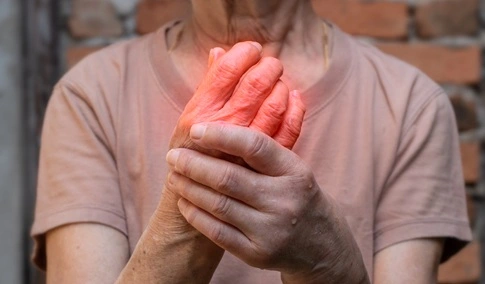
Arthritis in the fingers causes pain, stiffness, swelling and sometimes changes in the shape of the finger joints.
It can make everyday activities such as gripping, writing, opening jars and fastening buttons increasingly difficult.
Some people with finger arthritis develop hard bony lumps around their joints, while others experience swollen, tender joints, prolonged morning stiffness or reduced movement.
There are several types of finger arthritis, including osteoarthritis and rheumatoid arthritis, and the symptoms and treatment options vary depending on the underlying cause.
In This Article:
What Is Arthritis Of The Fingers?
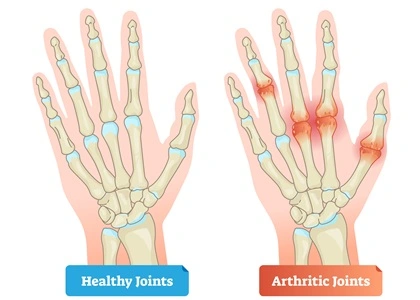
Arthritis in the fingers occurs when one or more finger joints become affected by inflammation or degenerative changes, resulting in pain, stiffness, swelling and sometimes changes in the finger shape.
The fingers contain several small joints that allow us to bend, straighten, grip and manipulate objects. Arthritis can affect any of these joints, making everyday activities such as writing, opening jars, fastening buttons and holding utensils more difficult.
The main finger joints include:
- DIP Joints: The joints closest to the fingertips
- PIP Joints: The middle joints of the fingers
- MCP Joints: The knuckles where the fingers join the hand
Arthritis can affect the cartilage, bone, joint lining and surrounding tissues. Depending on the type of arthritis, the joints may become painful, swollen, stiff or enlarged. Arthritis is a common cause of finger joint pain.
Find out more in the Hand Anatomy article.
Types Of Arthritis That Affect The Fingers
Several types of arthritis can affect the finger joints:
- Osteoarthritis: The most common type, involving degenerative changes within the joint that can cause pain, stiffness and bony enlargement
- Rheumatoid Arthritis: An autoimmune condition that causes inflammation of the joint lining and can progressively damage the joints
- Psoriatic Arthritis: An inflammatory form of arthritis associated with psoriasis that can cause finger joint swelling and sometimes swelling of an entire finger
- Gout: Arthritis caused by uric acid crystal build-up, often resulting in sudden episodes of severe pain and swelling
- Post-Traumatic Arthritis: Arthritis that develops following damage to a finger joint from a previous injury or fracture
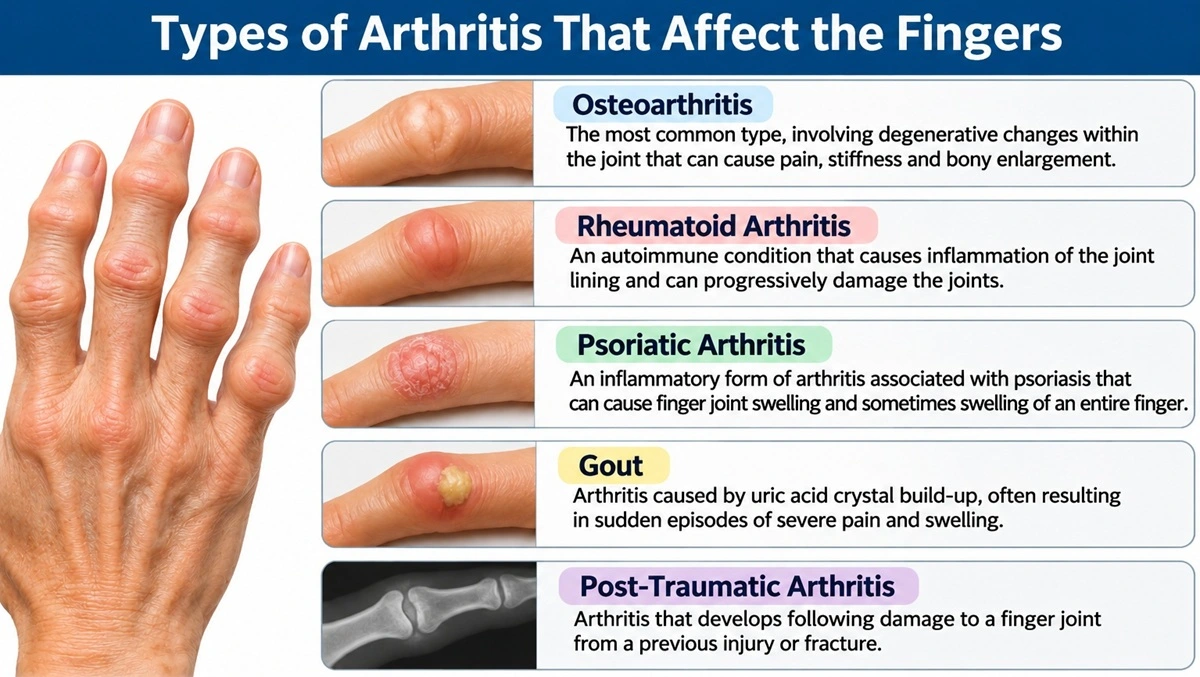
Each type of arthritis affects the finger joints differently, influencing the symptoms you experience and the treatment you may need.
For more information about the different types of arthritis, including how they affect the hands, see my guide to Hand Arthritis.
What Causes Arthritis In Finger Joints?
Finger arthritis can develop due to changes within the joints over time, previous damage or problems with the body's immune system. Several factors can increase the likelihood of developing arthritis of the fingers:
- Age: Finger osteoarthritis becomes more common after 50 as cartilage and joint tissues change with age. It is particularly common in women after menopause, although it can develop earlier in life
- Genetics: Family history can increase susceptibility to developing arthritis, particularly osteoarthritis
- Previous Injuries: Finger fractures, dislocations and ligament injuries can damage the joints and increase the risk of arthritis later in life
- Repetitive Stress: Repeated gripping, pinching and forceful hand movements can place increased stress on the finger joints and aggravate symptoms
- Autoimmune Factors: Abnormal immune system activity can cause the body to attack its own joint tissues, leading to inflammation and damage
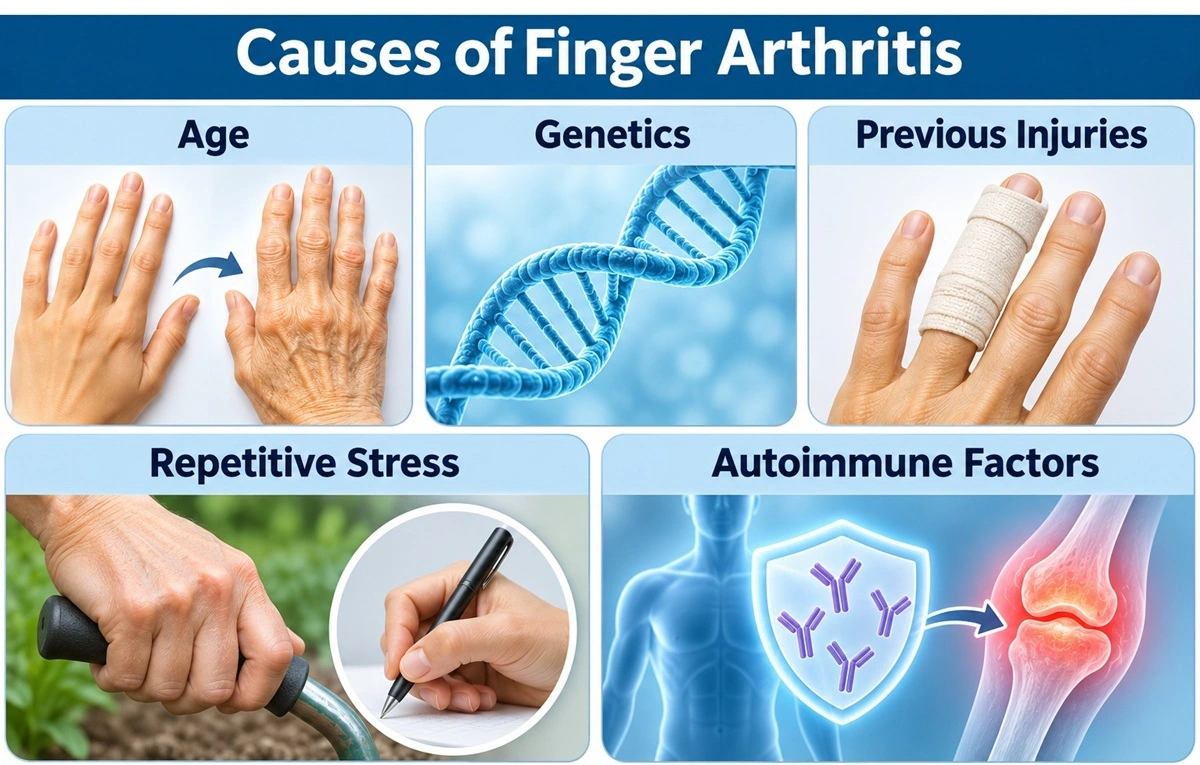
Although some risk factors cannot be changed, protecting your finger joints from excessive stress and seeking early assessment of persistent symptoms may help preserve hand function.
Symptoms Of Arthritis In The Fingers
Arthritis in the fingers can cause a range of symptoms depending on which joints are affected and the type and severity of the condition.
Common symptoms include:
- Finger Joint Pain: Aching or sharp pain when gripping, pinching or using the hands
- Stiffness: Difficulty bending or straightening the fingers, particularly in the morning or after periods of inactivity
- Swelling: Enlarged finger joints caused by inflammation or structural changes
- Reduced Movement: Difficulty fully bending or straightening the affected fingers
- Tenderness: Pain when pressing on or squeezing the finger joints
- Weakness: Reduced grip strength and difficulty holding objects
- Finger Deformity: Changes in the shape or alignment of the fingers in more advanced cases
- Clicking Or Grinding: Sensations caused by changes within the joint as the fingers move
Symptoms may fluctuate, with periods of increased pain and stiffness followed by times when the fingers feel more comfortable.
Osteoarthritis symptoms are often aggravated by gripping and repetitive use, whereas rheumatoid arthritis finger may cause more persistent swelling, warmth and prolonged morning stiffness.
Arthritis Finger Bumps And Nodules
Arthritis can cause noticeable lumps or enlargements around the finger joints. These may develop because of changes in the underlying bone or inflammation affecting the tissues around the joint.
- Heberden's Nodes: Hard, bony bumps that develop around the DIP joints, closest to the fingertips, due to osteoarthritis
- Bouchard's Nodes: Bony enlargements that develop around the PIP joints, in the middle of the fingers, due to osteoarthritis
- Rheumatoid Arthritis Finger Nodules: Firm lumps beneath the skin associated with rheumatoid arthritis, often developing around pressure points such as the fingers or knuckles
- Gouty Nodules: Gout can cause firm lumps of uric acid crystals to develop around finger joints, known as tophi, which may cause swelling and restricted movement
Heberden's and Bouchard's nodes can make the finger joints look enlarged, crooked or irregular. They may be painful when developing but can become relatively painless once established. Gout nodules tend to form around the knuckles and finger joints.
Rheumatoid nodules are different because they form in the soft tissues rather than being bony enlargements of the joint. Not everyone with rheumatoid arthritis develops them.
If you notice a new lump around a finger joint, particularly if it is painful, growing or associated with swelling, it is worth getting it assessed.
Diagnosing Arthritis In The Fingers

Arthritis in the fingers is usually diagnosed by assessing your symptoms and examining the affected joints.
Your doctor will look at which joints are affected, whether they are swollen or tender, how well your fingers move and whether there are any changes in their shape.
X-rays may be used to identify joint space narrowing, bony spurs and other changes associated with osteoarthritis. Blood tests may be recommended if rheumatoid arthritis or another inflammatory condition is suspected.
The pattern of symptoms can help distinguish between different types of arthritis. For example, osteoarthritis commonly affects the joints closest to the fingertips and middle finger joints, whereas rheumatoid arthritis often affects the knuckles and middle finger joints, with prolonged morning stiffness and swelling.
There are lots of other causes of pain and lumps in the fingers - check out the following articles to find out about the other causes and for help working out what is wrong: Finger Pain Diagnosis and Lumps On Fingers.
When To See A Doctor
Arrange an assessment if you have persistent finger joint pain, swelling or stiffness, particularly if symptoms are affecting everyday activities or progressively worsening.
It is particularly important to seek medical advice if:
- Several finger joints are becoming swollen or painful
- Morning stiffness is prolonged
- Your finger joints are becoming enlarged or changing shape
- You are struggling to grip or use your hands normally
Early assessment is important if rheumatoid arthritis finger is suspected, as treatment can help control inflammation and reduce the risk of permanent joint damage.
A suddenly hot, red, very painful and swollen finger joint should be assessed urgently, particularly if you feel unwell or have a fever, as this may indicate an infection or another acute condition rather than ordinary arthritis.
How To Treat Arthritis In The Fingers
Treatment for arthritis in the fingers aims to reduce pain and stiffness, improve joint movement, maintain hand function and make everyday activities easier. Treatment will depend slightly on the type of arthritis and the severity of your symptoms.
#CommissionsEarned from Amazon on qualifying purchases
Non-Surgical Treatment
There are lots of home treatment options for finger arthritis. The most effective approach is to find a combination of treatments that helps manage your symptoms and keeps your fingers as mobile and functional as possible.
1. Modify Activities
Modifying activities that aggravate your symptoms is a good place to start. If certain activities consistently aggravate your symptoms, try modifying how you perform them rather than stopping using your hands altogether.
For example:
- Use larger handles on kitchen utensils and tools to reduce gripping force
- Avoid prolonged, forceful pinching or gripping when possible
- Break up repetitive hand activities with short rest periods
- Use both hands when lifting or carrying heavier objects
- Use jar openers or other adaptive equipment when needed

The aim is to reduce unnecessary stress on painful joints while keeping your fingers moving and maintaining as much normal function as possible.
2. Heat Therapy
Heat can be particularly helpful treatment for arthritis in the fingers if your joints feel stiff, achy or difficult to move. Applying warmth can help relax the surrounding tissues, reduce the sensation of stiffness and make it easier to move the fingers.
You could try:
- Soaking your hands in warm water
- Using a warm towel or heat pack wrapped in a towel
- Using warm water before performing finger exercises
Heat is often most helpful first thing in the morning or before activities that require a lot of finger movement.
However, avoid excessive, prolonged heat, particularly if your fingers are already very swollen or inflamed, and take care not to burn your skin.
3. Cold Therapy
Cold therapy may help when finger joints are particularly painful, swollen or irritated.
Applying a cold pack wrapped in a towel for around 10–15 minutes may help reduce discomfort after activities that aggravate your symptoms.
Cold can be particularly useful during a flare-up of pain and swelling, although it may temporarily make the fingers feel stiffer.
Do not apply ice directly to the skin, and avoid cold therapy if you have reduced sensation or circulation problems in your fingers unless advised by a healthcare professional.
4. Medication
Medication may help reduce pain and inflammation associated with finger arthritis.
Options may include:
- Topical Anti-Inflammatory Gels: Applied directly to the affected area to help reduce pain, particularly in osteoarthritis, e.g. penetrex
- Oral Anti-Inflammatory Medication: May help reduce pain and inflammation but is not suitable for everyone
- Painkillers: Such as paracetamol, may help manage symptoms depending on your medical history
- Corticosteroid Injections: Sometimes used to reduce inflammation and pain in particularly troublesome joints
- Joint Supplements: Supplements such as glucosamine and chondroitin are commonly used for joint health, although evidence of their effectiveness for arthritis is mixed
Medication choice depends on your health, other medicines you take and the type of arthritis you have. A pharmacist or doctor can help you choose the most appropriate option.
For rheumatoid arthritis finger, treatment often includes disease-modifying medication to control the immune system's inflammatory activity and reduce the risk of long-term joint damage. These medications are prescribed and monitored by a specialist.
5. Finger Splints And Supports
Another useful treatment for arthritis finger pain is splinting. Finger splints may help support painful finger joints, reduce stress during certain activities and improve comfort, particularly when pain is aggravated by gripping or repeated movement.
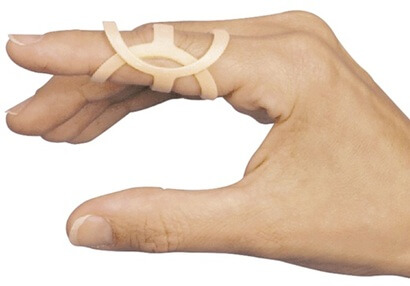
Depending on which joint is affected, a splint may help:
- Reduce painful joint movement
- Support the finger during activities
- Improve comfort when gripping or pinching
Splints should not unnecessarily restrict finger movement for prolonged periods. Ideally, they should be selected to suit the affected joint and the activities you need to perform.
6. Arthritis Finger Exercises
Gentle exercises are an important part of finger arthritis treatment and can help reduce stiffness, maintain joint mobility, strengthen the muscles and make everyday hand movements easier. Simple exercises may include:
- Finger Bends: Gently bend your fingers towards your palm, then straighten them again
- Finger Spreads: Spread your fingers apart and slowly bring them back together
- Thumb Opposition: Touch your thumb to each fingertip in turn
- Tendon Glides: Move your fingers through different positions to encourage smooth tendon movement
Exercises should feel comfortable or cause only mild discomfort. Avoid forcing stiff joints or continuing with movements that significantly increase pain or swelling.
For a more comprehensive programme, including step-by-step instructions and illustrations, see my guide to Exercises For Finger And Hand Arthritis.
7. Hand Therapy
Hand therapy can help reduce pain, improve finger movement and maintain hand function. A hand therapist may provide:
- Finger mobility and strengthening exercises
- Joint protection advice and activity modification
- Splinting to support painful joints
- Advice on adapting everyday activities
Hand therapy can be particularly helpful if finger joint arthritis is affecting your grip or making daily tasks more difficult.
Surgical Treatment For Finger Arthritis
Surgery is generally considered when finger arthritis causes significant pain or loss of function and non-surgical treatment has not provided sufficient relief.
The type of surgery depends on which finger joint is affected, the extent of joint damage, your symptoms and how much movement you need to maintain.
1. Joint Fusion (Arthrodesis)
Joint fusion involves joining the bones on either side of an affected joint so that they become permanently fused together.
This removes movement at the joint, which can help reduce pain caused by damaged joint surfaces moving against one another.
Joint fusion may be considered for certain finger joints when arthritis is severe and pain is persistent.
The main disadvantage is that the joint will no longer bend, so the position of the finger is important to maintain useful hand function.
2. Joint Replacement
In some cases, the damaged finger joint may be replaced with an artificial joint.
Joint replacement aims to reduce pain while preserving some movement, although the results depend on the joint involved, the type of implant and the condition of the surrounding tissues.
It may be considered for people with significant hand and finger arthritis who want to improve finger function and reduce pain.
3. Other Surgical Procedures
Other procedures may be considered depending on the specific joint and the nature of the damage. These may include removing bony spurs to improve movement, or removing inflamed tissue within the joint.
Your surgeon will discuss the potential benefits, limitations, recovery time and risks of surgery to help you decide whether it is appropriate.
Surgery is not necessary for most people with finger arthritis, and many can manage their symptoms successfully with non-surgical treatment.
Prevention Strategies For Finger Arthritis
Although finger arthritis cannot always be prevented, particularly when age, genetics or autoimmune conditions are involved, there are ways to reduce joint stress and maintain hand function.
- Protect Your Finger Joints: Avoid excessive force when gripping, lifting or carrying objects. Use both hands where possible to reduce strain
- Reduce Repetitive Strain: Take regular breaks from repetitive gripping and pinching activities, and use tools with larger handles
- Keep Your Fingers Moving: Regular, gentle finger movements help maintain joint mobility and reduce stiffness
- Manage Injuries Promptly: Seek assessment for significant finger injuries, as fractures, dislocations and joint damage can increase the risk of arthritis later in life
FAQs About Arthritis In The Fingers
1. Does Arthritis Cause Finger Swelling?
1. Does Arthritis Cause Finger Swelling?
Yes, arthritis can cause finger swelling. In osteoarthritis, swelling may develop because of changes in the joint structures, inflammation and bony enlargement.
In rheumatoid arthritis, swelling is often caused by inflammation of the joint lining, which can make the fingers feel warm, tender and puffy. Swelling may affect one joint or several joints and can fluctuate depending on the type of arthritis and how active it is.
2. Can Arthritis Cause Finger Numbness?
2. Can Arthritis Cause Finger Numbness?
Arthritis can sometimes contribute to finger numbness, although numbness is not a typical primary symptom of arthritis itself. Swelling or structural changes around the joints may occasionally contribute to irritation or compression of nearby nerves.
However, finger numbness is more commonly associated with conditions such as carpal tunnel syndrome, nerve compression or problems originating in the neck. Persistent numbness should be assessed to identify the underlying cause.
3. Is Trigger Finger Arthritis?
3. Is Trigger Finger Arthritis?
No, trigger finger is not a form of arthritis. It is a condition affecting the tendons and the pulley system that allows the fingers to bend. Trigger finger causes catching, clicking, locking or difficulty straightening the affected finger.
Arthritis affects the joints themselves, causing pain, stiffness, swelling and sometimes joint damage. However, trigger finger and arthritis can occur at the same time, so it is possible to have both conditions in the same finger.
4. Can You Get Arthritis In Just One Finger?
4. Can You Get Arthritis In Just One Finger?
Yes, arthritis can affect just one finger or one joint. Osteoarthritis may develop in a single joint, particularly following a previous injury, although it can also affect several joints. Inflammatory arthritis often affects multiple joints, but the pattern varies between individuals.
Having pain in just one finger does not rule out arthritis, although other causes such as tendon problems, injuries or infection may also need to be considered. Find out more in the Finger Pain Diagnosis section.
5. Can Arthritis In The Fingers Be Reversed?
5. Can Arthritis In The Fingers Be Reversed?
Arthritis cannot generally be reversed once structural damage has developed within the joint. However, that does not mean symptoms will necessarily continue to worsen. Pain, stiffness and swelling can often be managed effectively with appropriate treatment, and many people maintain good hand function for years.
In rheumatoid arthritis, early treatment is particularly important because controlling inflammation can help reduce the risk of further joint damage.
6. Why Are My Finger Joints Getting Bigger?
6. Why Are My Finger Joints Getting Bigger?
Finger joints may become enlarged because of arthritis-related changes in the bone, inflammation or thickening of the surrounding tissues. In osteoarthritis, bony enlargements called Heberden's nodes and Bouchard's nodes can develop around the joints closest to the fingertips and in the middle of the fingers. Rheumatoid arthritis may cause soft, swollen joints or rheumatoid nodules beneath the skin.
If a joint is becoming progressively larger, it is worth having it assessed. You can find out more about the common causes of finger lumps and how to treat them in the Lump On Fingers article.
7. Does Arthritis In The Fingers Get Worse Over Time?
7. Does Arthritis In The Fingers Get Worse Over Time?
Finger arthritis can progress over time, but the rate of progression varies considerably. Osteoarthritis may develop slowly over many years, with symptoms that fluctuate between periods of discomfort and relative improvement.
Rheumatoid arthritis can cause more significant joint damage if inflammation is not adequately controlled. Appropriate treatment, activity modification and maintaining finger mobility can help manage symptoms and preserve function.
Summary: Arthritis In The Fingers
Arthritis in the fingers is a common cause of joint pain, stiffness, swelling and changes in the appearance of the hands. Osteoarthritis is the most common type, but rheumatoid arthritis, psoriatic arthritis, gout and arthritis following an injury can also affect the finger joints.
Symptoms may include pain when gripping, morning stiffness, swollen joints, reduced movement, weakness and bony lumps around the fingers. Osteoarthritis can cause Heberden's nodes around the joints closest to the fingertips and Bouchard's nodes around the middle finger joints, while rheumatoid arthritis can cause inflammatory swelling and rheumatoid nodules.
Treatment depends on the type and severity of finger arthritis but often involves activity modification, heat and cold therapy, medication, finger exercises, splints and hand therapy. Surgery may be considered when joint damage causes persistent pain and significantly affects function.
Arthritis is just one possible cause of hand and finger pain. You may also be interested in the following articles:
- Finger Lumps & Bumps
- Thumb Pain Diagnosis
- Pain In Palm Of Hand
- Causes of Wrist Pain
- Wrist Strengthening Exercises
Related Articles
Wrist Diagnosis
November 12th, 2026
Shoulder Diagnosis
September 23rd, 2026
Elbow Diagnosis
April 29, 2026
Medical & Scientific References
- Osteoarthritis of the Fingers. Orthopaedics & Trauma Journal
- Management Of Hand Osteoarthritis: From An US Evidence-Based Medicine Guideline To A European Patient-Centric Approach. Aging Clinical & Experimental Research
- Inflammation as a Treatment Target in Hand Osteoarthritis: A Review of Previous Studies and Future Perspectives. Journal Of Rheumatology
- Short-Term Effects of Occupational Therapy on Hand Function and Pain in Patients With Carpometacarpal Osteoarthritis: Secondary Analyses From a Randomized Controlled Trial. Arthritis Care & Research Journal
Page Last Updated: November 25th, 2026
Next Review Due: November 25th, 2028

Visitor Comments
"Such an informative and valuable site. Clearly written and matches the guidance from my orthopedic surgeon. Even offers many rehab exercises. Thank you very much!" Izabela
"I am a massage therapist and found your website perfect. Very useful. Clear, easy understand. Big help. Thank you!" Viktoria
"This is a great site. Very informative" Marilyn
"I benefited a lot from your distinguished work, thank you." Sayed
"Hi
and thanks so much, great site! You
are doing a lot of good in the world with this helpful site, thanks again." Karen
The material on this website is intended for educational information purposes only. It should not delay or substitute medical advice, diagnosis or treatment. See our T&C's
Shoulder-Pain-Explained.com is a trading name of Wilson Health Ltd. All rights reserved. Terms & Conditions apply
© shoulder-pain-explained.com 2015-26 Last updated 26th November 2026
Contact Us About Us Blog Privacy Policy Advertising Policy Sitemap
